|
|
 |
 |
|
"My first memory is actually printing a piece of book arts (individual letters cut in lino and printed singly) to the serialized Quo Vadis, probably in 1966."
|
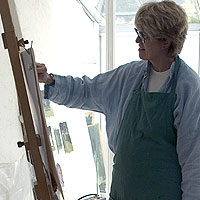
I've listened to Radio 4, while I painted, since I was student - and more recently while painting over 100 portraits of poets for my Poetry Box, a text and image artwork presented as a game. The Box grew from an invitation to participate in an exhibition, Acts of Renewal, at the Victoria and Albert Museum in London in 2002, where a number of artists were invited to respond to an artefact in the museum's Japanese collection. I chose a 19th-century poetry card game, uta karuta, whose origins combine a traditional clamshell-matching game with European playing cards. Uta karuta relies on the players having knowledge of the hyakunin ishu, an anthology of 31-syllable poems by different poets. As there is no comparable universally-known canon of poetry in the UK, I invited 100 people to select their favourite poems. Each contributor was also asked to provide their date of birth and a one-line self-portrait, so I inadvertently documented a small-scale survey of who has been reading what, and why, at the beginning of the 21st century. My favourite self-portraits were Leonard Rosoman, who described himself as "short" and Wendy Cope's "a churchgoing Winchester housewife."
Some of the people I asked to take part were long-standing friends or colleagues, others I had known for a shorter time. I wanted to represent as many generations as I could to reflect different "fashions" of reading, and asked several children to take part as well as adults, and I also sought a different mix of nationalities, professions and differing ways of life.
There were some living poets among the group the selectors had cast my way, but many were long since dead and I had to search for reference materials of all kinds - period paintings, photographs, written and verbal accounts - all allowed me to accumulate a mix of images from which I could distil one of my own. There seemed to be some sort of synchronicity with Radio 4's poetry programmes and the poets I painted.
Some poets were old favourites so it was no surprise that Poetry Please had readings by Rudyard Kipling, W H Auden, T S Elliot, G K Chesterton, etc. More surprising were the lesser-known poets - Charlotte Mew (there was an entire programme about her), R S Thomas, ee cummings, and Alfred Noyes.
Some of the people I was fortunate enough to have sittings with - Moniza Alvi, Fleur Adcock and Craig Raine - also made appearances on Radio 4 and when I painted Wendy Cope she and I actually listened to her on the radio during the sitting. Her insights into other contemporary poets was fascinating. I had the luck to discover Craig Raine in his multi-coloured dressing gown (he had forgotten I was coming) and, in a very different way, it was equally revealing to have the privilege of drawing Fleur Adcock ("grandmother, ex-New Zealander, family historian") in her own habitat. Although alarming, it proved helpful to have some feedback from the living poets about the portraits I had made of them.
|
|
|
|
|
|
Eileen Hogan was born in 1946 in London where she continues to live. She trained at the Royal College of Art, the British School of Archaeology in Athens, at the Royal Academy Schools and at the Camberwell School of Arts and Crafts. She has been principal lecturer at Camberwell College of Art and Dean of this college.
Solo exhibitions of her work have been held at various places around the world. In Great Britain, her work has been shown at such institutions as the London College of Fashion; Bourne Fine Art, Edinburgh; Fine Art Society, London; The Imperial War Museum; Bohun Gallery, Henley-Upon-Thames; Hiscock Gallery, Portsmouth; Cootes Gallery, Lewes; the Royal College of Art; Horniman Museum, London; Orangerie Holland Park, London; Magdelene Street Gallery, Cambridge; Gallery 273, Queen Mary College, London and New Grafton Gallery. Abroad she has had solo exhibitions at the University of Alabama; Morehead University, Kentucky; Ohio University; Galerie Simon's Laden, Hamburg and at the British Council, Athens.
In Great Britain, her work can be found in the collections of Cambridge University Library; Graves Art Gallery, Sheffield; The Imperial War Museum; the Royal Academy of Arts and the Victoria and Albert Museum. On the Continent, her work is housed in Haarlem Staadsbibliotecheck and Rijksmuseum-Meermanno, The Hague as well as in the National Library of Australia. In the USA, her work is in the collections of many institutions, including: the Library of Congress; Houghton Library, Harvard; Stanford University, California; the University of San Francisco; Brigham Young University, Utah; Buffalo University, New York.
Her work has also won many awards, including the Reeve Purchase Prize, the Arthur Hacker Prize, the Eric Kennington Prize and the Greater London Award for Young Artists.
In 1975, she established the Allfarthing Gallery and the Burnt Wood Press in 1976. In 1983, she established the Camberwell Press and two years later, she organised The First British Conference of Fine Painting.
The mediums in which she works include oil on board, watercolour and acrylic. She usually depicts figures and landscapes.
|
|
|
|
|
|



