|
|
 |
 |
|
"Radio 4 has provided the soundscape in my studio
for some 14 years now."
|
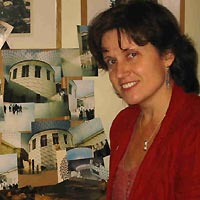
I work in a large airy room on the first floor of my tall terraced house in east London and my working day begins at about 10.00am, kicking off with Woman's Hour. As I sit at my desk engraving a new wood engraving or linocut or constructing some complex printed collage, the familiar nagging guilt of the working mother is regularly stirred by the programme's all too regular discussions about the rights and wrongs of combining work and motherhood.
Whilst I work well to a backdrop of Woman's Hour chatter (finding it, in equal measure, gently entertaining and absolutely infuriating), the serial at 10.45 can cause me to down tools. Arundhati Roy's The God of Small Things is a good example: the unfolding tragedy of traumatised and separated twins blasted away all attempts at concentrating on my latest wood engraving series of the Great Court of the British Museum with its infinitely complex lattice-work of string-vest shadows. And yet, perhaps, something of the complexities, the onion-like layers of such a story's plotline are the subconscious stimuli that prompt me to create complex visual layers upon layers within my collages and prints.
I work through You and Yours and The World at One, breaking for a late lunch at 2.00, so I can concentrate on The Archers. Then I start work again during the afternoon play - Poirot or Holmes perhaps, or recently, The No. 1 Ladies' Detective Agency - but often find I've missed some vital plotlink through only half listening, being absorbed in my work. After the play there might be Case Notes to engrave to, or Shoptalk or Word of Mouth - health, work and intellectual play all on tap. Changing Places described the conservation and marketing of a rare species of orchid by pupils from a Somerset Comprehensive. As I work I find my mind wandering off to my seven-year-old son at primary school, hoping he'll have at least one inspirational teacher during his school career, like the one in this programme.
Working as an artist alone in one's studio can be potentially a very isolating, lonely experience, albeit creatively rewarding. Radio 4 provides company - a constant background buzz of half-heard conversations, advice, experiences, other people's lives.
From Our Own Correspondent takes my mind to other countries, other viewpoints, other ways of living, while my body stays at home and pursues the engraving task in hand. A recent and ongoing series of my collages depicts contemporary towers of Babel or perhaps of Babble - a subconscious reference, maybe, to the unceasing stream of Radio 4 voices as a constant soundscape. The news too, I learn from Radio 4. Radio 4 first brought me the horrors of 9/11, the tragedy of Beslan, and thus my imagery unconsciously takes on a darker, more sombre tone.
But there comes the welcome light relief of The News Quiz, I'm Sorry I Haven't a Clue, Jeremy Hardy Speaks to the Nation or The Now Show - the first two being old diehards and the last being worthy followers in the great traditions of Radio 4 comedy from the much missed Week Ending to Goodness Gracious Me, Andy Hamilton's Old Harry's Game and the brilliantly improvised Masterson Inheritance.
I print to music: pop or jazz, to create a rhythm that speeds up the process of editioning. But I engrave my blocks to Radio 4 and, as each block can take two or three months to complete, there's time for all those voices to exert their subtle influence.
|
|
|
|
|
|
Studied at the Ruskin School of Drawing and Fine Art, Oxford University, and the Central School of Art and Design.
Shows regularly with the RE, the Society of Wood Engravers, the Printmakers Council and the Royal Academy Summer Exhibitions.
Work featured in publications such as Engravers Two, Printmaking Today, and Wood Engraving and the Woodcut in Britain c1980-1990.
Anne Desmet was awarded a Rome Scholarship in Printmaking in 1989, which enabled her to spend a year living and working in Italy. The discovery of ancient Roman ruins, medieval churches and crumbling Baroque facades juxtaposed as a potent yet silent presence alongside the TV aerials and frenetic, noisy traffic of life in the modern world was a seminal experience; it has influenced the content of her work ever since. She endeavours to depict both the sense of timelessness and solidity that certain architectural forms can convey, whilst also suggesting their potential impermanence and vulnerability.
|
|
|
|
|
|



