Adventures in 2D: Graphene and Beyond
Five leading researchers, including Nobel laureate Konstantin Novoselov, discuss the future of graphene and other ‘2D’ materials at Graphene Week, held at Manchester University.
Top graphene researchers, including the Nobel laureate who first isolated pure graphene, talk to Bridget Kendall about the future of not just this 'wonder-material' but also a whole host of other 2-dimensional crystals now available. How close are we to a cheap production of quality graphene on an industrial scale? Can the EU's Graphene Flagship, a research and industrial consortium which includes about 150 partners in over 20 countries, quickly move graphene products from the lab to the consumer? And should we worry about the safety of 2D materials? Recorded at Graphene Week held at the University of Manchester, with Sir Konstantin Novoselov, Sarah Haigh, Jari Kinaret, Toby Heys and Jonathan Coleman.
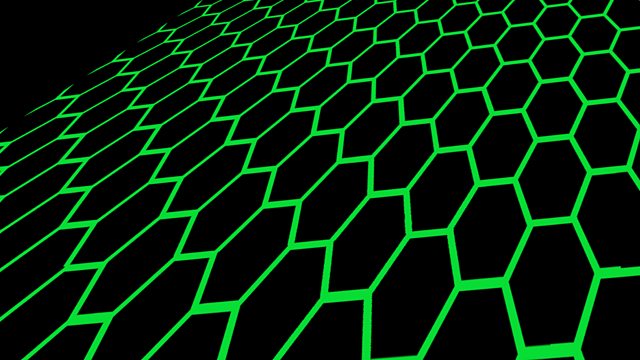
Photo: An artist's illustration depicting graphene: by Shan Pillay
Last on

Clip
-
![]()
A very surprising use for Belgian chocolate
Duration: 00:55

Chapters
-
The Magic of Graphene
Duration: 13:33
-
Adventures in 2 Dimensions
Duration: 07:21
-
Graphene vs. Silicon
Duration: 04:45
-
Why the Future may be Flexible
Duration: 10:17
Konstantin Novoselov
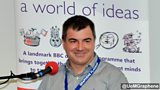
Sir Konstantin Sergeevich Novoselov is a Russian-British physicist and Langworthy Professor in the School of Physics and Astronomy at the University of Manchester. His work on graphene with Andre Geim, earned them the Nobel Prize in Physics in 2010. In 2004 Novoselov, Geim, and colleagues succeeded in isolating graphene, a one-atom-thick sheet of carbon found in a hexagonal lattice. Graphene is an extremely good conductor of electricity and may surpass silicon to form the next generation of computer chips. Graphene is also almost totally transparent, so it could be an ideal material for touch screens and solar cells.
Sarah Haigh

Jari Kinaret
Toby Heys
Toby Heys has worked as a Digital Technologies Research Fellow at the Manchester Institute for Research and Innovation in Art and Design (MIRIAD) since 2012. He is an active external member and researcher within Hexagram, an international network dedicated to research-creation in media arts, design, technology and digital culture, which it investigates through the following three axes: Senses, Embodiment and Movement; Materiality; and Ubiquity. Heys also works with Steve Goodman as AUDINT, a research cell investigating how ultrasonic, sonic and infrasonic frequencies used to demarcate territory in the soundscape, producing sound/video performances, installations, and books for venues such as Art in General (New York), Herford Museum of Contemporary Art (Germany), Academy of Art (Berlin) and TATE Britain (London) .
Jonathan Coleman
Broadcasts
- Sat 4 Jul 2015 14:05GMTBBC World Service Online
- Mon 6 Jul 2015 01:05GMTBBC World Service Online
- Tue 7 Jul 2015 08:05GMTBBC World Service Online
Podcast
-
![]()
The Forum
The programme that explains the present by exploring the past