How Long is ‘Now’?
How do we perceive time passing? With neuroscientist Virginie van Wassenhove, writer Shumon Basar and music professor Lawrence Zbikowski.
How does our brain perceive time passing? Is there such a thing as a ‘now’, and if so, how long is it, exactly? And, why do we sometimes feel that time has slowed down or even stopped altogether, for instance when listening to music or in extreme situations? Helping to explain the latest thinking and research about time, the brain and the world are cognitive neuroscientist Virginie van Wassenhove, writer Shumon Basar, author of a new book about an ‘extreme present’, and Lawrence Zbikowski, professor of Music at the University of Chicago.
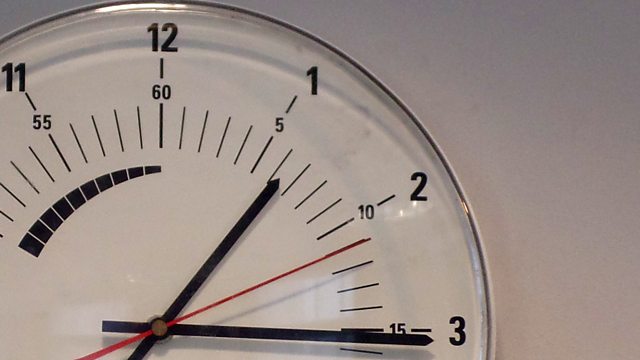
(Photo: Part of an analogue clock face. Credit: Shan Pillay)
Last on

More episodes
Previous
Clip
-
![]()
How digital devices rewire our sense of time: Shumon Basar
Duration: 01:37

Chapters
-
Virginie van Wassenhove
How the brain tracks time
Duration: 12:22
-
Shumon Basar
A guide to the ‘extreme present’
Duration: 07:33
-
60 Second Idea
Getting back lost time
Duration: 03:54
-
Lawrence Zbikowski
Music makes time stand still
Duration: 13:10
Virginie van Wassenhove

Shumon Basar
Lawrence Zbikowski

Sixty Second Idea to Change the World

Broadcasts
- Mon 4 May 2015 01:05GMTBBC World Service Online
- Tue 5 May 2015 08:05GMTBBC World Service Online
Podcast
-
![]()
The Forum
The programme that explains the present by exploring the past