Unintended Consequences
Why was a poem accused of causing a war? Can we really control the consequences of our actions? Poet Peter Anderson, novelist James Friel and philosopher Lisa Bortolotti discuss.
What role does our imagination play in taking us down paths we do not expect? And how far does an artist relinquish control with a work of art? Bridget Kendall asks the poet Peter Anderson, the novelist James Friel and the philosopher Lisa Bortolotti to pool thoughts about unintended consequences.
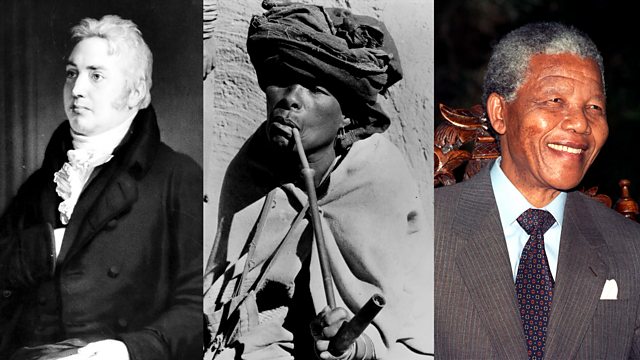
(Photo: From left to right, Samuel Taylor Coleridge, a Xhosa warrior, Nelson Mandela. Credit: Getty Images)
Last on

Clip
-
![]()
Choice blindness in the supermarket
Duration: 00:51

Chapters
-
Peter Anderson
How a poem helped stir revolution
Duration: 15:57
-
James Friel
How a novel is a gift to the reader
Duration: 07:03
-
60 Second Idea:
Become a trio of selves
Duration: 06:09
-
Lisa Bortolotti
Why our actions have unexpected outcomes
Duration: 11:21
Peter Anderson

Dr Peter Anderson is a senior lecturer in English literature at the University of Cape Town. He shares with us his latest research on how the work of the 19th century English writer Samuel Taylor Coleridge inspired a poem which was accused of causing a war in South Africa, and then eventually contributed to the country’s freedom from apartheid this century. He believes it shows how the power of the imagination can cut through the logical sequence of events, and create incredible unintended consequences. Peter is also the author of two volumes of poetry, Litany Bird and Foundling’s Island.
James Friel
Lisa Bortolotti

60 second Idea to Change the World: become a trio of selves

KUBLA KHAN
by Samuel Taylor Coleridge
In Xanadu did Kubla Khan
A stately pleasure-dome decree:
Where Alph, the sacred river, ran
Through caverns measureless to man
Down to a
sunless sea.
So twice five miles of fertile ground
With walls and towers were girdled round:
And there were gardens bright with sinuous rills
Where blossomed many an incense-bearing tree;
And here were forests ancient as the hills,
Enfolding sunny spots of greenery.
But oh! That deep romantic chasm which slanted
Down the green hill athwart a cedarn cover!
A savage place! As holy and enchanted
As e’er beneath a waning moon was haunted
By woman wailing for her demon-lover!
And from this chasm, with ceaseless turmoil seething,
As if this earth in fast thick pants were breathing,
A mighty fountain momently was forced;
Amid whose swift half-intermitted burst
Huge fragments vaulted like rebounding hail,
Or chaffy grain beneath the thresher’s flail:
And ‘mid these
dancing rocks at once and ever
It flung up momently the sacred river.
Five miles meandering with a mazy motion
Through wood and dale the sacred river ran,
Then reached the caverns measureless to man,
And sank in tumult to a lifeless ocean’
And ‘mid this tumult Kubla heard from far
Ancestral voices prophesying war!
The shadow of the dome of pleasure
Floated midway on the waves;
Where was heard the mingled measure
From the fountain and the caves.
It was a miracle of rare device,
A sunny pleasure-dome with caves of ice!
A damsel with a dulcimer
In a vision once I saw;
It was an Abyssinian maid,
And on her dulcimer she played,
Singing of Mount Abora.
Could I revive within me
Her symphony and song,
To such a deep delight ‘twould win me,
That with music loud and long,
I would built that dome in air,
That sunny dome! Those caves of ice!
And all who heard should see them there,
And all should cry, Beware! Beware!
His flashing eyes, his floating hair!
Weave a circle round him thrice,
And close your eyes with holy dread,
For he on honey-dew hath fed,
And drunk the milk of Paradise.
MAKANNA’S GATHERING
by Thomas Pringle
Wake! Amakósa, wake!
And arm yourselves for war.
As coming winds the forest shake,
I hear a sound from far:
It is not thunder in the sky,
Nor lion's roar upon the hill,
But the voice of HIM who sits on high,
And bids me speak his will!
He bids me call you forth,
Bold sons of Káhabee,
To sweep the White Men from the earth,
And drive them to the sea:
The sea, which heaved them up at first,
For Amakósa's curse and bane,
Howls for the progeny she nurst,
To swallow them again.
Hark! 'tis UHLANGA'S voice
From Debè's mountain caves!
He calls you now to make your choice --
To conquer or be slaves:
To meet proud Amanglézi's guns,
And fight like warriors nobly born:
Or, like Umláo's feeble sons,
Become the freeman's scorn.
Then come, ye Chieftains bold,
With war-plumes waving high;
Come, every warrior young and old,
With club and assagai.
Remember how the spoiler's host
Did through our land like locusts range!
Your herds, your wives, your comrades lost --
Remember -- and revenge!
Fling your broad shields away --
Bootless against such foes;
But hand to hand we'll fight to-day,
And with their bayonets close.
Grasp each man short his stabbing spear --
And, when to battle's edge we come,
Rush on their ranks in full career,
And to their hearts strike home!
Wake! Amakósa, wake!
And muster for the war:
The wizard-wolves from Keisi's brake,
The vultures from afar,
Are gathering at UHLANGA'S call,
And follow fast our westward way --
For well they know, ere evening-fall,
They shall have glorious prey!
THE INCANTATION
by Thomas Pringle
HALF-WAY up Indóda climbing,
Hangs the wizard-forest old,
From whose shade is heard the chiming
Of a streamlet clear and cold:
With a mournful sound it gushes
From its cavern in the steep;
Then at once its wailing hushes
In a lakelet dark and deep.
Standing by the dark blue water,
Robed in panther's speckled hide,
Who is she! Jalúhsa's daughter,
Bold Makanna's widowed bride.
Stern she stands, her left hand
clasping
By the arm her wondering child:
He, her shaggy mantle grasping,
Gazes up with aspect wild.
Thrice in the soft fount of nursing
With sharp steel she pierced a vein.
Thrice the White Oppressor cursing,
While the blood gushed forth amain,
Wide upon the dark-blue water,
Sprinkling thrice the crimson tide,—
Spoke Jalúhsa's high-souled daughter,
Bold Makanna's widowed bride.
‘Thus into the Demon's River
Blood instead of milk I fling:
Hear, UHLANGA —great Life-Giver!
Hear, TOGUH —Avenging King!
Thus the Mother's feelings tender
In my breast I stifle now:
Thus I summon you to render
Vengeance for the Widow's vow!
‘Who shall be the Chief's Avenger!
Who the Champion of the Land!
Boy! the pale Son of the Stranger
Is devoted to thy hand.
HE who wields the bolt of thunder
Witnesses thy Mother's vow!
HE who rends the rocks asunder
To the task shall train thee now!
‘When thy arm grows strong for battle,
Thou shalt sound Makanna's cry,
Till ten thousand shields shall rattle
To war-club and assagai:
Then, when like hail-storm in harvest
On the foe sweeps thy career,
Shall UHLANGA whom thou servest,
Make them stubble to thy spear!
Broadcasts
- Mon 8 Dec 2014 03:05GMTBBC World Service Online
- Tue 9 Dec 2014 09:05GMTBBC World Service Online
Podcast
-
![]()
The Forum
The programme that explains the present by exploring the past