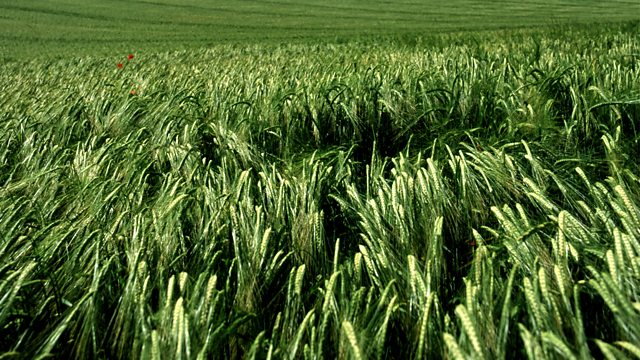
Grass
Grass provides 60% of human calorie intake and covers a quarter of the planet. Samira Ahmed explores its vital role with Dr Umesh Singh, Dr Stephen Harris and Susanne Lucas.
Almost all of us at some point play on, relax on, plant, tend, or harvest grasses – but how much do we really understand them and how much do they shape human existence? Samira Ahmed is joined by Susanne Lucas, executive director of the World Bamboo Organisation, Dr Umesh Singh a plant pathologist and biotechnologist from the International Rice Research Institute and Dr Stephen Harris a population geneticist and curator of the Oxford University Herbaria.
Photo: BBC
Last on

Chapters
-
Biologist and author Stephen Harris
Grass species and their role in food security, soil stabilisation and golf courses
Duration: 13:53
-
Senior Scientist, Dr. Umesh Singh
On developing rice that is resistant to drought and flooding
Duration: 05:48
-
60 Second Idea
An App for the brain which will simultaneously translate all languages wherever you are.
Duration: 04:12
-
Horticulturist and author Susanne Lucas
Why Bamboo is much more than a fast growing woody giant and the food of Giant Pandas.
Duration: 12:59
Stephen Harris
Umesh Singh
Photo courtesy of Umesh Singh
Susanne Lucas
Susanne Lucas, is Executive Director of the World Bamboo Organization, a horticulturist and author of Bamboo (Reaktion books published 2013). She says that it often comes as a surprise that Bamboo is a grass. Numerous species are distributed widely throughout the world, and as well as being used in food, clothing and shelter, it is believed that the first books were written on bamboo. There is evidence that more than 5,000 years ago it was shaped by humans into musical instruments as well as the framework of housing. Susanne says that bamboo’s special characteristics, such as its ability to grow quickly and thus be an easily replaced resource, offers potential solutions to modern ecological dilemmas. As modern research and technologies advance, she says that bamboo use has increased dramatically—it can now be found in the filaments of light bulbs, airplanes, the reinforcements of concrete, and even bicycles.
Photo courtesy of Susanne Lucas
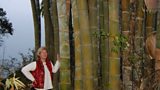
Susanne Lucas with bamboo in Sikkim in India
60 Second Idea to Change the World
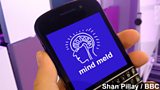
Susanne Lucas proposes a Communications App for the brain. She suggests that we are all "lost in translation" and the remedy is a free APP , an instant download, that would enable our brains to receive a simultaneous translation of every language and every dialect, no matter where we are. It's not for our mobile phones but for our brains. Something similar to what Spock from Star Trek called a "mind meld". But will it put the translators out of business and what about privacy if we are all instantaneously understood by everyone?
Broadcasts
- Sat 16 Aug 2014 21:05GMTBBC World Service Online
- Sun 17 Aug 2014 09:05GMTBBC World Service Online
- Mon 18 Aug 2014 02:05GMTBBC World Service Online
Podcast
-
![]()
The Forum
The programme that explains the present by exploring the past