Peering into Space at Aspen Ideas Festival
Cutting-edge space science, including asteroids, dark matter and how to detect tiny units
Cutting-edge space science from this year's Aspen Ideas Festival in Colorado. Former astronaut Edward Lu explains why we urgently need to map all sizeable near-Earth orbit asteroids if we want to avoid becoming 'dinosaur toast'. Also, Lisa Randall, a theoretical physicist at Harvard, explores the mysteries of dark matter - the invisible, seemingly inert stuff, which is thought to account for about a quarter of the mass-energy of the known universe. And Fermilab's Craig Hogan is behind a new experiment to probe the fabric of space itself, by seeing if it's possible to detect the very tiniest units in the universe.
(Image: From left to right, presenter Bridget Kendall, Craig Hogan, Edward Lu and Lisa Randall. Credit: © All rights reserved by aspeninstitute-internal
Last on

More episodes
Clip
Chapters
-
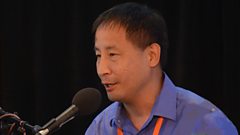
Ed Lu: Hunting for deadly asteroids
Duration: 14:23
-
Lisa Randall: Probing the mysteries of dark matter
Duration: 08:37
-
Craig Hogan: Measuring the bandwidth of reality
Duration: 17:07
Ed Lu
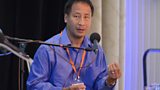
Photo © All rights reserved by aspeninstitute-internal
Lisa Randall
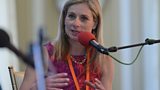
What if there is a proportion of dark matter which interacts with ordinary matter much more strongly than we’d thought? Harvard physicist Lisa Randall says that new data will soon become available from cosmic observations and terrestrial experiments which will shed light on her new theory about Double-Disk Dark Matter. If proven correct, there is a chance that dark matter might even influence the paths of comets through the Solar sytem.
Photo © All rights reserved by aspeninstitute-internalCraig Hogan
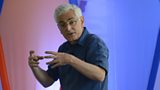
Imagine trying to measure the effects of cosmic jitter at a scale billion billion times smaller than an atom. (That’s right, a billion billion times!). This is what Craig Hogan’s team at Fermilab in Batavia is attempting. If successful, it should give us fundamental insights into the nature of space itself: is it classically smooth or in discrete units, like grains of sand on a beach?
Photo © All rights reserved by aspeninstitute-internalComments on the programme
Maybe it would be a good thing if an asteroid did hit the earth. I hope it wipes out all humans, but leaves some species like apes alive to repopulate the Earth with more planet-friendly creatures.
Charles de Matas
Wow, what a brilliant show, imagination on fire. Bridget Kendall and team, well done!
Romjan Ali
Next week:
Broadcasts
- Sat 6 Jul 2013 15:06GMTBBC World Service Online
- Sat 6 Jul 2013 23:06GMTBBC World Service Online
- Sun 7 Jul 2013 10:06GMTBBC World Service Online
- Mon 8 Jul 2013 02:06GMTBBC World Service Online
Podcast
-
![]()
The Forum
The programme that explains the present by exploring the past