We Quit
David Cameron’s closest advisers and Europe’s top leaders reveal how he tried to tackle the Europe question, and his battles at home and in Brussels before the referendum.
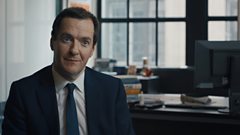
For the first time on television, David Cameron’s top advisers - including George Osborne and William Hague - reveal the discussions that led to the decision for which Cameron will go down in history: to hold an in/out referendum. George Osborne describes how he warned Cameron against taking such a gamble, saying it could be ‘a disaster for Britain.’ But he fails to persuade the Prime Minister. William Hague backs the decision, arguing that the calls for a referendum were so loud that there was little choice. ‘This wasn’t a decision taken lightly or hastily,’ he says, ‘but this was coming. Either we had to lead that or be the victims of it.’ Nick Clegg, Cameron’s coalition partner, describes how he told the Prime Minister it was like ‘being in a cage with a demented gorilla, constantly thrashing around, trying to find ever more Eurosceptic and anti-European things to feed to the tabloids.’
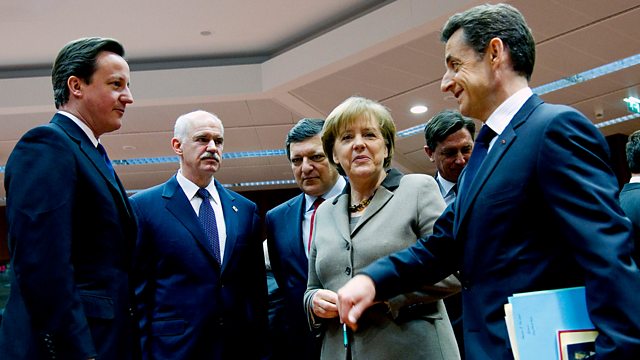
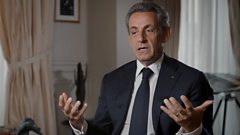
Cameron promised before the referendum he would secure a new deal for Britain. We follow the Prime Minister as he tries desperately to secure concessions from his European partners but keeps getting knocked back. French President Nicholas Sarkozy had given Cameron a stark warning: ‘If you try to force our hand you’ll get nothing. If you want to break our arm, you will get nothing. This is not negotiable.’ The German Chancellor, Angela Merkel, was the leader he had to convince and Cameron’s most senior adviser on Europe, Ivan Rogers – in his first interview for British television – describes how the PM tried to persuade her to back a plan to limit the number of EU migrants allowed to work in the UK. ‘She is wholly unsympathetic,’ Rogers tells us. ‘She says “I don’t really understand what the problem is. You don’t have a social or economic crisis, you have very low unemployment. No way David, I could never agree to limits on free movement.’
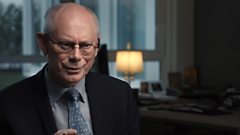
But Cameron tries to stop Jean-Claude Juncker becoming president of the European Commission. Herman van Rompuy, the President of the European Council, describes his shock when Cameron invited him to Downing Street to ask for his help against Juncker: ‘He urged me, he pressured me. And that was a bridge too far. I didn't come to London to receive orders.’ Again, Cameron is left out in the cold as Europe’s leaders go ahead and back Juncker without him.
When Cameron is re-elected in 2015, his promises come back to haunt him. Donald Tusk, the new president of the European Council, describes an extraordinary conversation with the Prime Minister where Cameron reveals he wasn’t expecting to have to follow through with his promise: I asked David Cameron, ‘Why did you decide on this referendum? It’s so dangerous, so even stupid.’ And he told me, and I was really amazed and even shocked, that the only reason was his own party, the Tories. He felt really safe, because he thought at the same time that there’s no risk of a referendum, because his coalition partner, the Liberals, would block this idea of referendum.
But then, surprisingly, he won the election, and there was no coalition partner. So paradoxically, David Cameron became the real victim of his own victory. French President Francois Hollande told the Prime Minister he could decide not to hold the referendum: ‘This would not be the first time that a commitment made at an election had not been kept.’ But Cameron pushed ahead.
We see his year-long charm offensive throughout the European Union – visiting countries no British Prime Minister has been to in decades – in order to secure a deal. From beers in Prague to dinners at Chequers, the Prime Minister tries to convince his partners to give him something to show Britain can claw back power from Brussels – especially on immigration. EU leaders reveal how they were happy to do what they could, but that there was only so far they could reasonably be expected to bend. Jean-Claude Juncker describes a lunch with Cameron: I said ‘this is the price to pay. I didn’t like the price, but my feeling was that we have to agree on this. Because I always had in my mind, maybe even in my heart, this feeling that without Britain we would be poorer.
Even with Juncker’s support, Cameron arrives at a crunch summit in Brussels knowing he has to secure a deal. After 26 hours the talks were stuck and David Cameron, lying on the floor of his delegation office to ease his bad back, had a surprise visit from the German Chancellor. But Cameron almost blew it with a slip of the tongue. The last person standing, the Czech Prime Minister, was brought over the line by Donald Tusk.
But the deal is not enough to save Cameron. His closest political ally, George Osborne, describes the final hours in Downing Street before David Cameron’s resignation, while his fellow leaders reveal what was said at the Cameron’s last, emotional, summit in Brussels.
Last on
More episodes
Previous
You are at the first episode
Clips
-
![]()
When Sarkozy said no to Cameron
Duration: 00:50
-
![]()
The referendum issue
Duration: 00:44
-
![]()
A warning from Nicolas Sarkozy
Duration: 01:15
-
![]()
Inside Europe: Ten Years of Turmoil | Trailer
Duration: 00:30
Credits
| Role | Contributor |
|---|---|
| Narrator | Caroline Catz |
| Series Producer | Norma Percy |
| Director | Tim Stirzaker |
| Director | Tania Rakhmanova |
| Assistant Producer | Max Stern |
| Assistant Producer | Nicholas de Taranto |
| Editor | Toby Marter |
| Composer | Simon Russell |
| Camera Operator | Vlad Trivic |
| Camera Operator | Nina Bernfeld |
| Camera Operator | Georgi Lazareveski |
| Camera Operator | Will Pugh |
| Sound | Jaime Goodbrand |
| Sound | Jean-Christophe Girard |
| Sound | Ben Livingstone |
| Re-recording mixer | George Foulgham |
| On-line editing | Laurence Thripp |
| Colourist | Vanessa Taylor |
| Graphic Designer | Dom Bailey |
| Production Manager | Amy Tapper |
| Executive Producer | Lucy Hetherington |
| Executive Producer | Greg Sanderson |
| Production Company | Brook Lapping Productions |
| Researcher | Declan Smith |
Broadcasts
 Mon 28 Jan 2019 21:00
- Sat 16 Feb 2019 03:20
- Fri 29 Mar 2019 19:00
Featured in...
![]()
Documentaries by Norma Percy
Award-winning documentary maker Norma Percy examines key events in contemporary history.
![]()
The Battle for Power
Exploring the lives of politicians and powerful figures, and their tumultuous times.
![]()
Documentaries by Norma Percy
Acclaimed documentary filmmaker Norma Percy examines key events in contemporary history.
![]()
The Stories That Changed Us
Watershed events from the past that made the world we live in now.
![]()
Power Politics
Exploring the lives of politicians and powerful figures, and their tumultuous times.