D-Day: The military success that Winston Churchill feared would be a failure
2 June 2017
The battle that has now begun will grow constantly in scale and in intensity for many weeks to come and I shall not attempt to speculate upon its course.Winston Churchill
On 6 June, 1944, the largest seaborne invasion in history was launched – Operation Overlord, better known as D-Day. When Prime Minister Winston Churchill announced the invasion in the House of Commons, he was cautiously optimistic of its success.
Dundonian actor Brian Cox is starring as the iconic wartime leader in a new film set in the days leading up to D-Day. He revealed to Timeline’s Glenn Campbell that Churchill actually thought the invasion should not go ahead due to fear of heavy losses in the face of fighting elite enemy formations in north-west Europe.
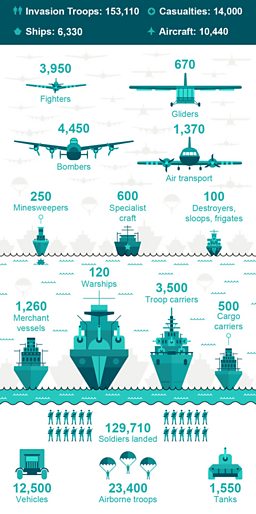
D-Day numbers
Piping on the battlefield
Another man who had reservations about D-Day was legendary piper Bill Millin. But his were slightly different to those of Winston Churchill – he was asked by Lord Lovat to pipe commandos into battle on one of the French beaches.
His son John reported that his father thought about it for a moment before being quickly convinced when Lovat told him that, ‘This moment will go down in history’.
Unarmed, he played the pipes as the soldiers landed on Sword Beach before they went on to fight their way to Pegasus Bridge.
The kilt was floating in front of me like a ballerinaBill Millin
One of the commandos, Denis Roby, recalled, ‘We ran over it with bullets singing round our ears, with Lord Lovat and Bill Millin in front’.
Bill Millin was also a commando who became Lord Lovat's personal piper after meeting the famous officer at Achnacarry near Fort William.
As well as the statue in Normandy, Millin’s actions were also immortalised in the 1962 film The Longest Day.
Latest features from BBC Scotland
-
![]()
'Wild swimming helps me process the grief of losing my son'
The benefits of cold water therapy.
-
![]()
Winter adventures are appealing, but an expert advises caution
Trips in winter require particular knowledge and skills.
-
![]()
The rescuers: Why volunteers risk their lives in mountain emergencies
Landward meets members of the Cairngorm Mountain Rescue Team.
-
![]()
‘Look for the light’ – practical tips to help you through another winter with SAD
Useful advice and tips to combat low moods at this time of year.
-
![]()
How you could be a binge drinker without even knowing
Binge drinking is classed as fewer units than many people may realise.
-
![]()
How chocolate biscuits and drama classes helped one man leave prison behind
The healing power of creativity.
-
![]()
'When people believe in you, it’s life-changing'
Author Graeme Armstrong revisits the man who helped turn his life around.
-
![]()
The 'breath-taking' display of US birds swept on to British soil
Recent storms have brought rare birds to our shores.
-
![]()
Six things we learned about Alan Cumming on Take the Floor (Spoiler: includes accordions)
The actor spoke to Take the Floor's Gary Innes.
-
![]()
How street gangs trap young men in a dangerous cycle of violence
The almost inescapable pull of life in a gang.
-
![]()
Why stylist Gok Wan believes there's no such thing as bad fashion
The fashion expert says we should stop following rules and do what feels right.
-
![]()
Is sending a CV still the right way to apply for a job?
They've been central to job applications for years, but are they worth it?