 | 24 September 2014 |

|
|
| BBC Homepage | | |
| |||
| Contact Us | | |
Local historyYou are in: Nottingham > History > Local history > Nottinghamshire's VC winners 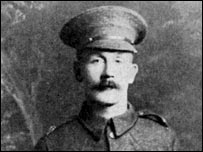 Nottinghamshire's VC winnersThe stories of 20 Nottinghamshire men who were awarded the Victoria Cross go on display at Nottingham's Council House. William Henry JohnsonHe was born in Worksop in 1890 and served with the Sherwood Foresters. On 3 October 1918 at Ramicourt in France, his platoon was held up by a nest of machine guns. Sergeant Johnson worked his way forward and despite the heavy gun fire managed to single handedly charge the emplacement, bayoneting several gunners and capturing two of the machine guns. The BBC is not responsible for the content of external websites He was severely wounded during the attack but continued to lead his men forward. After the first attack the platoon was again held up by machine guns. Once again Sergeant Johnson made a solo attack and silenced the other machine gains. He died in April 1945 and is buried in Redhill cemetery in Nottingham. The BBC is not responsible for the content of external websites William Thomas MarshallBorn in Newark on 5 December 1854, during the battle at El Teb in Sudan in 1884 he helped save the life of a senior officer. The Commanding officer of the 18th Hussars was severely wounded and surrounded by the enemy. Quartermaster-Sergeant Marshall, who stayed behind with him, seized his hand and dragged him through the enemy back to the Regiment, saving him from certain death. Samuel MorleyBorn in Radcliffe on Trent in 1829, he saw action in India where, at Azimgurh on 15 April 1858, he saved the life of an adjutant of the Sikh cavalry who'd been dismounted and wounded. Together with a farrier, Private Morley helped shield the soldier's body until help arrived. He died in 1888 and is buried in the General Cemetery (Canning Circus) in Nottingham. Harry NichollsBorn in the Meadows, Nottingham in 1918, he served with the Grenadier Guards. In May 1940, during the withdrawal of the British Expeditionary Force, near the river Escaut in Belgium, Lance Corporal Nicholls, although suffering from a shrapnel wound, led his section in a counter attack against the enemy. The BBC is not responsible for the content of external websites At one point he grabbed a Bren gun, put three machine guns out of action then attacked the enemy infantry until he ran out of ammunition and was taken prisoner. The BBC is not responsible for the content of external websites He was awarded the Victoria Cross posthumously, as he was believed to be missing, presumed dead. He was notified of his award by the Camp Commandant of Stalag XXA, apparently on the orders of Adolf Hitler. He died in 1975 and is buried in Nottingham's Southern cemetery (Wilford Hill cemetery). The BBC is not responsible for the content of external websites Walter Richard ParkerPart of the Royal Marine Light Infantry, he earned his award during the First World War. At Gaba Tepe, Gallipoli in April 1915 he was a volunteer stretcher bearer. He helped take vital supplies to an isolated trench despite the fact many men had died trying to attempt the task. He reached his comrades, tended the wounded and helped the casualties to safety despite being wounded himself. Parker died in 1936 and is buried in Stapleford Cemetery, Nottingham. The BBC is not responsible for the content of external websites William RaynorBorn in 1795 at Plumtree, Nottingham he saw action in India in 1857. At Delhi, Lieutenant Raynor was one of nine men who defended an ammunition dump for more than five hours against heavy odds. With no prospect of help they destroyed the ammunition. Six of the nine died in the explosion. Raynor survived but died three years later in 1860. He's buried in India. The BBC is not responsible for the content of external websites Robert St Vincent SherbrookeHe was born in 1901 in Oxton, Nottinghamshire and served with the Royal Navy. On 31 December 1942 off the North Cape of the Barents Sea, Captain Sherbrooke was in command of HMS Onslow, a destroyer escorting a convoy. On four occasions his vessel managed to repel enemy ships trying to destroy the convoy. Captain Sherbrooke was seriously wounded in the face and was temporarily blinded but continued to direct the ships under his command. He's buried in St Peters and St Pauls churchyard in Oxton. The BBC is not responsible for the content of external websites James UptonA member of the Sherwood Foresters, he was born in the Meadows in 1888. In May 1915 at Rouges, France, Corporal Upton displayed great courage all day in rescuing the wounded from the battlefield despite being exposed to heavy rifle and artillery fire. He died in 1949. The BBC is not responsible for the content of external websites Sir Geoffrey VickersBorn in 1894 in Nottingham. In the trenches at Hohenzollern Redoubt in France on 14 October 1915 he held a barrier for several hours against heavy German bomb attacks. He ordered a second barrier to be built behind him to ensure the safety of the trench even though his own retreat was cut off. He survived despite being severely wounded. He died in 1982. Francis WheatleyA member of the Rifle Brigade, Private Wheatley was born in Ruddington, Notts in 1822. He was honoured during the Crimea conflict. On 22 April 1855 he saved several lives by dealing with a live shell that had fallen into a trench. He first tried to knock out the burning fuse with the butt of his rifle. When this failed he picked up the shell and threw it over the parapet where it immediately exploded. He died in 1865. last updated: 31/07/2009 at 10:46 SEE ALSOYou are in: Nottingham > History > Local history > Nottinghamshire's VC winners 
 |
| | About the BBC | Help | Terms of Use | Privacy & Cookies Policy |