In 1952 about 18,000 acres of flax were grown
in Northern Ireland, but today in 2004 there is virtually
no flax grown. In a small corner of Tyrone however,
not far from Cookstown, the blue flower of the flax
plant will be seen this summer thanks to Tullylagan
Vintage Owners Association. YPAM reporter John Gregg
was there on a sunny April evening when Fred Faulkner
sowed about a third of an acre with the crop.
Tullylagan Vintage Owners Association have 14 acres
at Berkeley's Farm, in the townland of Gallanagh (meaning
white marsh) just off the Cookstown/Dungannon road,
which Lafarge Blue Circle Cement Ireland Ltd allow them
to rent for a minimal sum. Here the association keeps
the traditional methods of farming alive.
 |
Gunters
chain |
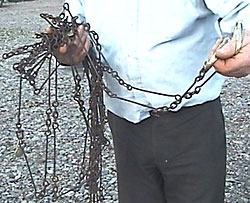
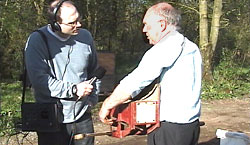
When John arrived Fred Faulkner (Chairman of the
Association) was handling a heavy looking
chain. This chain was apparently the original method
used to measure land. A 'Gunters chain' is 22 yards
long (the length of a cricket pitch), with brass
swivel handles at each end and is divided up into
4 perches or sections (each 5.5 yards in length)
which are separated by little brass tags. Fred and
another member, Robert Stewart, stretched the chain
out across a grassy field. They then moved along,
with the chain between them, dividing the field
up into triangles (you only need to do this if the
field is not square), using the chain to work out
the measurements. As Fred talked about multiplying
this and the square root of that, John wished he
could remember more of his maths from school!! |
 |
Flax
seed |
Flax seed is brown in colour, very fine and has
a lovely silky feel to it. As he ran it through
his fingers, Fred thought it felt like soft soap
- not surprising really as the seed is made up of
40% oil. One Tullylagan vintage member remembered
his father saying that if a horse was in poor condition,
after a month feeding it on flax seed its coat would
have a good shine.
Fred explained to John that the plan was to sow
about a third of an acre and that around half
a bushel of seed should be required.
|
 |
Fred
Faulkner operating a fiddle |
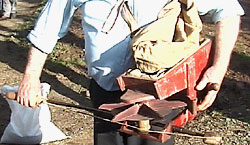
A seed fiddle is the traditional piece of equipment that
was used for sowing. There is a bow at the front which
you move back and forth to rotate a dispenser which throws
out the seed. A bag on top holds the seed and you can
alter the calibration on the side to control how much
you want to spread across the ground. Before starting,
Fred marked the edge of the field to ensure that he would
walk up and down the field in a straight line when sowing
the seed. Then the still spring air hummed to the rattle
of the fiddle as Fred slid its bow back and forth spraying
seed in an arc in front of him as he paced it out over
the upturned earth.
If the weather is kind, the Association aim to harvest
the resulting flax crop in the autumn. Your Place &
Mine will be there to record it being gathered in. Let's
hope the Association's first attempt at growing flax
is a great success.
 |
|
|
|
Click on picture to
watch flax sowing |
The online team donned their wellington boots, video camera
in hand, to record this planting of flax in the old fashioned
way.
Watch
the result by clicking here.
|
|
Related web links
View
a painting of a flax dam by Brian Willis and read
about the research he carried out beforehand.
Listen
to a radio programme from the BBC archives featuring
farmers in the Eglinton area talking about growing flax.
John Pattison recalls growing flax in Co Fermanagh
during World War II - find
out more
John Pattison's grandchildren had a go at growing
flax themselves and they decided to visit
the Linen Museum in Lisburn as well.
Brian Willis visited the Aviation Heritage Centre
at Langford Lodge to see how
Irish Linen was used on wartime aircraft.
Read about the history
of Herdmans mill, which has been involved
in the spinning of flax since the middle of 19th
century.
Read Isa
Lilley's memories of her mother working in
the weaving factory in Larne.
Find out more about the lifestyle and working
conditions of linen
mill workers in Ulster.
Helen Mark visited Wellbrook Beetling Mill near
Cookstown for BBC Radio 4's Open Country and was
taken through the many stages of the linen making
process - eavesdrop
on her visit.
|
|



 print version





















 POST
A COMMENT ON THIS ARTICLE
POST
A COMMENT ON THIS ARTICLE 
