|
|
|
 |
|
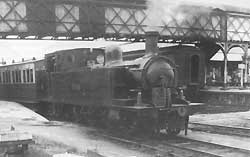
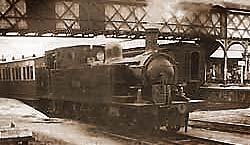
"Lydia" |
|
Engines always seemed to be female and, as Willie John
Carlin explains, each had its own character and in many
instances even a name. Not only were they given names
such as Lydia, Blanche and Alice, but crew members would
have treated their engine like a member of the family.
Every spare minute would be spent polishing away to
keep everything shiny bright, and even the foot plate
was kept spotlessly clean! Willie John and George remember
how some of the drivers took particular care.
Listen - spotless engines
|
|
|
 |
|
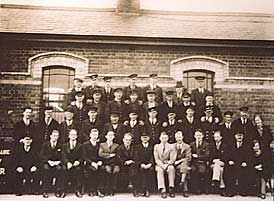
Strabane Railwaymen, 1937
|
|
The railway itself was like one big family, with railwaymen
striking up long and lasting friendships with each other.
Perhaps it's not surprising then that working on the
railways tended to run in families, son following father
or brother following brother. In this group photograph
of members of staff, taken at Strabane Station in 1937,
a number of the men featured had family connections.
Two brothers, Robert McKean (middle of second row) and
Tommy McKean (4th from right, second row) appear in
the picture. Also, Frank Doherty (3rd left, second row)
had 2 sons who followed him in and Pat Madden's (6th
from right, second row) father and brother worked for
the railway. Freddie Boggs (1st left, second row) was
working as a checker when this picture was taken. But
by the time Strabane Station closed he was the yard
foreman responsible for all the freight transhipment.
As far as we are aware, at the time of writing (Feb
2002), Freddie Boggs is the only person from this photograph
still surviving. If you have stories about any of these
men we'd love to hear from you. (It should be pointed
out that this group is only a proportion of the people
who would have worked at Strabane Station at that time.
In fact, the station employed about 300 when it closed
in the 1960's.)
|
|
|
 |
|
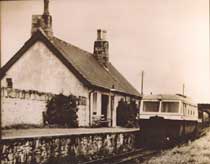
Railcar, Clady Station |
|
The train featured in this photograph of Clady Station
is in fact a railcar. You can just about see, attached
behind it, a trailer and van. There were probably more
people travelling that day and the trailer gave them somewhere
to sit. The van was used to transport their luggage. I'm
sure you'll agree that the railcar looks very much like
a bus and, in fact, some companies did convert road buses
to rail operation. Railcars were able to run independently
because they had their own engine. Early versions would
have been petrol driven, but later on a drive for economy
lead to them becoming diesel operated. In fact, according
to George Haire, Co Donegal was the first railway in the
world to try diesel.
Listen
- railcars
Also from a financial point of view, railcars were
a great advantage on journeys where passenger numbers
were low. They could be switched off when not needed,
whereas a steam locomotive had to be fired up 6 hours
before it was needed. If, for example, it did a short
one hour trip in the morning and wasn't required again
until the afternoon - you still had to keep feeding
the engine with coal to keep the train fired up for
its next outing.
|
|
|
 |
|
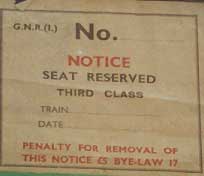
3rd Class Reserved Seat Notice, G.N.R.
|
|
George Haire's local station, when he was a boy, was Clady.
The line closed when he was 11 years old, but he has fond
memories of the excursions to Rossnowlagh on certain Sundays
during the summer. A steam locomotive was used so that
at various stations along the way extra coaches could
be added to it. A typical excursion train would have had
12 or 14 coaches on it. Christopher Wilson, as a boy,
travelled with his family to Enniskillen every July. He
still remembers the differences between the plainness
of 3rd class and plushness of the 1st class carriages;
the fun of sticking your head out the window to see the
train snaking round the curves, steam belching out and
trying to avoid getting cinders in your eye!
Listen
- train journeys
The railway wasn't only responsible for building track
and stations. At Victoria Bridge 4 houses were erected
for returning Boer War soldiers, who might want to work
on the railway. The houses were called "Ladysmith" after
one of the Boer War battles. If you have photographs
of these houses past or present - I'm sure others would
be fascinated to see them. Also any information you
would have about the soldiers who lived in them.
YOUR RESPONSES
Patricia Brennon - February '08
My grandfather and grandmother lived in one of the houses
at Victoria Bridge. My grandfather worked on the railway
there, his name was James Mullen and my grandmother
was Helen Mullen. My father was born there in 1919.
He had two sisters and six brothers. My father remembers
that there was no running water and no electricit.To
get water they had to go to a water pump nearby. We
do not know for sure but, his father (my grandfather)
could have been one of the soldiers that the house
was built for. Althouugh he was poor, he does have
fond memories of his childhood growing up there. Unfortunately
he does not have any photograghs of the station.
Collette McHugh - Jan '08
I had a grandfather that worked on the railway in the signal box his name was
Arther McHugh, he died many year ago. I would love to see some footage of my
grandfather working on the railways, for one I would like to see the railways
come back to Strabane again, or a museum in Strabane dececated to Strabane
railways, would be nice
As a small boy, my father and his brother used to
play near the tracks. Their names are John McHugh and
Christopher McHugh.
William Mc Cormick - Sept' 06
Greetings from Calgary, Alberta, Canada.
I enjoyed looking at this site, especially the pic of
Clady Station. My memories go back to the 1950s riding
on the wee rail bus and train to the Academy in Strabane.
Thanks for sharing pics and info.
Michael J Conroy (Colchester, Essex)
- Aug '06
James Conroy mentioned in the article is my grandad.
This is the first photo of him that I have ever seen
- thank you.
Emily Lynskey - May '06
My name is Emily Lynskey nee Conroy I am the last remaining
child of railway man James Conroy. I loved the article
about my farther and the happy memories of those days
in the signal box. I am now retired and living in Callow
- Foxford Co. Mayo after living in Manchester. I will
tell my relations about this site.
Drummond Gillespie - March '06
In the 1960s I spent many happy days in the Signal Cabin
with Willie John. I made stereo recordings in the North
Cabin of the sounds of the signal cabin, including Willie
John and others singing for me, and of the trains shunting.
The Sony reel to reel coast me three months wages in
1962 or so.
I saved up all my money to go to Strabane (we lived
in Sheffield) There was something so special in the
atmosphere.
I also have many slides which I am in the process of
scanning. I took the black and white photo of the people
on the platform on a very wet day.
What wonderful memories.
Sadie Gamble nee Dunn - Feb '06
My father, John James Dunn,who is in the group photograph
(back row last on right) started working on the railways
in 1923 and finished as Station Foreman in Strabane
when the railways closed in 1965.
Helen and John - Jan '06
As a very good friend of Anne Marie I had the pleasure
of getting to know her father Willie John and her Mum
Anne.
What a remarkable man he was, a gentleman and an honour
to have known Willie John.
May Anne, Anne Marie and Tony and Paul find comfort
in the wonderful husband and father that they were blessed
with and the legacy he has left behind.
God bless
Helen and John
Muff
Donegal
Charles Barr - Jan '06
I would like to know if Eileen Mc Kenna is the daughter
of my aunt Lizzy Lindsay. My Grandfather Charles Barr
was signalman on the railway. My father Charles Barr
who is in the photo (back row, second from left). My
name is also Charles Barr, and I also worked at Strabane
station for a time, also at Porthall station.
Ann Ederer, nee Ann Wellesley Worrall
- Sept '05
I live in Canada. My cousin pointed out this Web Site
to me.
My father (2nd left in front row) is Richard Arthur
WellwsleyWorrall. He worked in the ticket sales office.
He married Margaret Thompson Parker of Ballindrait.
I was born in
1936.
I remember Freddy Boggs.
I would love to hear from anyone who knew my father.
I was only six when he died.
Eileen Mckenna - July '05
I enjoyed reading the article and looking at photograph
showing the staff of Strabane Railway Station. My Grandfather
(Charles Barr)worked as a signalman probably around
that time or maybe in the forties or early fifties.
His two sons also were employed there.
Ann Ingram - May 05
My grandfather was station master at Rossnowlagh, my
father was born at Station House overlooking the strand.
If you're at all interested my grandfather was Thomas
McCafferty and my father was Patrick McCafferty
Bill Killackey - February '05
Extremely useful. I wish there was more like it.
Patricia Doran - September - '04
Fantastic article about the trains and Strabane.
|



 print version





















 POST
A COMMENT ON THIS ARTICLE
POST
A COMMENT ON THIS ARTICLE 