|
In June 1941, six months before the United States
entered the war, American 'technicians' arrived in Derry and
built a new quay at Lisahally, a ship repair base, a radio
station and ammunition depots. Then, on 26 January 1942, the
first American troops stepped ashore at Belfast's Dufferin
Quay, and by May the number of Americans had reached 37,000.
At Langford Lodge the Lockheed Corporation repaired
and maintained aircraft and US airmen were stationed at airfields
all over the region. In 1943 greater numbers arrived in readiness
for the Normandy landings, and for a time there were 120,000
Americans in the North. The United States spent 75 million
dollars developing its facilities in Derry, including the
most important naval radio station in the European theatre
of operations.
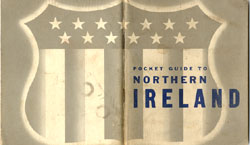
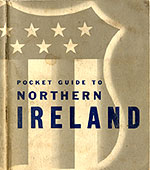 Each
GI (so called as their equipment and military issue clothing
was stamped GI - General issue ) was given a series of handbooks
on Northern Ireland to prepare them for their time in Ulster. Each
GI (so called as their equipment and military issue clothing
was stamped GI - General issue ) was given a series of handbooks
on Northern Ireland to prepare them for their time in Ulster.
This book is a wonderful glimpse into the observations made
by the advance party of the American officers into the social,
historical and cultural traits of the Province. Below are
some of the more interesting remarks and advice noted about
living among the natives in 1940's Northern Ireland.
Quite sensibly the first chapter is called "There are
two Irelands" and begins with a stark reminder of the
task ahead:
"You are going away from home on an important
mission - to meet Hitler and beat him on his own ground"....
"Every american thinks he knows something
about Ireland. But which Ireland? there are two Irelands.
The shamrock, St Patrick's Day, the wearing of the green -
these belong to Southern Ireland, now called Eire (Air-a).
Eire is neutral to the war.
Northern Ireland treasures its governmental union with England
above all things. There are historic reasons for these attitudes."
"There are two excellent rules of conduct
for the American abroad. They are good rules anywhere but
they are particularly important in Ireland :
(1) Don't argue religion
(2) Don't argue politics."
"Summing up: Religion is a matter of public
as well as private concern in Ulster and you'll be wise not
to talk about it. In America we ask, "Where do you come
from?" In Ulster they ask, "What church do you belong
to?" If the question is put to you, tell the truth and
then change the subject."
Great advice for Northern Ireland
today too. Next, the climate and geography of the province
come under scrutiny.
"Northern Ireland - usually called Ulster
- is a small country, only slightly larger than Connecticut......first
off you might not like the climate . It is damp, chilly, rainy
. If you are from the Southwest or from California you may
find yourself homesick for sunshine.......many people in Ireland
wear thick, woolen clothing all year round."
Under the heading 'Government'
the book tells us "Irish
history is endlessly complicated " and
in true Ulster tradition, and as instructed by the guide itself,
we'll not argue politics.
Then another warning
: "Be on your guard! The Nazis are trying to find out
all about the A.E.F. Watch what you say in public. Enemy ears
are listening."
| "It's
is common decency to treat your friends well; it is a
military necessity to treat your allies well." |
The 'Customs and Manners' section
tells the GI`s not to boast about skyscrapers, modern plumbing,
express highways and the size of automobiles back home adding
that "your
role is to listen".
The people of Ulster are, in general, serious-minded
and hard-working. They are independent in their beliefs and
stubborn in their opinions. The heavy infiltration of Scotch
blood may have something to do with the fact that they are
exceedingly thrifty. But they are thrifty also because Ireland
is not a rich country and a living is difficult to come by.
The Ulster man likes to drive a hard bargain in business affairs
and he thinks a spendthrift is a dope.
"yet at the same time, Ulster is a most
hospitable place. If you pause at a farmer's house , you are
likely to be invited in for a cup of tea. Tea is now rationed,
but recently an American soldier speaking on a short-wave
broadcast said he had drunk more tea during his first two
weeks in Ireland than he had in his whole life before."
The social aspect of people
in Northern Ireland has been closely observed, especially
the "male social center" - the pub.
"The male social center in Ulster is the
tavern or public house. While there are temperance advocates
and a few prohibitionists in Ireland , you won`t see much
of them. Irish whiskey is famous, but the price is now so
high that you will find most people drink stout, ale, and
porter which they call 'beer'. The American-type beer (which
is, of course, really German type ) comes only in bottles
and is known as 'lager'.
Up in the hills you may be offered an illicit concoction known
as 'potheen' . This is moonshine whiskey made out of potato
mash.Watch it. It's dynamite......The beer and ale served
in the 'pubs' is usually heavier and stronger than ours. Don't
expect ice-cold drinks.The Irish, like Europeans generally,
are accustomed to drinks served at room temperature.They like
them that way.
The Irish don't go in for the Dutch treat system. If five
men enter a pub, each will stand a round, and etiquette demands
that all stay until the last of the five rounds has been bought.
If you are invited to join such a group, and do so, remember
that you will give offense by a refusal to treat and be treated."
"Argument its own sake is a Scotch-Irish
specialty and the pub is the principal forum. You may be deceived
by the high temperatures developed in these discussions. The
Irish call each other names, accuse each other of the most
bizarre irregularities, indulge in wild exaggeration and virulent
personal abuse. Listening, you may expect a rousing fist fight
at any moment. Actually this is all part of the fun and the
show. In America we don't hold it against a man because he
tells a tall story with a couple of beers under his belt.
In Ulster it is quite within the rules of the game to accuse
your adversary not only of pig stealing but of actual treason.
A word of warning: your place in these arguments is on the
side lines."
"There is virtually no night life. Pubs
close early, and the floor show and juke joint are nonexistent.
You will find motion-picture houses ( cinemas) in all the
larger towns; many American films are shown. The theatres
are closed on Sunday. In fact, everything is closed on Sunday
because of the devout church-going habits of the population
and the strict blue laws."
The sporting life in Ulster
didn't`t fare well in the guide -
"The pre-war tourist frequently remarked,
in criticism of Ulster, that there is nothing to do there.
It is true that the Irish do not go in for organized sport
as much as the English do or as much as we do. But you'll
rarely see any-thing more exciting than a football ( soccer)
game between two tough Irish professional teams; tempers rise
and the police are frequently on hand to keep order.
Both dog racing and horse racing are popular; all field sports
are popular, and you might be able to get permission from
a farmer to shoot over his land or to trout-fish his brook,
but make very sure you get permission - poaching isn't popular
in North Ireland."
| "Wherever
you go in Northern ireland you are apt to meet a herd
of sheep or cows. Remember the animals have the right-of-way." |
The Ulster accent and local
terminology is explained and compared to American vocabulary-
"In its richest form, the Irish version
of English is a brogue, and there is a brogue for every county
in Ireland, just as we have a Brooklyn accent, a Boston broad
"a", and a Texas drawl. Many of the expressions
may strike you as funny; some of them may not be understandable.
Remember that many of your expressions will strike the Irishman
as funny - even if he is too polite to laugh - and that he
has a hard time understanding you too."
"The moving pictures have brought some Americanisms to
Ireland. You will find that the young people use and understand
terms such as "okay," "oke," "guy,"
and 'scram." But they will also invite you in for "a
squib of tea," and refer to an unmarried man or woman
well over 40 as a 'boy" or a "girl". Only married
people who have children are called men and women; bachelors
and spinsters remain juvenile until the end of their days."
"When an Irishman says: '.I am after drinking my beer,"
he doesn't mean he is about to do it or that he wants to do
it; he means, quite sensibly, that he has just finished doing
it. When he says his wife is a "homely kind of person"
he is paying her a compliment; he means not that she is ugly
but that she is cozy, kind, and unassuming."
"He is likely to be vague and optimistic in giving you
directions: "Just up the road a bit" may mean a
long way, and a "five minute walk" a jaunt of several
miles. You may not know that a drug store is a chemist's shop;
that garters are "sock suspenders," and suspenders
"braces" or "galluses"; that a street
car is a "tram"; that a "stationer" sells
writing materials and newspapers, and a "draper's shop"
clothing."
"The Ulsterman will be tolerant about your
ignorance of Ireland; it is only fair play to be tolerant
about his ignorance of America. If you live in Buffalo and
he inquires if you know his uncle in Los Angeles, don't laugh
at him - you'll pull an equally bad boner about Ireland before
the hour is out. "
quite.
A warning is given not to flaunt
cash in the faces of Ulster locals and British troops as comparisons
are made with the apparent high wages that the GI's were paid.
"You carry the greatest source of potential
trouble right around with you in your billfold. American wages
and American soldiers' pay are about the highest in the world.
The British soldier is apt to be pretty touchy about the difference
between his wages and yours. It is only human nature to wonder
why exposure to dying should be quoted at different rates
- and such different rates.
Remember that the private in the British army makes on average
50 cents a day and that, according to our standards, most
of the people in Ulster are exceedingly poor."
"Don't be a spendthrift . Don't be a dope".
The Conclusion
Every American soldier
is an ambassador of good will.
Don't criticize the food, the beer, the cigarettes.
Avoid arguing religion or politics.
Don't throw your money around.
Don't tell them - let them tell you.
In dealings with the people of Northern ireland, let this
be your slogan :
It's common decency to
treat your friends well; it is a military necessity to treat
your allies well.
So there you have it, the GI handbook for Northern Ireland
during WWII. What do you think ? Did they get it right ? If
you remember the American soldiers in your area, especially
during the build up to D-Day we'd love to hear from you.
Perhaps you were one of the GI`s that read this very book
as you travelled across the Atlantic bound for Belfast ?
Send us your comment in the box below.

|


 print version





















 POST A COMMENT ON THIS ARTICLE