It's with great sadness
that we have to update this story with the news that
following a short illness, Stanley Burrows passed away,
peacefully, on the 2nd of October 2004.
Here at YPAM we are very fortunate to get the
opportunity to speak with and interview men and women
who have put their lives at the ultimate risk for their
country. To hear first hand their stories of bravery,
delivered in such a modest and proud manner, is a very
humbling experience. Stanley Burrows was no exception.
Article written July '04
|
|
|
 |
|
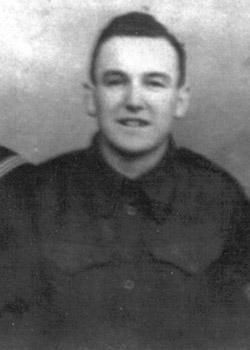
Stanley Burrows |
|
In 1940 Stanley Burrows was eighteen years old
and, inspired by the distinguished military careers of
his father and uncles, was desperate to join the army.
However he was already in full-time employment and his
father, aware of his desire to sign-up, and reluctant
to have another son join the front-line, had persuaded
his bosses at the shipyard to refuse him permission to
leave on the grounds that he was involved in ‘important
work’ for the war effort. Undeterred, Stanley came
up with a cunning plan, he would get himself sacked from
Harland and Wolf and be free to join up!
Audio
Clip 1:
Stanley talks about his 'cunning plan'.
Everything went according to plan. Having been 'successfully'
dismissed from his job, Stanley was able, to join the
70th Battallion of the Royal Ulster Rifles. His intensive
training began almost immediately and before his platoon’s
eventual move to England in 1941 Stanley had taken part
in two air-raids in Belfast and had already been exposed
to the horrors of war. Standing on duty in Belfast’s
Corporaton Street he was responsible for guiding the
frightened masses of people to safety and later, digging
casualties and bodies from the rubble.
An Ambitious Soldier
The 70th battalion's move to England, was closely followed
by a decision to disband the unit, volunteers were sought
for other divisions within the Rifles. ‘Anxious
for thrills’ Stanley tried to sign up for the
Commandos but his application was too late, however
he was more fortunate in applying for the 6th Airborne
Division and was accepted into the Gliders.
To earn his ‘Para's wings’ a soldier had
to make eight flights. On his first flight, Stanley
recalls asking the pilot how many trips he had made,
this would be his third, and he’d crash landed
the first two, was the reply! But they made it down
safely - although he does remember some hairy moments
when they landed and crashed through hedges or anything
else that got in the way.
A Mother’s Intervention
Still someway short of eight jumps, Stanley was called
in for a second medical and alarm bells immediately
started to ring. On entering the army, he’d managed
to disguise a perforated eardrum, continuously seeping
he’d dried it out by pouring peroxide into his
ear – had he now been discovered?
He had been! After just six weeks with the Paras he
had to be released, it was decided that his feet would
have to remain firmly on the ground.
It wasn’t until many years later when his mother
had died that Stanley discovered she’d notified
the authorities of his condition. Out of deep concern
for his wellbeing and anxious that he was putting himself
in added jeopardy by being in the Gliders, she had written
a letter to his superiors
warning them of his perforated eardrum.
Exercise Fabulous
Although unable to continue in the 6th Airbourne Division,
Stanley was welcomed into the 2nd Battalion of the Royal
Ulster Rifles, 3rd Division. Intensive training began
almost immediately. Although the men were under the
illusion that they were being deployed to the Mediterranean
for the invasion of Sicily, word eventually spread that
General Montgomery, who had fought before with the Ulster
Rifles, was commandeering them for his new mission.
|
|
|
|
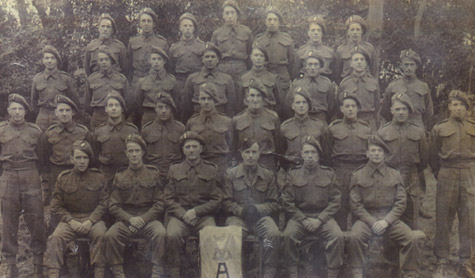
Ninth
Platoon, A Company 2nd Battalion of the Royal
Ulster Rifles - Hawick 1945. |
|
In May 1944 the Battalion was moved to Draxford in the
South of England, still unaware of the exact location
of their mission they were faced with sand models of
the Normandy beaches, Stanley to this day and with the
benefit of hindsight, marvels at how lifelike and identical
they were to the beaches on the French coast.
Training was relentless and rigorous, Monty believed
that in a war situation it was ‘noise and fatigue’
that breaks a man down, so in training live Bren guns
and rifles were fired over the heads of the men and
when the weather became really bad exercises were lengthened
rather than shortened!
The hardy 3rd division were selected in May 1944 to
take part in Exercise Fabulous, a precursor of what
was to come in the next month. On arrival back to camp
the men were treated returning heroes, something they
did nothing to dispel.
Audio
Clip 2:
Stanley talks about 'exercise fabulous'.
D-Day
Crossing
The Crossing
Bad weather resulted in the initial postponement
of Operation Overlord, but two days later the allies
were ready to advance to France. Stanley recalls men
crammed in tight, sitting on beds stacked in tiers of
four or five, from floor to ceiling. Many were sick,
the seasickness tablets seeming only to exacerbate their
condition. After rendezvousing with the rest of the
forces at a designated point in the Channel called Piccadilly
Circus, men were allowed above deck. Below, a calmness
permeated the ship as the men were instructed to write
a last letter home, Stanley wrote to his mother, saying
all the things he felt he should of but had never got
around to saying.
Audio
Clip 3:
Stanley emotively recalls the letter he wrote to his mother
during the crossing.
Betsey's Baptism
As Stanley’s ship approached Sword Beach he remembers
being absolutely amazed at the blackness of the sea
and air - covered with ships and planes. The Germans
began to attack almost immediately and Stanley’s
landing craft was hit by a shell, which passed through
the hull and luckily failed to explode.
Grounding the ship in eight foot of water, two members
of the division went ashore first, taking with them
a lifeline (a rope), which the others were to use to
guide them to the beach. Looking over the side of the
ship into the water below Stanley knew that he’d
never make the shore if he had to carry his bicycle,
his Brem gun (Betsey) and 56 pounds of equipment, so
he made a quick decision and
ditched his bicycle.
Audio
Clip 4:
Stanley recounts his journey to the shore and 'Betsey's
baptism'.
Leon–Sur-Mer
The shelling was relentless, and all around men were
falling into the water, miraculously everybody from
Stanley’s company managed to make it to onto the
beach unharmed, forging on to the assembly point at
Leon-Sur –Mer, a small village about a mile inland.
Snipers constantly bombarded the sodden troops on the
way to the assembly point, however the battalions excellent
sniper team managed to deflect any serious threat.
However it was while bedding down after having dug
in for the night that Stanley encountered his first
German at close quarters. Aware of a rustling within
earshot, Stanley and a colleague were suspicious, was
it a wild animal in the woods or was it something more
sinister?
Audio
Clip 5:
Stanley talks about capturing his first prisoner of war.
A Double Escape
The next day the Battalion were ordered to capture Cambes,
a small village thickly wooded and six miles inland,
that was strategically important for progression towards
Caen. Believed to be lightly held by the Germans and
surrounded by a large ten-foot wall, the Rifles D company
were to lead the attack, followed up by Stanley and
A company. As A company advanced up the road four Luftwaffe
fighters appeared from nowhere and riddled the middle
of the road with heavy fire, the men who’d been
marching up either side of the road, dived for cover,
unbelievably not one was injured.
Audio
Clip 6:
Listen as Stanley recalls his double escape.
Forging into the wood D company lost many men that day,
the Germans had a much securer hold on it than had originally
been suspected and Stanley and his company were forced
to retreat. On the way back they were sought refuge
in a house which had been occupied by German forces,
and it was here that Stanley again cheated death for
the second time that day.
Cambes Wood
On the 9th June, a consolidated attack was planned
for the capture of Cambes Wood. The battalion was to
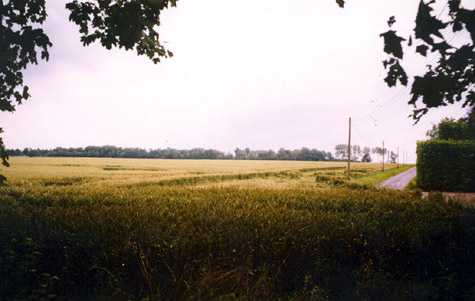
advance at 15.15 hrs, traversing through the open cornfield
to reach the U shaped hole in the ten foot wall surrounding
the wood. As the men progressed fifteen feet into the
field the assault started, the heavy shelling and mortar
fire were relentless, men were falling all around, Stanley’s
platoon officer, lying with blood trickling down his
face waved his hand at Stanley for the men to continue
advancing. Stanley and his colleagues, still standing,
made a run for the hole in the wall, nine of them made
it, but inside they were to witness a scene of terrible
carnage – all around British and German soldiers
where lying dead.
|
|
|
|
The cornfield the men had to cross to reach
Cambers Wood.
|
|
Anger at an Officer
The nine of them then fought their way to a large farmhouse,
where Lieutenant Corporal White asked for a volunteer
to run back to the company to let them know of their
whereabouts. Stanley gallantly offered. Running back
through the wood, at a frantic pace, he had to keep
shouting to the men from his company not to shoot, that
he wasn’t a German. On reaching the company puffing
and panting and obviously out of breath, Stanley became
more incensed than he’d ever been with a fellow
soldier. Unsympathetic and seemingly oblivious to Stanley’s
ordeal, the officer in charge barked at him to stop
spluttering and say what he had to say. At that moment
risking his life to notify this man seemed like a foolhearty
gesture!
Although they experienced heavy casualties the battalion
managed to secure Cambes that day.
The Chicken
Soup Incident
From then on Stanley and his company were stationed
at Cambes. On the 17th June 1944, Stanley caught sight
of a chicken wandering around No-man's land, constantly
hungry, he immediately sprung into action and within
minutes the bird was captured and placed with some goosegabs
and leaks in a in a biscuit tin. Cooking up the chicken
soup, a shell struck the petrol and the tin splashed
the boiling liquid all over a startled Stanley. He immediately
dived for cover and covered his hands and face in earth,
however he didn't realise that he'd caught fire and
his fellow officers had to extinguish his burning clothes.
Havingnegelected to seek treatment from the medics,
Stanley's body went into shock that evening and by morning
his exposed skin had blistered all over, his fate was
sealed, he had to return to England for treatment. Even
his return home was not without incident, flying back
over the Channel his plane came under fire from the
Royal Navy, yet again Staley managed to remain unscathed!
Remembering Crangles
After recuperating in England Stanley rejoined the
Rifles but was injured again on 9th August 1944, this
heralded the end of his service with them. However he
did continue to serve with other units, and was attached
to the 1st Paras when they joyously liberated the gratefull
citizens of Copenhagen.
Stanley army career ended in 1946, when he was demobbed.
By then, he had gratefully escaped many precarious and
dangerous situations with his life intact, however he
witnessed many horrific sights, but none more personally
upsetting than the death of his close friend Crangles.
Coming through their training together, Crangles and
Stanley forged a close friendship, with Stanley even
refusing promotion to stay with his pal. Crangles horrific
death at Cambes Wood left an indelible print on Stanley's
mind. However travelling back many years later to Cambes
Wood, and witnessing the fitting tributes and graves
given to Crangles and the others, has helped assuage
the discontent that Stanley felt for many years.
Audio
Clip 7:
Stanley remembers Crangles.
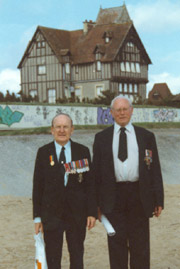
Stanley has travelled back to Normandy often with his
friend and fellow YPAM interviewee Richard keegan. Most
recently attending the momentous 60th Anniversary Celebrations.
 |
 |
| Stanley
and his friend Richard Keegan on Sword Beach at
a memorial ceremony. |
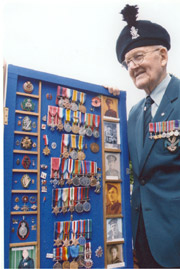
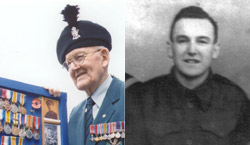
Stanley
exhibiting all the medals gained by his family from
military service. |
|



 print version





















 POST A COMMENT ON THIS ARTICLE