| JB- February '08
Message for Patrick Brolly, try 16th Irish Division
in the Great War website.
Patrick Brolly
- Nov '06
I was wondering if anyone knew of a Hugh Brolly POW
somewhere. He was my grandfather and never spoke much
ot it. He was in the Royal Enniskillin Fusiliers. Where
could I start?
Don Miller - Dec '05
What great history you all have! I'm reading an old
book [1927] on the Red Baron, and it says that he was
born and raised in this town, and also that he would
send all his war trophies back to his mothers house
there. Does anyone know if this house still exists?
Thank you for any info you might have.
Pauline Cowley - November '05
I was interested to read your account of your Grandfather
William McAlpine and his stay in the Schweidnitz POW
camp in Eastern Germany.
My relative, Private Frank Brown of the 1st/7th Battalion
Durham Light Infantry is buried in Gladeon Communal
Cemetery, France on 29th July 1918 after spending time
as a POW. I don't know where but it must have been nearby.
I am just trawling the Net trying to find any information
about POW camps in that area. Anyway, felt better when
I read of the funeral on your site - perhaps the Germans
treated him with the same respect.
Ruve Baker - New Zealand - August
05
My Grandfather (G. Tarn Harker) was also a POW in Schweidnitz.
He was British, flying Nieuports in Squadron 29. Upon
capture (23.6.1917) at Douai he was taken to Karslude
Camp then transferred to Schweidnitz Camp, were he and
23 others successfully escaped via a tunnel.
We have this written by Tarn; 'as officers we were
left much to ourselves except to be present at morning
and evening roll calls. During this other time 1 and
25 other chaps dug a tunnel and eventually made an escape.
The tunnel was made by excavating with metal spoons,
putting soil into mugs - tied with string wth was shuttled
back and forth. Only one man could work on the tunnel
at one time'. Records show the date of escape being
19 March 1918.
They were free for just over 3 weeks and able to get
over border into Austria, but were taken prisoners again
and told they were prisoners of Austria. Tarn also wrote,
'they did manage their escape, but it wasn't for long,
of the 3 of them one was shot dead by the enemy, the
other 2 spend days without food until Tarn eventually
gave himself up, thinking that camp was easier than
this life, and Scott (the 3rd), was never seen of or
heard of again'.
Records show they traveled by foot and goods train,
in the hope of reaching Switzerland via Austria.Tarn
was caught at Konigratz and Lieut Athuis (which may
have been Scott as mentioned above) was picked up at
Deutschbrod.
Again records state ' Tarn and 18 other British officers
were tried by court martial at Holzminden Camp on 27
September 1918 for the escape from Schweidnitz, and
sentenced to 6 months imprisonment.
With great relief I'm sure, Tarn Harker sailed for
England 13 December 1918. If you have any information
about the Schweidnitz tunnel escape I would be very
grateful to receive it.
Gaynor Howard - July '05
My father was also at Schweidnitz. He sang in the prison
chapel choir, sharing a book with another young man
from his home town, who eventually became his brother-in-
law. I too have many photographs, and events leading
up to my father's arrival at the prison camp can be
found on the website of the 17th Welsh, under the title
"One Man's War".
Dorothy Moore - July '05
Looking for information on James Moore from Wigan possibly
was in a lancashire regiment, escaped from Schweidnitz
1918
Alexandre Desbarats - May '05
My grandfather, Edouard Desbarats, was a prisoner at
Schweidnitz from early 1918 until the end of the war.
He was a canadian fighter pilot serving with No.1 squadron
of the Royal Naval Air Service. He was shot down while
doing low-level spotting for artillery during the Third
Battle of Ypres (Passchendael) in september of 1917.
He crashed in no-man's land, was taken prisoner and
sent, intially, to the camp at Holzminden. From there,
he was transferred to Schweidnitz. I have several of
his photographs, including a large group photo of RNAS/RFC
officers at the camp, which I would be happy to post
if there is an interest.
Paul Jerram, USA - March 05
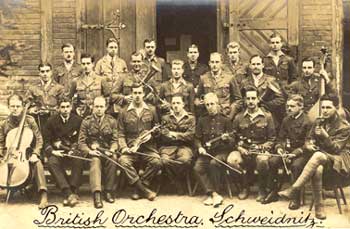
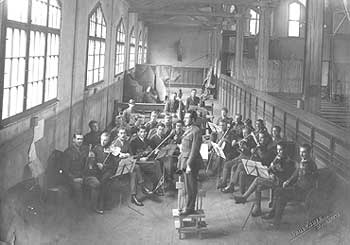
These are indeed both photographs of officers in Schweidnitz
POW camp in 1918. I have the lower ("Orchestra
Practice") card in my collection.
My Grandfather, Lt. Frank Audsley Marsden, M.M., 9th
King's Own Yorkshire Light Infantry, is pictured in
the lower photograph, seated on the second row from
the front, and is the second man from the left.
In the top ("British Orchestra") picture,
I believe he is pictured on the back row, and is the
man on the extreme left.
He was imprisoned from 27 May, 1918 until January 1919,
when he was repatriated.
Thank you for providing some lost information on my
Grandfather!
Kind regards,
Paul Jerram
Roswell, GA, USA
Max Potter - April '05
Schweidnitz - Prisoner of War Book Scheme
We were interested to read your pages about the Schweidnitz
POW camp in WWI. My wife had an uncle, Lt E M Cope,
Staffordshire Regiment, who was imprisoned there in
March 1918. We have just been looking at two books which
were supplied to him there by the British Prisoners
of War Book Scheme. One is marked Schweidnitz II , which
suggests there may have been more than one camp there.
Here are scans of the end page and title pages of one
of the books, which may be of interest.
click here
to view photos
The other book, on astronomy, only has a single stamped
mark 'Geprüft I Schweidnitz'. Unfortunateley Lt
Cope died in Germany in 1919 while serving in the Army
of Occupation. His grave in Cologne has been visited
by various members of the family on a number of occasions.
|



 print version






















 POST A COMMENT ON THIS ARTICLE