BBC HomeExplore the BBC
This page has been archived and is no longer updated. Find out more about page archiving.

16 October 2014
your place and mine
Your Place & Mine Radio Ulster Website

BBC Homepage
BBC Northern Ireland
home
antrim
Armagh
Down
Fermanagh
Londonderry
tyrone
greater Belfast
topics
coast
contact ypam
about ypam
help

print versionprint version


Contact Us

WW2 - Poem for a fallen brother

Recently I came across a poem while going through photographs and letters belonging to my great aunt

Poppies

writeAdd a new article
contribute your article to the site

POST A COMMENT ON THIS ARTICLE
read replies to this article


"THIS WAS MY BROTHER"
        submitted by an Ex-Pat Canadian living in N.I.

Recently I came across a poem while going through photographs and letters belonging to my great aunt Isabel Conklin who has just died.

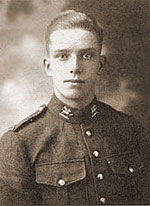
The way the poem had been so carefully preserved showed obviously that it meant a lot to her since it is about a brother dying in war and Isabel had lost her own brother Bob fighting with the Canadian forces during the battle of Arras on the 29th August 1918. Bob had been injured by shrapnel during an artillery attack in April and had only returned to the front on 17th August.

The poem that Isabel Conklin had so carefully preserved was written by a woman called Mona Gould recalling her own brother who was killed in the Dieppe raids of August 1942 during the next World War.

Bob's family marked Mona's poem as "A tribute by a youthful author in memory of her older brother"

This was my brother
At Dieppe,
Quietly a hero
Who gave his life
Like a gift,
Withholding nothing.

His Youth..his love..
His enjoyment of being alive..
His future, like a book
With half the pages still uncut.

This was my brother
At Dieppe.
The one who built me a doll house
When I was seven.
Complete to the last small picture frame.
Nothing forgotten.

He was awfully good at fixing things,
At stepping into the breach when he was needed.

That's what he did at Dieppe;
He was needed.
And even death must have been a little shamed
At his eagerness

Click Here to hear the poem as spoken word.
(read by Bob Crookes)


Bob Conklin's mother received the following coldly phrased telegram on 6th September 1918.


Mrs Laura Conklin
418 Euclid Avenue
Toronto
Ontario

Deeply regret inform you 228305 Pte Robert James Davidson Conklin infantry officially reported died of wounds 1 casualty clearing station August 29th gunshot wound back


Pte Robert James Conklin

What made it all the sadder is that the day they received the telegram would have been Bob's 21st birthday. In an added twist Isabel also died on Bob's birthday but some eighty four years later when she had reached the ripe old age of 96.

After his death his family received three letters from him that he'd posted from the front but which had taken a long time to reach Canada. This is the last one to arrive and was addressed to his sister Evelyn and dated 22 August 1918;


It is a scorching hot day, but I am thankful to say that I am stretched out on the grass 'in the shade of the old apple tree'. There is a faint breeze blowing at times, and it is much enjoyed I assure you. Now my dear 'kid sister, who is Eighteen', I have written you a letter, but there is one thing that is lacking that is essential for a good letter and that is news, and just as you have meatless, heatless and eatless days, we have our newsless days. But some day I'll be able to say what I would like to, I think, if all goes well, and then there won't be any need to close as follows: Well, my news is finished, so I'll ring off. PS I will write Mother in a few days. Love to all. Bob


He never got to write that letter to his mother.

Bob Conklin, together with 632 other Commonwealth soldiers and 46 German soldiers, is buried in the quiet war cemetery at Ligny-St Flochel in France.

Five weeks after his death that terrible war ended on the eleventh hour of the eleventh day of the eleventh month of 1918.

Both of the photographs below were returned to Laura Conklin with the rest of Bob's possessions.

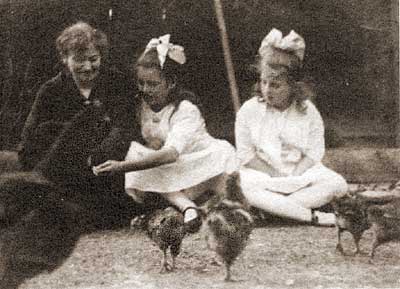
Bob's mother Laura and his two sisters

This photo shows Bob's mother Laura and his two sisters Isabel (centre) and Dorothy, feeding chickens at their summer home on Lake Ontario just to the east of the City of Toronto: June 1918

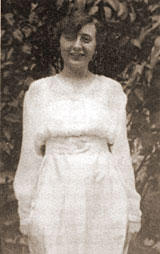
Bob's fiancée Isobel Howes

A picture of Bob's fiancée, Isobel Howes. She had written on the back "How do you like my wedding dress?"

She died, working as a nurse, in the Spanish influenza epidemic which killed 50,000 Canadians. Bob's family always felt however that what really killed her was a broken heart.

About the Dieppe raid:
General Montgomery had chosen the 2nd Canadian Infantry Division for the raid and General Andrew McNaughten, who commanded the First Canadian Army and General Crerar, commander of Ist Canadian Corps eagerly accepted this opportunity for Canadian soldiers to get some combat experience as they had been stationed in Great Britain for two years without having ever engaged the enemy in a major operation. In Canada, public opinion was starting to question this inactivity: the time was ripe and Canadians soldiers were roaring to go and make a name for themselves like their predecessors of WWI did. The Dieppe raid was a terrible failure mainly due to inexperienced officers making gross errors in their assessments of the enemy strength and also to particularly poor communications. After the abortive raid 2,752 Canadians remained on the beach, dead or soon to be made prisoners.


"Isobel Howe's photograph is now back with Bob. I buried it in his grave on March 26 2004...."
Read how Leslie, Bob's great niece from Canada, returned to France to visit his grave. Click here...


read replies to this article
Use the form below to post comments on this article
Your Comments
Your Name (required)
Your Email (optional)


About the BBC | Help | Terms of Use | Privacy & Cookies Policy