|
All right then... what is it? I found
it whilst "Skip Sourcing" many years ago and it has
lain about in the garage ever since. I once strapped
the pipe to my electric fret-saw to blow the dust away.
But this was only moderately successful. Remembering
to pump the bellows with my foot and work the saw at
the same time was too much for my feeble brain. (Which
probably explains why I can't play the bagpipes either).
|
|
|
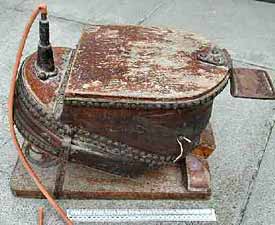 |
My mysterious bellows.
12 inch (30 cm) ruler for scale |
|
Leather It
is a handmade set of leather bellows with a spigot
on the top. From this spigot comes a rubber tube
of about six feet in length. There is nothing
on the end of this tube, which incidentally is
badly perished. The whole apparatus rests on a
thick wooden board. There is a spring to return
the bellows to their "Open" state.
The bellows are in two parts with the upper section
mounted with a foot pedal on the back. Pushing
this down activates not only the top bellows but
appears to make the underneath ones work as well.
Giving the combined blow of both sets. |
|
|
|
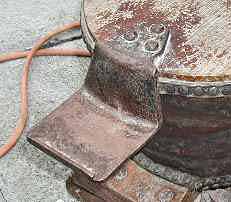 |
Close-up of the "foot pedal"
showing ridge on back edge. |
|
The Foot Pedal
I call the flat section at the back a "foot pedal"
but am only guessing. There is a peculiar ridge
at the back edge of this "pedal" too which I don't
understand. |
|
|
|
 |
|
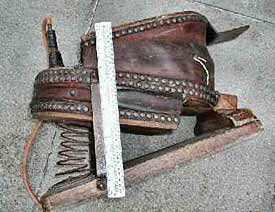
Side view with 12 inch (30 cm) ruler for
scale. |
|
Final Puzzle
Hanging from a nail on the side of the top bellows
is a small length of string. Now of course this
might once have carried the label of the lot number
at an auction or some other prosaic reason. But
why plonk one of the leather upholstery nails
slap in the middle of the bellows? This side view
also shows the twin bellows to better effect.
|
Please let me know your thoughts so I can once
more sleep at nights.
Update
You'll see in the "Discuss this Article" section (at
bottom of page) about this Bellows article that "SEF"
suggests the ridge on the pedal might be for the heel
of the operator.
|
|
|
 |
|
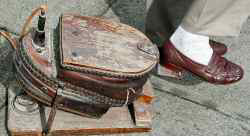
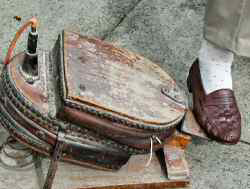
Heel used to work bellows |
|
Hi SEF, So
I tried your idea of using my heel to work the
bellows. Fitting my heel in/on was a bit of a
tight squeeze, though I think it would work for
a smaller heel. |
|
|
|
 |
|
.Foot on bellow's ridge |
|
An alternative thought is if
the ridge might be there to help stop your foot
from slipping off when the pedal is depressed
and at an angle.
Dunno! |
|
YOUR RESPONSES
Alan Clarke - Mar '07
We had a set of these bellows at work Admiralty Experimental
Diving Unit Portsmouth I thought I would let you know
The Fourth Schedule to the General Regulations (Rescue) 1928
required each Central Rescue Station to maintain 4 sets, and
each colliery employing 100 or more persons underground one
set, of tube breathing apparatus. The eighth Schedule to the
regulations required the official calling assistance in case
of emergency to requisition the "smoke helmet" or
other apparatus serving the same purpose.
1.- Helmet Type. This type of apparatus allowed the wearer
to go a limited distance into a dangerous atmosphere by obtaining
fresh air, forced through a tube, from a point beyond poisonous
area.
The Spirelmo type comprised a leather helmet with an apron
which completely enveloped the head of the wearer; the fresh
air being delivered to him, through an air tube of two-ply
canvas insertion rubber with an internally embedded wire armour
and an external canvas fabric covering. The air was pumped
into the helmet by means of a hand or foot operated bellows
worked by another person. The air tube is 3/4"diameter,
usually in 2-60ft. lengths, and fitted with screwed unions.
Ivan Briggs wearing smoke helmet and Asst Superintendent
Radford on bellows.
When in use it was vital for the bellows to be operated continuously,
to supply a continuous flow of fresh air to the wearer, and
to maintain a pressure above that of the atmosphere, in the
helmet.
William Jackson - Nov '06
I remember similar bellows used at St. Peters Cof E Secondary
School on Byrom Street Blackburn around 1951- used to AIR
power NATURAL GAS torches for annealing and Silver brazing
the Copper Pin Bowles that EVERY class member was required
to make. Incidentally I wonder if the size of the foot pedal
indicates that the bellows might be designed from Historically
being that many forges were manually powered by the use of
Child Labour, true of England to some degree and certainly
true of the Asian Continent.
Chris - Aug '06
Hi Brian
You can now sleep easy. zzzzzzzz!
The answer to the puzzle is as follows:- The item is a Foot
Bellows, possibly made by a company called Greenslade.
Foot operated Bellows was used in the Jewellery trade, by
out-workers employed to braze pins onto badges etc. Foot Bellows
had a very robust iron framework which enabled variations
to be made in the frame to hold the fittings of a forge, giving
the user the option of mobility.
It is described as 'double action' or 'double blast' ie: air
is forced out of the pipe when the operator's foot is pushed
down and lifted up.
To operate the bellows I suggest the heel of the foot is placed
on the metal plate with the sole of the foot on the wooden
top board of the bellows. One should then adopt a rocking
motion with the foot, in a similar manner to that used on
a treadle sewing machine or wood turning lathe. There is quite
a knack to this but once mastered it becomes second nature,
as long as you remember to keep the memento going.
The piece of string is not part of the bellows, but don't
remove the nail from which it hangs, as this will allow the
air to escape and make the bellows useless.
The rubber tube is probably a modern replacement of the original
metal tube that was fitted to the nozzle. It was made of metal
to concentrate the flow of air from the bellows and was resistant
to the heat of the fire.
Pleasant dreams.
Chris
Jane - June '06
Skip Sourcing is a delicate form of Bin Diving?
OK so my identical item is also redundant but the fact still
remains that - nobody has answered conclusively the 3 pertinent
questions!
1. What was it used for?
2. What is it called?
3. What is it worth?
There is an oval mark & two pin/screw holes where there
was once a makers plate, maybe if we knew the manufacturer
we could progress? What did he call it? Who did he selll it
to?
By process of elimination -
Not for a forge. Not pretty enough for domstic use. So intended
for use on work that requires less heat but more accuracy.
Jewellry sounds good, but straightforward provision of air
has some merit - firefighting / anasthaesia?
Whatever the purpose - did VONO beds sponsor this? Why?
Because I'm sure the spring was last seen on a Vono bed base!
John Winder - May '06
I too have a set of these bellows, they were from a lot of
items from an old forge. Only on my set the bellows set underneath
is operated by a separate rod to give a pump both on the up
and down stroke. I have seen them in use on the UK Tv program
"Time Team" on a portable forge.
Orlando Clarke - Januray '06
I agree with mark and roy masters. I have seen about 80 sets
of these bellows used in the jewelry workshops at saint martins
college of art and design.
Helen Porter - Sept '05
So glad to see this query! I have a working set of these bellows,
almost exactly the same but in beautiful condition which I
am looking to sell, but I have no idea what to call them,
so was finding it hard to describe them. I now know what they
do, but can anybody please tell me what they are called. Many
thanks
Bob Prout - August '05
I think you may find that these are bellows that were used
for breathing apparatus for fire fighting at sea mainly in
Mercahnt \ navy ships, I may be wrong but I have seen similar
ones in use at the fire fighting schools around UK.
Mark - June '05
I have used similar bellows in various workshops that had
yet to install an electric blower. They supplied the air blast
for the gas torches used to the soldering and annealing of
larger work. They once quite common in most silversmith and
tinsmith workshops and I have a small delicate one as used
by jewellers and laboratories, but I have yet to see one used
with a blacksmith forge. Bernard Cuzner has one in a drawing
in his book "a silversmith's manuel", page 13. They
are not so easy to find still working due to deterioration
of the leather and people sticking nails where they shouldn't.
Roy Masters - December '04
Hi Brian, I disagree with Paul Baker, I am a traditional Master
Blacksmith and I am certain your bellows would not have enough
output for even the smallest of forges.
But I do think they may have been used in a laboratory for
a small but powerful flame, say for moulding glass tubes and
making equipment.
Paul Baker - December '04
These are typical Blacksmith's bellows. Originally used in
a forge to get the temperature of the forge hot enough.
|



 print version






















 POST A COMMENT ON THIS ARTICLE