Page 2
Sam Hamilton is a
local man in Maghera. Both Sam & George Shiels
share a very keen interest in this church and graveyard.
They
both reminisce
here over a special service which was conducted here
back in the 1960s by the late Canon Swain.
It was an anniversary service, and was supported
by all
of
the local churches.
They remember that hundreds attended and the congregation
spilled outside the church grounds. George remembers
being on the outside of the wall looking over at
the proceedings. A substantially larger congregation
than country churches enjoy today. One of the last people to be buried in St. Lurach’s
graveyard was a relative of George Shiels. He takes
us to the grave of James Shiels and Margaret (Gretta)
Shiels. George says he has no recollection
of any burial taking place after Gretta’s in
1977. William Roulston remarks that this modern headstone
is quite unusual in this environment as most of the
headstone here are two or three hundred years old.
| |
|
|
Stone with symbolic
carvings
|
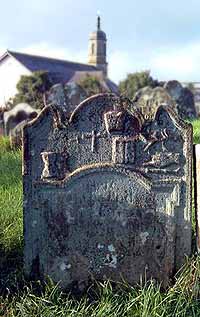
Here, as with numerous other graveyards around
Northern Ireland, you will occassionally find
artistic or symbolic carvings on some of the
headstones.
The appearance of these motifs are indicative
of the trend of stonemasons at various periods.
One
particular
stone in
this graveyard, that of Henry Diamond (died
1767), clearly depicts an Hour-Glass (representing
the flight of time), a Cross, a Crown, an open
book (most likely the Bible), a horn or trumpet
of some kind and a pointing finger.
Although some of the carvings are known
mortality symbols, and can be seen elsewhere,
the choice of the musical instrument and the
crown remains unexplained.
William Roulston feels that these artistic
and individualistic symbols actually tell us
quite a lot about how highly Henry Diamond
was regarded by his family. He poses the thought
that in 1767, this may well have been the most
ornate headstone
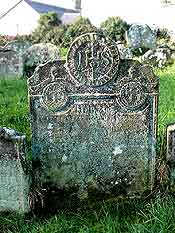
in this graveyard. Another gravestone nearby
has a carving depicting two cherubs.
|
| |
There are numerous headstones in this graveyard
which bear only the inscription “Here
lieth the body” with no name below.
Why this should be is something of a mystery.
One of the theories that attempts to explain
this is that families or individuals may have
bought their burial plot and headstone
during their lifetime and then, when they were
dead, no-one took it upon themselves to have
the stonemason fill in their names. Another
suggested possibility is that the famillies
couldn't afford to bring the mason back to
carve the
names
and
these
were eventually overlooked over time as the
family died out.
Whatever the explanation, no-one will ever
know who the families are who lie beneath these
anonymous stones. No records exist. Their identity
must remain a mystery.
|
Watty Graham was a local farmer
who got himself involved in the 1798 rebellion. He
was hanged from
the tree which used to stand at the rectory gates.
(The tree was destroyed by a storm in 1945). After
he was executed, a servant was made to walk through
the streets of Maghera with Watty’s head on
the end of a pike. Watty Graham was buried in Culnady
and then later, when the disturbances in the country
calmed down again, he was brought back here and re-buried
in St.Lurach’s
graveyard.
More curious perhaps is the story of William
Cuddy, who
was also hanged from the same tree. Legend has
it that
he was aided and cut down from the tree very
quickly after the hanging and was actually revived
back to life. Subsequently he is said to have emigrated
to America.
That said,
there
is
a headstone here in the graveyard with his name on
it. Confusing? Well perhaps it’s supposed
to be… William
Roulston says that he has recently heard a story
that claims there was a mock funeral held purely
to confuse the
authorities
into
thinking that William Cuddy had in fact died at the
hanging.
|



 print version





















 POST
A COMMENT ON THIS ARTICLE
POST
A COMMENT ON THIS ARTICLE