Article & picture
submitted by Joe Simpson - Vancouver
- Nov '05
Excerpt from pp. 328-331 of:
The West of Ireland: It’s
Existing Conditions and Prospects
by Henry Coulter, Correspondent of Saunder’s News-Letter
(Dublin, London & Edinburgh; 1862)
Having reached the point of my destination in Donegal,
I returned by the county Fermanagh to Enniskillen, on
my way to Leitrim. I heard here that very extensive
improvements were in progress at Tempo, the estate of
our distinguished countryman, Sir James Emerson Tennent,
and although this district is not within the line marked
in my instructions, I considered it desirable to visit
the place. Arriving at Tempo, I was highly gratified
at the scene of activity which I witnessed there, and
at the through manner in which Sir James has set about
the improvement and beautifying of his property.
There is much interest attaching to the beautiful demesne
at Tempo, from the fact that the old mansion which stood
upon it was the scene of that remarkable Irish story,
Castle Rackrent, by Miss Edgeworth. It was the castle
of the Maguires, an ancient race, ennobled by James
the Second, from whom the estates passed into the family
of the present proprietor. The house, which Sir James
has just removed, contained the apartments in which
Miss Edgeworth placed the long imprisonment of Lady
Cathcart by her husband, Colonel Maguire (who was the
Sir Kit of the tale), and the window out of which the
forlorn lady, to preserve her diamonds from her husband,
threw them down to a beggarwoman, who faithfully conveyed
them to the person to whom Lady Cathcart wished them
confided, and from whom, many years after, she recovered
them in safety on her escape from confinement.
On the site of this old house Sir J. E. Tennent is
now building a mansion in the Byzantine Gothic style
of architecture, after a design by Messrs. Lanyon, Lynn,
and Lanyon, of Belfast. The building is of hammered
sandstone with dressings of cut stone; and, having seen
the plans and drawings, I can state that when completed
it will be one of the handsomest houses in the country.
It will contain about thirty apartments. The west side
will be 72 feet in length, the south about 50 feet,
and the apex of the gables 42 feet in height. The ornamentation
will be very tasteful, but not of an elaborate character.
The demesne of Tempo is of unusual beauty, being richly
planted with extremely fine old trees: and, besides
a river which flows through its entire extent, the hills
enclose three small lakes wooded down to the water’s
edge. When Sir James came into possession of the demesne,
it was in a wild and neglected state. The fine old timber
had been allowed to suffer considerably from decay,
the ground was overgrown with weeds, and sadly in want
of drainage, and the lakes were choked with sedges and
foul with decaying vegetable matter.
The place in short had been left for thirty or forty
years in a state of nature, and was little better than
a wilderness. To improve a place which had been so long
neglected, was a work of great labour and expense; but
Sir James has undertaken the task with an energy and
spirit which I should like to see evinced by other landed
proprietors, whose estates stand in need of improvement.
Since the month of October last, arterial and through
drainage works have been carried on at Tempo on a most
extensive scale; and other works, such as the leveling
of old and the making of new fences, have also been
proceeded with.
One hundred men have been kept continually engaged
in these several operations, in consequence of which
there is not a man for six miles round who is not fully
employed. The sum paid in wages varies from £40
to £50 a week, and the carrying out of all the
contemplated improvements will involve the expenditure
of several thousand pounds. A good-sized river runs
through the demesne, and as it often unable to discharge
its swollen waters through its neglected channel, they
overflowed and injured the adjoining meadows. This evil
has been remedied by the cutting of a straight, deep
channel, which will effectively prevent overflowing
in the future. When the works now laid out in the demesne
shall have been completed, there will be fully two miles
of arterial drains, five miles of thorough drains, two
miles of new fences, and the extent of old fences leveled
will not be much under four miles. The arterial drains
are from four to six feet deep, and some of the main
drains have been cut to a depth of 25 and 30 feet. One
lake covering six or eight acres of land has been completely
drained, and the others have been thoroughly cleansed.
The fences consist of a sunk fence five feet deep with
a good sound bank planted with thorn quicks. As soon
as the works in the demesne have been finished, thorough
drainage of the estate generally will be commenced.
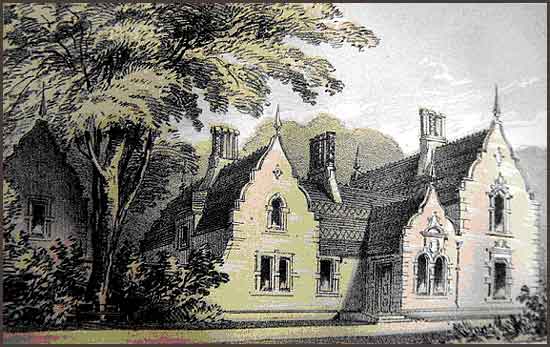 |
| Artist’s impression
(1862) for the book, of the future Tempo Manor (front
aspect) after completion of construction by Sir
James Emerson Tennent, which took place in 1863-4.
Note that the present-day tower and east wing (originally
a large billiard room, now the family kitchen) do
not appear at left of this drawing; these were added
only in 1867. |
Sir James E. Tennent has a very comfortable and respectable
class of tenants. The land is very good and the rents
moderate. I was assured there has not been a shilling
of arrears in the rentals for a considerable time back:
the present proprietor, since he succeeded to the estate,
has never had occasion to dispossess any farmer of his
holding. Last year they have had, generally speaking,
a fair oat crop; but the potatoes failed here as in
many other parts of Ireland. Most of them are very well
off, having saved money in former years. Fuel was very
scarce in this neighbourhood, but Sir James gave a large
quantity of timber gratuitously to the poor in the village
of Tempo and the surrounding localities. By the assistance
which he thus afforded, and the large amount of constant
employment that he has been giving for several months
past, he has proved himself a great public benefactor.
The estate is managed by a gentleman of high character
and great experience as an agent, Mr. Matthew H. Sankey,
of Brookeborough, who is also agent over the vast estate
of the late Sir A. Brooke in this county. The improvements
at Tempo are carried out under the superintendence of
Mr. Sankey, assisted by an intelligent steward and agriculturist,
Mr. Cowan, who is also charged with the duty of giving
instruction to the farmers as to the best and most suitable
methods of cultivating their holdings.
Article & Pictures
supplied by Joe Simpson
Joe Simpson sent us another article on the history
of Tempo Manor, which includes some photographs he took
in 2004. Click
here to read it:
|



 print version





















 POST
A COMMENT ON THIS ARTICLE
POST
A COMMENT ON THIS ARTICLE