‘ If I
survive I will have five’
Marion Maxwell recounts the story of the rather
irregular marriage of Fermanagh-born Colonel Hugh Maguire
of Tempo Manor and Lady Elizabeth Cathcart of Tewin
Hall in Hertfordshire.
|
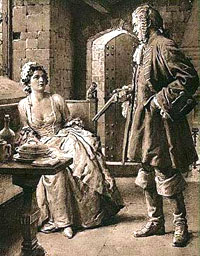
Lady Cathcart held prisoner
by her husband.
Picture courtesy of Tempo Manor |
The story appears in fictional form in the
18th century satirical Irish novel Castlerackrent, but
its author Maria Edgeworth based it on a set of real
events that unfolded partly in Fermanagh and partly
in Co. Longford :
Castle Rackrent looked out on Allyballycarrickoshaughlin.
Well, yes - it was really a bog, but Sir Kit had put
a lot of improving thought into landscaping it with
trees. So he was not impressed when his new English
bride derided the vista as a black swamp.
Further tensions arose when, in defiance of his
wife’s Jewish sensibilities, Sir Kit insisted
on having pork sausages for breakfast.
Lurking in the background, need you guess, was
some unresolved business: Sir Kit’s new Lady had
declined to contribute her fortune in jewels to the
needy family kitty. The result? He locked her up for
seven years.
The story line comes from Irish writer Maria Edgeworth’s
satirical novel Castle Rackrent, but her inspiration
was a set of real events involving the incumbent of
Castle Nugent, not far from the Edgeworths’ home
in Co. Longford.
Colonel Hugh Maguire was the real life Sir Kit and
villain of the peace. He had inherited Castle Nugent
from his mother, but it was probably in one or other
of the Maguire ancestral properties in Fermanagh that
the hapless bride’s imprisonment began.
At Hugh’s birthplace, Tempo
Manor, the original building has since been replaced,
but visitors there in the late 19th century with a taste
for the gothic were shown the room - by then a stable
block- where Elizabeth had been shut away in isolation.
Furthermore - fact being stranger than fiction- she
had been locked away not, as in the novel, for seven
years, but for upwards of twenty.
The marriage of Lady Elizabeth Cathcart of Tewin Hall,
Hertfordshire and Colonel Hugh Maguire took place in
1745. Daughter of a humble brewer by birth, Elizabeth
was already thrice widowed, later reflecting that of
her three childless marriages, number one had been to
please her parents, number two had been for fortune,
number three for rank.
That left love, and so it was as a menopausal ma’am
of 53 that she finally admitted to tying the knot with
stars in her eyes.
Her 35 year old Irish beau, lately returned to England
from a term as a soldier of fortune in Austria, was
joint heir to the heavily mortgaged Maguire estates
in Fermanagh, but what this dashing emigre lacked in
collateral, he made up for in roguish charm; he had
already sweet-talked the merry widow into buying him
a commission in the British army.
At their marriage ceremony, Lady Cathcart wore a specially
commissioned ring bearing the legend, “If I survive
I will have five”. Lady Elizabeth endowed her
new husband with half the income from her properties.
But when he discovered that she was far more wealthy
than he had been told, Hugh demanded her jewels and
the deeds to her properties at pistol point. She refused,
so he smuggled her away to Ireland and locked her up.
There, like his fictional counterpart Sir Kit, Colonel
Hugh entertained the neighbouring gentry with lavish
parties and balls. Far from seeking to hide his prisoner’s
presence upstairs, he would ask the assembled company
to drink her ladyship’s health and a servant,
dispatched to deliver his compliments, would duly return
conveying her ladyship’s thanks.
Lady Cathcart’s obituary, published later in
the Gentleman’s Magazine, gives the true picture
of her ordeal. Apart from her jewels which she had hidden
in her wig and her petticoats, her possessions consisted
of a prayer book and one old newspaper. Locked in a
sparsely furnished attic with one tiny window, she struggled
to retain her sanity by recording remembered conversations,
pricking them on the wallpaper with a pin. After yet
another menacing visit from Hugh, Elizabeth climbed
onto the bed and managed to bundle her jewels out the
window to a woman passer-by for safekeeping. Eventually,
he wore her down and established that the deeds to her
properties were hidden behind a panel in Tewin Hall.
Setting off post haste for Hertfordshire, he located
the hiding place of the coveted documents. Impatiently
taking a jack-knife to the rusty lock, he cut his hand.
Blood poisoning set in, he got lock jaw and within weeks
he was dead.
Eyewitnesses recorded that, at her release, the poor
prisoner: had scarcely clothes sufficient to cover her;
she wore a red wig, looked scared and her understanding
seemed stupified... Now 75, Elizabeth returned to Hertfordshire.
She never did take husband number five, but by all accounts
she recovered her spirits and was still enjoying dancing
well into her Eighties. She died in 1789, in her 98th
year, and was buried at her own wish with husband number
one. Almost a quarter of a century had passed since
husband number four had found his eternal rest back
in Fermanagh, in the Maguire burying ground on Devenish
Island.
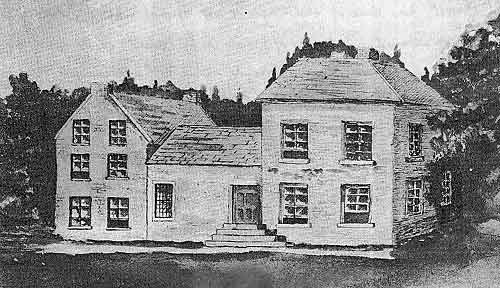
Above: The old Maguire house at Tempo, Co. Fermanagh,
1853,
demolished in about 1863 and replaced by present structure.
|



 print version





















 POST
A COMMENT ON THIS ARTICLE
POST
A COMMENT ON THIS ARTICLE