| Tidal Treasures
- Article submitted by Stan Howes -
Nov '05
It was half-eight on a Sunday morning in September,
dawn light lingering over Greyabbey Bay. Sitting in
the car I watched birds flicker across the sand flats
and the watery channels left by the tide.
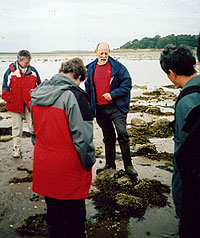 |
Tom McErlean (centre)
explains stone fish trap design |
A bearded middle-aged man in a blue anorak got out
of his car and approached. ‘Are you going on the
archaeology walk this morning?’ he said genially.
‘I’m Tom McErlean.’ We shook hands.
Tom, from the Centre for Marine Archaeology at the University
of Ulster, is one of the contributors to Strangford
Lough, a hefty hardback tome published by Blackstaff
Press on the five-year long archaeological survey of
the foreshore of the lough, which began in 1995. He
instantly came across as friendly and enthusiastic,
terrifically knowledgeable and bursting to talk about
his favourite subject.
During the survey over 680 sites were discovered shedding
a new and surprising light on the lough’s history,
from the tidal mills at Nendrum Monastery to the Neolithic
logboat stumbled on in Greyabbey Bay. It was the logboat
and other foreshore features that had me up at such
a painfully early hour.
When fifteen minutes had elapsed, about a dozen people
had shown up for the walk, which had been organised
by the National Trust. Tom seemed happy. He thought
smaller groups were better for everyone could hear what
he was saying and he didn’t have to repeat himself.
He began by giving an impromptu lecture on the history
of Strangford Lough: the fact the lough was once dry
land, the rising sea level following the Ice Age, drumlin
islands, hunter gatherer communities giving way to agricultural
ones, the shell middens, the exploitation of the foreshore
particularly under monastic control, the fish traps
and later the seaweed harvesting, the kelp trade and
its decline. In the space of ten minutes he had brought
us from prehistory to the twentieth century. My mind
was whirling with facts!
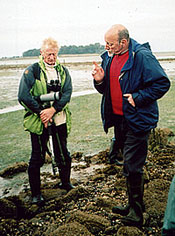 |
| David Thompson of the National Trust looks on
as Tom McErlean reveals the secrets of the foreshore |
As the day brightened and sunlight filled the sky we
set off in walking boots or wellingtons across the sand
flats spread with heaps of shells and rocky pladdies.
The foreshore, while still very wet and the sand and
mud soft in places, was starting to give up its archaeological
treasures. The most obvious were the stone fish traps:
a long line of boulders usually in a V or crescent shape
built similarly to drystone walls. Some are 200 metres
in length and one as long as 350 metres. When in use
the traps would have been 1-1.5 metres high. The object
was to catch fish on the ebb tide. In short, the fish
would be stranded in the shallow pool behind the wall
of the trap allowing them to be easily caught. The catch
would have been mainly herring, mullet and mackerel.
The location of the traps also suggests an accurate
knowledge by the builders of the movement of fish within
the lough. The stone traps date from the thirteenth
century when the Cistercians established a monastery
at Greyabbey and put the fishery in the bay on a more
commercial footing. Dried salted fish was always in
demand to feed English armies. (One recently restored
stone fish trap produced a catch of mullet). The wooden
traps date from the seventh century A.D. to the coming
of the Cistercians and function essentially in the same
way although they would have needed more maintenance.
The pointy pole ends are visible at low tide. Although
we were not to see them on our walk, shell middens were
another feature that turned up during the survey scattered
around the edges of the lough.
For thousands of years shellfish have been an important
food source: cockle, limpet, mussel, periwinkle, whelk
and native oyster. 27 middens were found and recorded,
some dating back to the Mesolithic period: 7000 to 4000BC.
The native oyster has seriously declined and there is
a project afoot to reintroduce it. Tom pointed out stumps
of old trees protruding above the sand. These blackened
remains have been dated to 6,700 BC. It was in this
area that we had hoped to see one of those rare finds:
a 5,000-year-old logboat. However, it was not to be;
tide and sand had re-buried it. To remove wood of this
antiquity results in almost immediate decay. Logboats
discovered in the past have been preserved, but at considerable
expense. Leaving it in situ was not only a cheaper solution,
but for those who would be lucky enough to see it there,
it would provide a more vivid historical and geographical
context than in a museum.
Close to one of the islands, our attention was drawn
to a kelp grid: a regular arrangement of rows of stones
on which seaweed is grown and harvested. Seaweed needs
a rocky base to attach its roots; it will not grow on
sandy shores. In the eighteenth century there was a
thriving kelp industry. When burned, kelp or seaweed
produces a soda ash (soda carbonate) which was used
in the manufacture of glass and soap and in the bleaching
of linen. Unfortunately for local workers, in the 1820s
the prices for kelp plummeted, when an alternative supply
was found in salt and barilla. The remains of a kelp
house and kilns can be seen on nearby Chapel Island.
In the nineteenth century seaweed was discovered to
contain iodine, but this was never produced in significant
quantities.
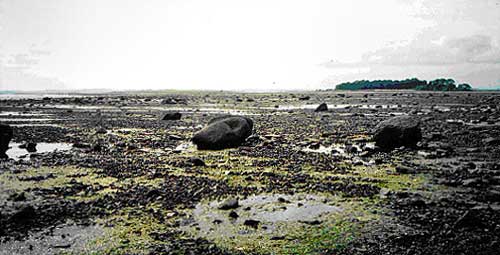
|
Strangford Lough - full of
Tidal Treasures |
It was nearing midday when we had seen all that there
was to be seen on the foreshore. Throughout the walk
Tom had invited questions and was never stumped for
an answer. In fact, he seemed to thrill at the challenge.
What was striking was his wide-ranging knowledge that
was clearly born out of an insatiable curiosity and
imaginative excitement about the past and those who
had gone before and who had left their enduring mark,
in the form of these archaeological monuments, on the
landscape.
Looking across the foreshore I was surprised to see
how far we had travelled both in distance and in historical
perspective. Further south towards the narrows, I could
see the water glistening under the warm sun and thought
this beautiful scene would have changed little since
one of the Cistercian monks, working a fish trap, might
have straightened a tired back and gazed around in wordless
wonder.
YOUR
RESPONSES
William A Moore - Dec
'07
I was born in N.Ireland but spent most of my life
in England, mainly in East Anglia. Now I'm trying
to catch up with the hitory of the land of my birth.
I have seen these stones in uniform layout, wondering
how long they have been there. I have asked many people
mainly locals (if you can find them) as there are a
lot of "Blow
Ins "! Unfortunately I got no help from anyone,
I think they thought I was away in the head wanting
to know about oul stones.
Alas help arrived to-day 23/12/2007, by way of a beautiful
book. Called Strangford, Portrait of an Irish Lough.
By Alain Le Garsmeur and Ian Hill.
Then I read this article, this is an answer to all
my questions. I'm really glad that I'm not the only
person around that is mad about stones. This a very
good article, I live in Portavogie, I see something
new every day when I look at the lough. I look in wonder
that all the water covering the lough passes through
that tiney gap that seperates Strangford from Portaferry.
Stephen Ashe - Aug'06
Just back from Kircubbin collecting cockles and mussles
beautiful place getting harder to find them.It seemed
easier to get them when I was a kid.
Lynda Croft - April '06
Wonderful stuff, you bring it to life with your words.
|



 print version





















 POST
A COMMENT ON THIS ARTICLE
POST
A COMMENT ON THIS ARTICLE