| Return
to Chapel Island - Article submitted
by Stan Howes - Nov '05
‘Did you bring your waterproofs Joe?’
I asked my friend as we arrived at Mount Stewart on
the shore of Strangford Lough. It was midday, overcast
with a flick of rain in the air. Typical July.
‘Yes,’ he said.
A wise move I reflected, recalling the walk
to Chapel Island at low tide the year before. It is
just one of a number of guided walks run by the National
Trust to cater to all tastes ranging from history to
bugs and butterflies.
On the previous occasion, we were a party of forty
who merrily set off in blazing sunshine only to meet
rain on the two-mile trudge to the island. However,
this was no light summer shower to cool the heated brow,
but something akin to a tropical monsoon! We staggered
through sometimes treacherous sands and ankle-deep pools.
(Forget the walking boots, I should have brought wellingtons!)
Coming ashore we looked like drowned rats. Strangely,
I had enjoyed that visit to the island despite the drenching
and the cold and was keen to return.
This time round we were a compact group of ten. Had
word spread about last year’s trip? Leading us
again was the National Trust’s David Thompson
the warden, or officially speaking, the property manager.
David, lean, white-haired and middle-aged, hails from
Northumbria and was formerly the head warden of the
Lake District National Park. As you might expect he
is immensely knowledgeable on wildlife matters and is
a passionate conservationist. He sardonically admitted
that last year’s walk had been a bit of an ‘adventure’.
|
Strangford Lough - full of
Tidal Treasures |
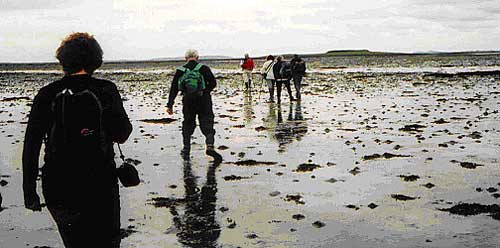
Crossing the sands to Chapel Island...
It’s a curious pleasure to walk out over the
sand flats at low tide into that great open space, going
where few people venture and seeing your surroundings
from a fresh perspective, our figures dwarfed against
the huge expanse of lough and sky. David had told us
we had a good ‘window’ to get to the island
and back before the tide returned so we wouldn’t
have to make a run for it! He also explained that to
get there safely you must follow a course parallel to
the island and then veer to the shore; otherwise, you
might find yourself sinking into one of the treacherous
muddy patches under the sand. He dramatically demonstrated
the danger at one point by plunging his crook-like walking
stick into the sand up to the handle. We gingerly tiptoed
around the area. A useful tip should you ever find yourself
knee-deep and seemingly immovable in Strangford mud:
fall down backwards and move your arms in a backstroke
fashion. In such a pickle there is no shame in leaving
your boots behind.
 |
|
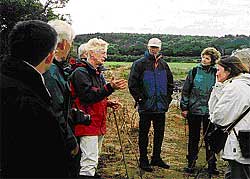
Thompson (third left) of the
National Trust
talks about ecology |
The lough being a Marine Nature Reserve, as well as
other designations, is a highly protected area for it
is rich in marine and wild life. One of the most striking
features of the foreshore is the volume of shellfish
often lying in little clusters, which makes the lough
along with the plentiful eelgrass such a Mecca for a
diversity of bird life including Terns, Brent Geese
and Oystercatchers.
There are 120 islands in all (if you include pladdies
– a local term for eroded drumlins - low rocky
reefs only visible at low tide). They provide habitat
for wild animals: otters, badgers and foxes. The lough
is also an important site in Ireland for the common
seal.
David highlighted the role of the National Trust in
managing and protecting its properties. Above all he
expressed his fears for the ecology of the lough focusing
on the commercial over-exploitation of the shellfish
stocks in spite of agreements on quotas. It was clearly
a subject he felt strongly about.
Getting to the island this time without being rained
upon produced a little glow of satisfaction and relief
and gave me a chance to take in the views across the
island-dotted lough to the mistily distant Mourne Mountains.
In such an atmosphere you could readily imagine sleek
Viking long boats cutting through the peaceful waters
a thousand years before, their crews sharp-eyed for
monastic plunder.
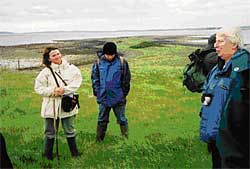
Chapel Island, a National Trust property, is one of
the bigger islands, uninhabited except for the sheep
that are grazed there at certain times of the year.
Where we came ashore at the northern tip a bank rises
like a spine that curves up to a small plateau at the
southern end. It was in the lee of the bank beside the
ruined kelp house overlooking the kelp grid on the shore
that we sank onto the grass and had a picnic. A time
for contented guzzling and contemplation amid the scenic
beauty.
|
Looking south from the chapel
site |
After our lunch and the briefest of light showers (!)
we followed the sheep tracks up the long back of the
island to where I hoped to see the remains of the old
chapel, something I hadn’t seen on my first visit.
The chapel hitherto is undated for it has not been archaeologically
dug though it probably goes back to the pre-Norman period
when hermitages were used by some of the Irish monasteries.
The chapel may have belonged to the Movilla Abbey being
on the southern boundary of its estate.
There are two similar sites on Dunsy Island and near
Audleystown. They were places where monks would go for
meditation and seclusion. Self-sufficiency was possible
at Chapel Island since there were fish traps close by
in addition to the ubiquitous supply of shellfish. The
island also has a fresh water source.
If you go to visit the chapel don’t get all excited
at the prospect of seeing moodily soaring Gothic remains
for you will be disappointed. What remains exist –
presumably a tumble of stones – are covered by
a dense mound of briars and long grass and encircled
by an almost undetectable enclosure. What is impressive,
however, is the location. It is perched on the highest
part of the island with commanding views in all directions.
On a fine summer day it must have seemed to the solitary
inhabitants like a little bit of heaven on earth. Even
on the cloudy day we visited you could savour the peace
and serenity of island life. The only sounds were the
cries of birds in the blustery wind. The modern world
seemed a long way off.
In the late afternoon before the tide returned we splashed
out over the sand flats again, tired and quietly exhilarated,
and rounded off our day with tea, buns and bonhomie
in the welcoming lights of Mount Stewart.
Maybe next year...
Stan Howes
|



 print version





















 POST
A COMMENT ON THIS ARTICLE
POST
A COMMENT ON THIS ARTICLE