|
Page 5
One of the most difficult aspects of life in Ballykinlar
was the awful uncertainty, the wondering when the men would eventually be
released. Peter refers to this in a letter in May, in which he tells Frances
he expects 'to be home in perhaps a
fortnight, but certainly in a month'. In most
of his letters he now refers to his expectations of getting home soon.
By
23 May he writes: '...
things here are not a bed of roses as we are not getting on well here at
all... We got a
lot of knocking about here on Saturday night last and some of our men were
arrested and put in the guardroom. I have no idea when things will settle
down but I hope soon'. In June he describes
Ballykinlar to Frances: 'This place
is nothing to boast about as we can see nothing but barbed wire here and
plenty of that. We never see anyone from outside.'
He mentions things like attending Irish and dancing classes, and tells Frances
about the 'hundreds of bags' (macramé)
being made in all colours by the internees. On 11 July he mixes high political
hopes with more mundane day-to-day issues:
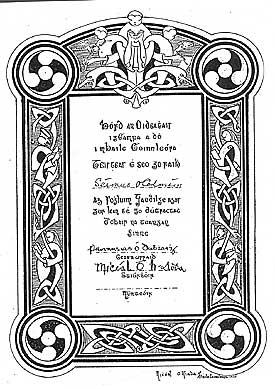 |
Irish certificate
awarded to James Coleman Ballykinlar Internment Camp
(Courtesy of Kilmainham Gaol Archives)
|
I hope everything will go on
well with Dev and that we will have peace with honour if not I do not
care to leave here...I want my country to come out of this conference
with that honour which she has never lost...And all in Ireland love
and trust Eamon as we know him well by now...I get up about 8 and go
to Mass. Then I have not to soil my hand for the whole day nothing
to do only make the bags or lie in the sun.
He continues on 21 July: '...you
forget that I am inside a barbed wire cage here and never see
the outside world and it is a hell of a place I would sooner
be in jail than this
place.'
A few days later, still with that
ever present hope of early release he writes: 'I
will wear my own grey trousers going home as I don't want
any of their stuff on my back when I leave here.' His
hopes of getting out soon are still alive on 1 August: 'I
expect things to go very quick now as we have seven DAIL
members in this camp.' He
continues on a more despairing note: 'I
have not had a decent feed since the 23rd of November last
as we
never get enough. But after
going
through last winter we can stand anything.'
Three
days later he seems still gripped by this despair: '...we
have no comfort of any description. I hope things will
be settled soon as this place is setting some poor men
wrong in the head in fact the
best of us are a little gone already...if we are here
for next winter it will be the death of some of us this
is
the worst Hell ever was
made.'
Towards the end of August he is in a more political frame
of mind as he writes to Frances: '...the
Country was never in better hands and our leaders are
the best men on earth we
trust them and whatever they do we will all follow them
as it would be better to die in the attempt to free our Dear
Land than live a day longer as slaves',
and, comparing himself with other figures from Irish
history: '...but
still if our poor Country wins her freedom what matter as a
year or two is nothing when we think of poor Tom Clarke who
done 20 years and Michael Davitt & O'Donovan Rossa and
all they suffered we are suffering nothing compared to them'.
But the months passed slowly by and
on 3 October he briefly says: 'A
fellow would be better in his grave than living in this hole',
but he qualifies that somewhat by recognising on 17 October: 'I
suppose you read in the papers about our treatment and that
we are without bed boards we are lying on the floor for the
past three weeks and so far as the blankets go we might as
well have fishing nets over us as they are threadbare its
our good humour that keeps us alive...'
Also in October he writes of the shooting of fellow internee
Tadg Barry: 'I
am very sorry to tell you that another of our poor comrades
was shot
here on Tuesday Tadg Barry',
and '... if the
enemy would only keep outside the cage and not be rushing
in in the
middle of the night and shouting that they will shoot us'.
By the end of November he is again referring to the eventual
release: 'but under
no circumstances will I apply for parole as when I leave
here
I will leave as a free man.' At
the beginning of December he simply states: '...we
are in on the second year now.'
And so Peter Byrne, together with
the autograph books and their humour and sketches, the camp
journals and the surviving photographs,
give us strong glimpses of life in Ballykinlar Camp, enabling
us to find a way around the respectful silence of so many
of the internees, including our own Hugh Deery. Peter reminds
Frances, and through her, all of us, of the precarious
existence
he led in the Camp, in two letters from September 1921: 'I
cannot tell you my troubles in this place enough to say I
have plenty of it...I find it fits in better to try smiling
as we have got tired praying for our enemy...' and 'I
am sorry my letter of Thursday last went astray. You see
we have to leave our letters open and the censor must have
put the letters in the wrong envelopes'.
The men would frequently impose their own limits on worried
letters home, and the censor worked thoroughly. Nevertheless,
we still succeed in penetrating somewhat the life in Ballykinlar
Camp, at the start of the 1920s.
This article appears by kind courtesy of both
the Down
County Museum
and the Kilmainham Gaol Museum
It is also featured in its 2005 year book.
____________________________________
Niamh
O'Sullivan graduated from University College Dublin and the
King's Inns, and started work in the Kilmainham
Jail Restoration Society in
1982. After the gaol was handed back to the State in 1986,
she stayed on, and in 1992 commenced work as Kilmainham Gaol
Archivist, where she has continued to work to the present.
Notes:
As a result of the events of 21 November 1920, when Michael
Collins' men assassinated fourteen British intelligence agents
in Dublin, the British authorities set up Ballykinlar Internment
Camp in County Down, applying strong new internment powers.
From surviving Ballykinlar documents in the Kilmainham Gaol
Archives, we can establish that Ballykinlar itself consisted
of two camps- Camp Number One and Camp Number Two. The
Roll of Men in Camp Two in
the Kilmainham archives lists the 38 huts which made up that
camp; other documents suggest Camp One had at least 37 huts.
We know from a letter written by prisoner Peter (O') Byrne
to his wife from Ballykinlar that each hut housed 25 men. These
figures suggest that Ballykinlar Internment Camp had a capacity
to hold up to at least 1875 prisoners. Peter (O') Byrne's final
letter to his wife is dated December 1921- his stay in the
camp therefore coincided roughly with its own life span- from
late 1920 until December 1921, a short time after the signing
of the Treaty on 6 December. In subsequent years, Ballykinlar
was used by both the UDR and the Royal Irish Regiment.
YOUR RESPONSES:
Tim Kiernan - Aug '08
My great uncle, Larry Kiernan, or Lorcan Mac Thighearnain
in Irish, was interned at Ballykinlar. If any one has
any information, autographs, or lists that mention that
name Ii would be very happy to hear from you. Any scanned
photos may also be helpful as he may be recognised.
I really wish moreof use would include email address
so that we could communicate directly. Some of you have
very interesting collections. Tim Kiernan, email: shaunakaatgmaildotcom
Marianne McPhillips -
Mar '08
My grandfather, Jim McPhillips, of Butlersbridge, Co Cavan, was arrested on 7
December 1920 and taken to Ballykinlar Camp, where he remained for around a
year. He did not live long after that and died at the age of 29. I would be
fascinated to know if there was any information about him that anyone had uncovered
in the intervening years.
Tommy Mooney - February '08
My father Thomas Mooney and his cousin Charles Mansfield
were arrested at Crobally, Co.Waterford on New Year's
Day 1921. T After being held in Kilworth Camp, Co.Cork
and then Cork City Jail they were taken by ship ( HMS
Waterhen) from Cork to Belfast and finally interned
at Ballykinlar Camp on 20th Feb 1921. My father was
released in June the same year. He "did his time" in
Camp 2 and, I am pretty sure, in Hut no 1.
I would be very pleased to have any info from anyone
about the internees at this Camp as I am presently
writing my Dad's life story. I can be contacted atnaomhdeuglawn
at eircom dot net
I give this form of address for "Spam Prevention".
Una Walls - Jan 08
Delighted to find all this info. Two of my great uncles
were interned in Ballykinlar and I believe they escaped.
They held a press conference in Dundalk on the conditions
in the camp and were eventually recaptured near Dublin.
If anyone has any info on them please email me. Their
names were Sam and Hugh Savage, Dundrum, Co Down.
I have a book of poems written by Tadgh Barry, given
to Sam Savage Christmas 1921. Has anyone ever tried
to make direct contact with Ballykinlar Camp to access
their historical records? - Thanks.
Dave Magner - Apr '07
My grand father spent two years in ballykinlar,have
his autograph book signed by comrades. Dave Magner
buttevant county cork.drawings of huts and camp layout.
the fighting spirit of the interns and their contempt
for their captors is very evident in the written verses.
Chris Mooney - Mar '07
I am researching aspects of the life of my father Tom
Mooney who was an inmate of Ballykinlar Camp during
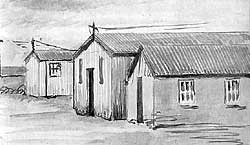
the year 1921. It was great to see the sketches of the
camp itself and to read something about the other inmates
as I never heard very much about camp life from my father
who died in 1971. I have an autograph album which he
kept during his time there and afterwards, and it contains
quite a few names of comrades together with little sketches
and verses they wrote. Among them are at least five
of the names mentioned by other posters to this website,
including MacBroartaigh and Carr. I am providing my
email address in case anyone has more information or
wishes to contact me on a related issue.
brostaigi@yahoo.ie
Maureen Christie - Feb
'07
Great to read about Ballykinlar. I am researching the
life of my grand uncle. His name was James Connolly,
from Unshinagh, Kinlough, Co. Leitrim. He was arrested
on 14 September 1920, his father was shot dead on the
same night, and he was taken out of his home and it
is believed that he was taken to Ballykinlar. I wonder
if anyone knows if his name appears on the list of prisoners
in Ballykinlar dating to 14/15 September 1920.
James Jeremiah Langton - Jan '07
Has anyone information on a Edward (Ned) Bennett of
the 4th Battalion Dublin brigade who was intered there
in 1921 to june 1922.
He was a prisoner in Kilmainham jail before being sent
there.Was also I believe intered at Tin Town, now known
as the Curragh. Any information welcome. My email is
langton39 at hotmail.com
Des Murphy - Jan '07
Looking for information on two men from Coolmeen Co.Clare
who were in Ballykinlar Camp in 1920. Their names wereDennis
Shannon
Simon (Siney) Haugh
John McCarlie - Dec
'06
I grew up in Larne, Co. Antrim, and now reside in Australia.
My uncle (long deceased) served in the Royal Naval Division
at Gallipoli in World War I and subsequently in the
RIC "B" Special Constabulary during the "Troubles"
before Partition, and the formation of Northern Ireland
as part of the United Kingdom.
I was told he was on guard duty on a ship moored in
Larne Lough, holding rebels who could not be acommodated
in Ballykinlar or were a major security risk. Is there
any information regarding this ship and the period it
was used?
Kathy King - Nov '06
What happened to Hugh Deery? Curious, my grandfathers
name was Hugh Deery and he was from Donegal.
Barry Sullivan - Nov
'06
My grandad was interned in Ballykinlar.
Ramond John Bonner -
Oct '06
Great to see the Poem written by my Great uncle John
Bonner, I can remember him when I was a young boy visiting
him in summerhill with my later father Pearse bonner
when John was in his 90s. Apparently John Bonner had
been involved in holding up a barracks with an empty
shotgun and had subsequently been on the run for about
a year when he was finally apprehended.
Cecelia McGuirk - Sep
'06
My Grand uncle was Jack Gallagher and was in Ballykinlar
from 1919-1921. So it was good to see images of the
huts. It would be great to find out some more information
about the people in the camp and other photos if available.
Also if anyone can tell me where to find information
of where to find lists of internees and any other info.
Bob Ward - Aug '06
I have a note (Taken from a website) that states that
"The felons cap is the noblest crown an Irish can
wear"
It was written by Seamas Ward, July 28, 1921.
This man may be a relative (?) Is there a rooster of
residents of this facility available?
Thanks
Vincent Davoren Boyle -
Aug '06
Thanks so much for such a wonderful document. My late
uncle, Stephen Vincent Davoren, was imprisoned here
in Nov. 1920 He was transferred up to Belfast on the
Sea Wolf from Dublin with a large group from Arbor Hill
prison . He was interred with Sean Lemass later Prime
Minister of Ireland. I think I have I have a picture
of him with some others in the camp. His Id was No.
8 A Company No 1 Camp. Any word or comment would be
apprecaited by the family.
Thanks again.
Other names mentioned in my late uncle's
-Stephen Vincent Davoren- papers. He was imprisoned
here from Dec. 3 1920 until end of Dec. 1921.
Names: OIC of our company was Seamus McGuill of Dundalk
hut leader was McMenamin of Dublin.
Camp commandant was Joe McGrath of Dublin Later Mossie
Donegan of Cork. He was under the name of Fitzpatrick.
Others in the hut. Joe Daly of Castleblaney Monaghan
Paddy Doyle well known football player.
John and Patrick Mc Hugh of Ballindine Mayo. P. O'Connor
a school teacher form Dublin.
My uncle belonged to the Officers Traning Corps heaed
by Hugo McNeil, nephew of Eoin McNeil.
Hope this is helpful to someone
Peadar Murnane - July
'06
I am very interested in the Camps at Ballykinlar and
am compiling a list of all prisoners interned there
in 1921. I would only be too glad to swap information
on the list of internees. I find it difficult to translate
the Irish version to the popular name in many cases.
Some I have failed to put an name to. Best Wishes.,
Peadar Murnane
Brian Bolger - May '06
What an insight, my grandfather John Bolger was interred
in Ballykinlar Camp - 1 Hut 29 from December 1920 till
February 1921 when he was released an innocent man.
He was mistakenly arrested as Peter Bolger which made
it all the more harder on him. I recently received a
copy of all his correspondence to my grandmother, his
arrest note and release order which along with this
web site brings this episode of my family history to
life for me. I look forward to seeing the Ballykinlar
collection in Kilmainham Jail.
Déaglán Ó
Mocháin - May '06
My own grandfather, Maurice Moen, Ballybay, Co. Monaghan
was interned in Ballykinlar from January 1921 until
the release of all political prisoners. I saw his name
in a book displayed at the National Museum of Ireland
a few years back. Most of the names were inscribed in
Irish.
Bhí mo sheanathair féin,
Maurice Moen, Béal Átha Beithe, Co. Mhuineacháin
i gcampa imtheorannaithe i mBaile Coinnleora ó
Mhí Eanáir 1921 go dtí gur scaoileadh
saor na príosúnaigh pholaitiúla
go léir. Chonaic mé leabhar a raibh a
ainm ann in Iarsmalann Náisiúnta na hÉireann
cúpla bliain ó shin. Bhí an chuid
ba mhó de scríofa i nGaeilge.
Pat Fahy - April '06
I received an autograph book from my aunt Kathleen Fahy.
It has about 80 autographs, some with drawings dating
1921 from the internees in Ballinkinlar. Some of the
autographs are in Irish, I would like to make a list
of autographees and contact their relatives.
Catherine Reilly - April '06
I really enjoyed this. My grandfather was interned in
Ballykinlar after 1916 he was an irish volunteer. I
am trying to find out more information about this period
in his life. I know he was shipped by boat from Dublin
and made several attempts to escape while an internee.
His name was Thomas Walsh, think his brother James was
also interned. Can anyone help me at all in tracing
any of this?
L&K Killion - April '06
We have a photo of the camp dated 20/7/21.
Laurel Wood nee Flynn - October '05
How wonderfull to find these pictures & info plus
poems. I'm an Aussie with Irish roots & just discovered
that a relative Paddy Garahy was interned here as was
a Joseph Reddin, a mate. I'm writing a book about my
family & will just have to include some of these
pictures, poems etc. THANKS
Gearoid Kingston - Sep
05
My great grandfather was John (Jack) Creed from Burncourt,
Cahir, Co. Tipperary. He was interned in Ballykinlar
camp 1, hut 19. I have seen his autograph book which
includes a drawing of huts remarkably similar in style
to the one in this article (drawn by same person?).
I would greatly appreciate any information other people
might have on the camp and internees and other sources
of information which people may know of. I have scanned
Jack Creed's autograph book which I can
Mary Darker
Delighted to find this very interesting site re Ballykinlar,
My late grandfather "Big Dick Kelly" was also
interned there but unfortunately all relatives are now
deceased and it is proving very difficult to get dates
etc. I do have a lovely ox bone carving that I beleive
he carved while in the prison, if anyone else has one
of these I would love to know i enclose my email : goldenfalls@eircom.net
Bill Crowe - Feb 08
I inherited a Ballykinlar autograph book that belonged
to my grandfather Edward McSweeney of Ballyvourney,
Co. Cork. It has 37 pages, some in Irish, some in English,
also some art work and all the dated entries are from
1921. I have scanned it and should have it on a web
site fairly soon, will post a link here when that is
done.
|



 print version





















 POST
A COMMENT ON THIS ARTICLE
POST
A COMMENT ON THIS ARTICLE