|
|
Page 2
There is a charming drawing by Eamon Hayes from 'Belfast
and Ballykinlar Internment Camp' in an unidentified
autograph book (19 MS 1C25 04) which depicts
a group of exotic birds in full colour huddled together talking amongst themselves,
with the caption reading: 'More
Camp Rumours - I hear we're getting out of the Cage to-morrow'.
This relates to the constant hopes the men cherished of being released, and
is an excellent example of the finely tuned sense of humour shared by the
prisoners, which formed a vital element in their survival.
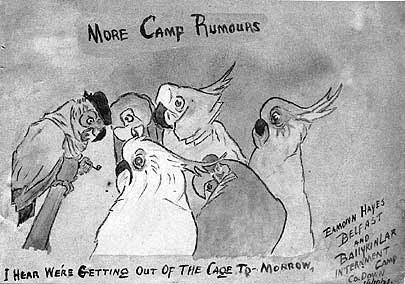 |
'More Camp Rumours' from
Ballykinlar autograph book
(Courtesy
of Kilmainham Gaol Archives) |
The autograph book which belonged to Patrick Hayes (19
MS 1C25 10) is filled
in completely in Irish, which emphasises the importance the prisoners
set on their native language - Irish classes were held in Ballykinlar
Camp.
The Kilmainham Ballykinlar Collection includes a copy
of a certificate awarded to James Coleman for his Irish studies (19
MS 1D45 24) in the Camp. And what
sacrifices did Tomas Ó h-Onan make when he pasted four differently coloured
Ballykinlar Internment Camp money tokens into his autograph book (19
MS 1C24 01) valued at 1/-, 6d, 3d and 1d respectively? Each of the tokens has Tomas' prisoner
number attached - No 130.
The Barbed Wire Photography essay
tells the story of the seriousness with which the prisoners themselves
approached the question of remembrance:
The continual hunt for souvenirs
by the internees suggested to our
photographer that perhaps he could satisfy to some extent the big demand
for mementoes
of
the days spent inside 'the cage'. The laws under which we were forced
to live barely permitted us to receive the ordinary necessities of life
and
a camera was one of the many luxuries which were declared forbidden.
The author relates how a camera was eventually smuggled into Ballykinlar:
...a substantial home-made cake arrived in the Camp
and with the assistance of our representatives in the censoring department
it escaped the piercing knife and eye of the military censor. It was
a well-made cake and the fact that a small folding camera was one of
the principal ingredients did not affect
its flavour.
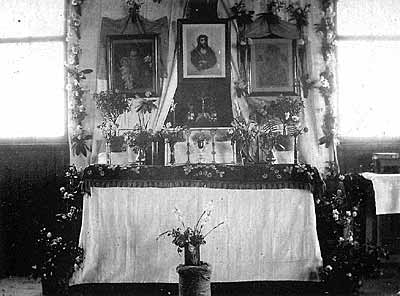 |
Altar set up in prisoners'
chapel in Ballykinlar
- taken with Ballykinlar camera
(Courtesy of Kilmainham Gaol Archives) |
He continues to relate more of the technical details involved in photography:
With or without the consent
of the Medical Officer the chemicals required for developing
were found or manufactured in the chemist's laboratory
attached to the hospital. A dark-room was easily obtainable
as most of the
huts were without light
from night-fall till morning and after some time we
were able to perform any task or odd job in the dark.
Some of the photographs
(19 PO 1A32 07) appearing herewith are those taken
with the Ballykinlar camera - a violin class with Conductors Martin
Walton and Frank Higgins from No 1 Camp; and the altar in the prisoners' chapel,
No 1 Camp, Ballykinlar. The essay finishes:
...the photographs exhibited
here are enlarged reproductions of these same negatives and comparing
the size of the negative with the big enlargements will give you an
idea of the excellence of the work executed by 'The Ballykinlar Photographer'.
|
Your Responses
Renee Fitzgeraldculbert - May '08
My granduncle was in Ballykinlar, and I have a photo frame
he made from Cork from glass bottles whilst in it. Have
you any idea where I can go to check when he was in it,
or for how long? Thanks
Tony Poutch - Dec '07
My grandfather William Norris Montague St Dublin was in no
1 camp hut 33 I have a picture from old news paper which
includes: P MacShay, P Bartley, R Lynch, H Duffy, P Daly
(Cavan), S Tracey, T`O Keefe, G Byrne, D Butler, J Lynch,
D Reilly, W Reilly, M Whelan (Dublin), S Sinnott Matthews
(England), T Leonard (Cavan), P Ryan, E Tully, P Lacey
(Galway), J Kelly (Clondalkin).
It's just a cutting from
the Mail or Herald and it's all I have belonging to him.
It's nice to have access to articles likes to help retrace
their footsteps.
Seamus Cooney - Mar '07
I too have an autograph book, that of my father Eamonn Cooney.
I find it frustrating that the many questions asked by previous
visitors go unanswered & that people's email addresses
are not displayed.
For those interested in exchanging scans, my email is cooneys
-'at' sign- chartermi.net (I enter it this way to avoid having
it collected for sending spam)
|


 print version





















 POST
A COMMENT ON THIS ARTICLE
POST
A COMMENT ON THIS ARTICLE