|
|
|
 |
|
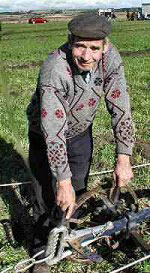
Bertie points to the "hack" |
|
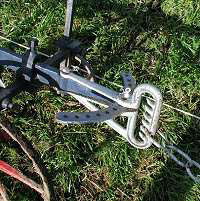
I discovered that my strange piece of metal is known amongst the ploughing fraternity in this locality as a "hack" (There is some dispute as to the correct spelling) , and Bertie showed me the one he was using. As "Ganaway" said - it links the horse, or horses, to the plough, or any other farm implement. The holes allow adjustments to be made to the geometry of how, and in what direction, the animals pull the device. We saw a pair of horses in the competition which were unequal in size and the ploughman confirmed he had altered the hack to account for their uneven pull.
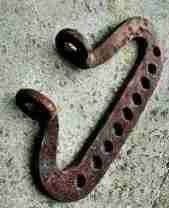
But hold on - it's not the same as mine. |
|
|
|
 |
|
The "hack" used for ploughing.
|
|
|
|
|
|
 |
|
My version.
|
|
|
The Judge
Time to bring in a judge. Samuel McKee was one of the three judges for the horse ploughing class that day. A breeder of Clydesdales (he has seven at the moment) he is keen and knowledgeable about the history of the horse plough and, according to his wife Irene , has "dozens of them" . I described my hack to him. He explained that those we saw in use that day had two degrees of adjustment - horizontally, from side to side along the curved row of holes and also vertically, so the chain (The "swingle") could be hung from a series of barbs. This was the version all the ploughmen were using at the match. The heads were cast iron whereas mine was forged - probably by the local blacksmith.
Samuel explained that mine was not used for ploughing but for making potato drills. I asked him to date it. Apparently alterations were regularly made to horse ploughs about every 25 years or so and a device like mine appeared about 1850. My own copy he thought dated from around 1900. So now I know.
|
|
|
 |
|
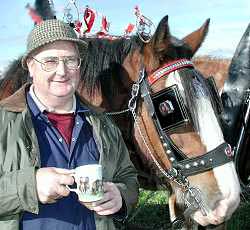
George Robertson and Marcus reunited
|
|
George Robertson.
We can't finish this article without a mention of the camp followers of horse ploughing. Yes these competitions have their own "groupies". One was George Robertson who had come over from Kilwinning in Ayrshire Scotland to watch Bertie in action. Or more importantly to watch Marcus the Clydesdale in action, for George sold Marcus to Mr Hanna about four years ago and now paid an annual visit to watch them working. Bertie reciprocated and regularly visits Scotland to see his old friend George horse ploughing over there. |
|
|
|
 |
|
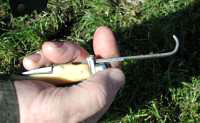
Hook for horses hooves
|
|
Hey here's an interesting thing. Remember when we were boy scouts/girl guides, how we used to have penknives with prod things that were supposedly for digging stones out of horses hooves. We never used it. Well here's George's and yes he actually regularly uses the hook to get stones from his horses hooves. And here was me thinking it was just a rural myth. |
Followers
And finally, especially of interest to you "Ganaway", we met three local ladies, the Lyons sisters, Dolly (McRoberts) , Netta (Tullogh) and Isabel Lyons . They were there especially to watch the Hanna team. During a lull they brought out mugs and flasks for us all (Thelwell Ponies on the mugs of course) and over tea and sandwiches they told us they were born and brought up in the home farm at nearby Ganaway. This is now a caravan park, but a nearby house has taken on the name of their old farmhouse and is called "Ganaway House".
So I guess you come from that part of the world "Ganaway". You don't happen to be the policeman who caught me speeding through Portavogie that afternoon do you?
Your responses to this article
Simone - Feb '07
H i bertie is my grandad and i was wondering do you
have any other pictures or information on him that i
can read up on thanks
Wendy Swingle - October '05
Hi Brian Willis
It has been a long time between postings but I hope
you or one of your knowledgeable friends can help further.
Can anyone give an approximate time when the Swingle-tree
first came into use? Was it widely used throughout UK
and Europe or restricted to certain rural areas? What
came first the chicken or the egg? Swingle the person
gave his name to the implement or - the user of the
implement took the name for his own? Anyone care to
offer a suggestion?
Sven-Olof Salomonsson - June 05
In Sweden we will hold the European Championship in
ploughing in September. We would like to get in touch
with som UK horse ploughers. Is there a society for
horse ploughmen?
____________
I read with interest this article about ploughing and the different 'hacks'
used. In the explanation of differences between two
examples it was stated that 'the connecting chain (the
Swingle) could be attached to various barbs. Can anyone
offer any information about the naming of the chain
'the SWINGLE'? Did the name originate in Ireland, England
or perhaps Scotland? Any idea when the term may have
first been used?
I have heard of a Swingle Bar (a wooden instrument for beating flax), and a Swingletree (a crossbar pivoted in the middle, to which the traces are attached in a cart, plough, etc.) but this is the first time I have encountered the name used for a chain.
My family name is SWINGLE - hence my interest.
Kind regards from Australia
______________
Hi "Australian Swingle",
Sorry to have taken so long but at last I have an answer
for you about the "Swingle Chain". And the answer is.
there's no such thing. Sorry to have mislead you. I
must have misunderstood what the ploughman told me.
I have been onto the horse-ploughing judge (Samuel McKee)
and as I wrote in the article he is very knowledgeable
about the history of horse ploughing and tells me it
is called the "Swing" chain - not Swingle. However he
confirms the Swingle-tree. He tried to explain the function
of these various bits and bobs over the phone but I
got totally confused. So the upshot is I have been invited
to his farm towards the end of this month, where he
will show me all the horse-to-plough coupling items
and explain how they work and fit together.
Brian Willis
Your Responses
John C Stott - Dec '06
I thought I would may be find the answer to
a problem on this web site, but to know avail. I heard
the term in the 1940s at a ploughing match and it was
HALVING and GEEING, Which I think referred to HALVE
meant the horse would turn to the left, and GEE that
the horse would turn Right. I would be pleased if any
one could enlighten me on these two terms Yours sincerely
J.C.Stott
|



 print version





















 POST
A COMMENT ON THIS ARTICLE
POST
A COMMENT ON THIS ARTICLE