|
|
|
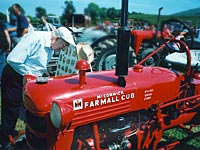 |
Smallest tractor in the
International Harvester line |
|
|
|
|
|
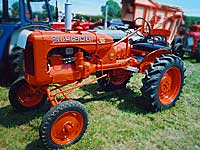 |
All the way from North America
|
|
|
The Farmall Cub (above left) is the smallest tractor in the International
Harvester line. Production began in 1947 and continued
relatively unchanged until 1964. This little tractor
was aimed at the needs of the small-acreage farmer.
Seven or eight implements were initially designed for
it: Plow, Disc, Backblade, Sickle-Bar Mower, Belly-Mower,
and a one-armed front-end loader for starters. The Cub
was easily one of the most popular small chore tractors
made in history. This is shown by the sheer numbers
of Cubs that were built. People would not stop buying
them! With a production run lasting almost 20 years,
over 200,000 of them were built between 1947 and 1964
(Above right) Allis-Chalmers' history
as a manufacturer extends to the 1840's in Milwaukee.
In 1914 the growing company entered into the farm equipment
business. Over the years Allis-Chalmers was responsible
for many innovations in farm equipment and grew to become
one of the largest and most diverse manufacturers in
North America. However, Allis-Chalmers became the victim
of rapidly changing financial times and was eventually
forced to sell the farm equipment division to K-H-Deutz
AG of Germany in 1985 |
|
|
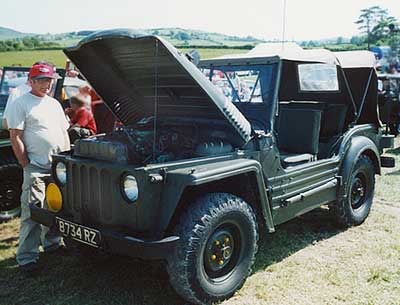 |
| An Austin Champ of the early '50s |
|
The Austin Champ: This specifically military
vehicle was designed to meet a British army specification
of the late 1940s. At the end of World War II the success
of the US Army's Jeep had many armed forces wanting
similar vehicles of their own. The FV1800, as the Champ
was first known, was powered by a 2.8L Rolls Royce engine
and the engine was fully enclosed for wading. The gearbox
had 5 forward and 5 reverse speeds and an all round
independent suspension. Production started in September
1951 and the first of what was to be a run of 12,000
vehicles, was delivered in March 1952. The War Office
ended up paying about £1200 for each one - in
today's money, about £30,000.
The soldiers who had to use the Champs weren't keen
on them and the list of defects - the worst of which
was rear axle failure - seemed endless and the Champ
quickly acquired a reputation for unreliability. It
remained in service with the Army from the mid '50s
to the '60s but were always considered awkward and expensive
to maintain and, in terms of miles per gallon, were
poor. They were eventually replaced by the cheaper but
very efficient Land Rover, still the standard issue
vehicle fifty years later.
There are those who would tell you that the Champ was
a vehicle which was technologically ahead of its time
and a victim of its own complexity but, in spite of
the innovations on board, it's ended up being generally
regarded as a failure.
|
|
|
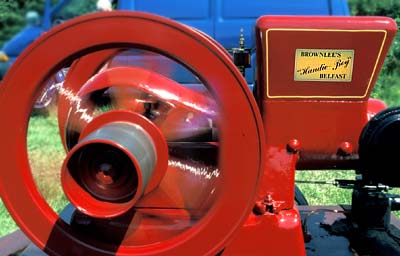 |
A static portable single cylinder
diesel engine, made in Belfast |
|
Of course the show doesn't only feature
all manner of wheeled vehicles. There are many 'Static
Engines' on show too. These once played a vital role
as portable sources of rotary power for pumping, generating,
woodcutting, grinding etc. Today, many such implements
carry their own power source, be it lightweight petrol
or electric motor. This lovely looking static Diesel
Engine is clearly designed to provide power to belt-driven
machinery. This one, called a 'Handie Boy', was made
by Brownlees of Belfast.
|
|
|
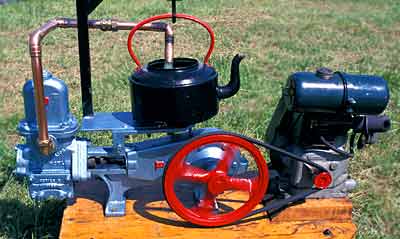 |
Anyone for tea? What is this
little engine designed to do? |
|
What this machine is doing is anybody's guess... perhaps you can
tell us? You can respond to this, or any article on
your place and mine, by clicking on "Reply to this Article".
(Photos - Marty Johnston)
|



 print version