Your replies
Steve Grannary - Aug '08
My husband is a descendant of the Warings in Belfast. We are
in Calgary, Alberta, Canada. My son was in Belfast 2 years
ago and was taken aback by how nice Waring Street was.
Paul Helmn - Aug '06
I am researching the Waring family as I understand a cottage
that existed near my house was the birthplace of this family
that came over from Lancashire, England in the 16th C.
Sarah - Dec '05
This is a comment/question ofor Lynn littler, I'm researching
my geneology and a branch of my family are the Warings. I'm
interested to find out if there is a connection here.
Raymond O'Regan - July '05
What good news that the former Ulster bank is to be turned
into a luxury hotel. Waring Street is also famous for it's
connection with Dean Jonathan Swift . William Waring came
from Toombridge, in the 17th.century, to set up a tannery
in Belfast and was granted a lease in a street that was to
take on his name.
He had a daughter called Jayne whom Jonathan Swift courted
for two years (he called her "Varina") but she turned
down his proposal of marriage. He had been minister in Kilroot
and eventually moved to Dublin to become Dean of St.Patricks.
It may interest people to know that he got the idea of the
giants in Gullivers Travels from the Cavehill. If you look
at the Cavehill at right angles just past McArts Fort from
the Shore Road (this would have been the route that Swift
would have taken on his way into Belfast from Kilroot to see
his "Varina") it looks like a giant lying sleeping.
In a map of Belfast in the 1850's there is a part of the
York Road called Lilliput Farm this may have been were Swift
got the name for his book that is if the farm existed during
his time in the north. If you go to the central library ;
Irish section and ask for the Belfast Rental Books you will
see the area on York Road called Lilliput Farm (the area is
just opposite the side entrance of the present day railway
yard). Further along Waring Street you will find Sugarhouse
Entry in this entry the United Irishmen met in Peggy Barclays
"Benjamin Franklin Tavern". It was not for nothing
that in the 18th. century Belfast was known as the "Boston
of the North" because of the actions of the radical Presbyterians
who as members of the United Irishmen attempted to unite Catholic,
Protestant and Dissenter.
Next to Sugarhouse entry is the Commercial Buildings (nowadays
known as The Northern Whig). It was opened in 1820 and replaced
four thatched cottages one of which was a woolen drapers shop
owned by the famous United Irishman Samuel Neilson. You can
see how much history there is in just one of Belfast's oldest
streets and I would encourage everybody to take an interest
in the history of this fascinating city as there is so much
more to discover.
Aleshia from Canada - April '05
Hi there :-)
This comment/question is for Lynn Littler. My mother acquired
this beautiful old bed frame that was painted white. She sanded
the paint off and found what she thinks is gorgeous mahogany
wood beneath. Stamped into the wood was the word "Warings"
with a crown symbol. I did a bunch of research and found a
lot of info about the company of Waring and Gillow, along
with info about the history of Gillow, but I couldn't find
anything about Waring...until I read your comment on this
site. :-) Can you tell me any more about Warings and if this
bed frame could be a product of SJ Waring and Sons? If so,
when were they formed and how old might this frame be? From
what I gather about the joining of the two companies, it has
to be at least older than 1896. :-) Any info would be wonderful!
Thanks so much... Aleshia.
Wayne - February '05
Recently I was sent to look at a job in the Ulster Bank in
Waring Street and I was absolutely amazed by its beauty. It
is my first time in the bank and I'm really glad that it is
not being demolished but that it is being renovated for other
people to admire its beauty. The most amazing part of the
bank is the maze of corridors leading from the bottom floor
at the main vault to the offices that are on the top floor.
What an outstanding piece of architecture, hats off to James
Hamilton for this amazing task so many years ago.
Lynn Littler (nee Waring) - February '05
William Waring my ancestor - I am delighted that
this beautiful building is being preserved in Waring Street.
You may be interested to learn that William Waring went on
to found Waringstown, where he introduced linen weaving to
Ireland.
A branch of his descendants, of which I am one, moved to
Liverpool in the early 1800s and founded S.J.Waring &
Sons Cabinet makers, later to become the world famous Waring
& Gillows.
William's father John came to Ireland from Lancashire in
the late 1500s. If anyone would like more details of this
family or can add to it please contact me through YPAM.
Kay McKenna - August '04
This is one of the most uplifting bits of news I have hear
from Belfast! It is wonderful to see that there is someone
with a sense of futuristic vision to save this beautiful building
for the youth of Belfast to know their grandparents were capable
builders and perhaps, some day soon, they may follow in their
footsteps to take pride in their city.
Visitors daily are discovering what a wonderful place Belfast
city and her people are and they, in turn, are sharing this
with others. Have a peaceable future!
Lorraine Vojick - August 2004
I was in Ireland a month a go. I did not see this bank. Perhaps
I was not far away. The next time I go to Belfast, it will
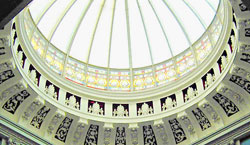
be to see this bank. It was very beautiful. Thanks for picture.
Hope Sloan - August 2004
Wow, this is by far the most beautiful bank I have ever seen.
I am delighted to see it being saved from the horrible wrecking
ball.
John McCormick - August 2004
Let's hope that the building is kept reasonably intact: too
often planning permission in Belfast has been given to third
rate 'architecture' while allowing landmark buildings to be
destroyed.
Ciaran - August 2004
After reading your article, I felt a sense of delight that
this building is to be saved by restoration. It would have
been a shame and a crime to demolish the building. We have
already lost so much history in Belfast and to see more of
it wiped from our memories would be sad. A big thank you to
the people who care.
Happy Snapper - August '04
Have you any more photos of this wonderful place?
Amateur Historian - August '04
It was with a great sense of relief that I read of the plans
to preserve the structure and most of the very beautiful and
interesting internal features of this building. The developers
are planning to create a superb luxury hotel with several
other hospitality outlets incorporated.
This should surely bring back to life one of the oldest streets
in Belfast. In Cathal O'Byrne's book of historical sketches
of Belfast he states that in the year 1660 in a plan of Belfast
there was only five streets named. One of these was Waring
Street.
He also states that there was many thriving businesses, dwellings
and hostelry's which operated with success throughout ensuing
years.
So I say, top marks to the developers for recognising the
potential of this building and the value of preserving what
is good from the city's past. I wish them every success with
their plans.
|



 print version





















 POST
A COMMENT ON THIS ARTICLE
POST
A COMMENT ON THIS ARTICLE 
