|
| The
first apprentices' strike in the yard...
Article by Wilson John Haire Nov 05
In 1950 I was standing at my bench in the Joiners'
Shop when I heard a commotion at the far end of the
shop. It was hard to make out faces from a distance
for the shop was huge. I would say that over a thousand
joiners and apprentices worked there.
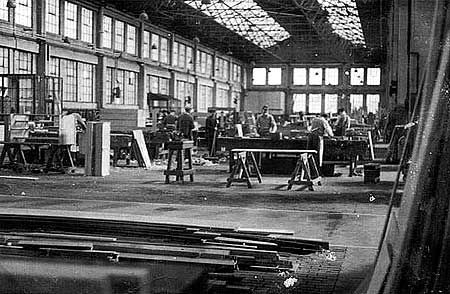
In the centre of the shop was the woodworking machines
with the wood machinists and their apprentices. Another
section was the paint shop with the painters and their
apprentices. The benches of the joiners were organised
in sections with a chargehand in a brown dust coat and
bowler hat. We had about twelve joiner chargehands.
Over all the sections was a foreman, who wore a suit
and bowler hat Over the whole shop floor was a head
foreman in a more expensive suit and the usual bowler
hat. But over all of them, including the wood machinists
and the painters, was the manager wearing an even more
stylish suit and a bowler hat.
We made the furniture for the ships, the doors and
frames, wooden stairways, mahogany handrails, teak handrails
for exterior use, heavy teak doors for the same purpose.
There was no rush because the work had to be perfect.
When finished, it was closely inspected by the chargehand
who made the decision if it should be passed. It was
always an anxious moment for us. We were under continual
scrutiny. The chargehand's office was made totally of
glass so as he could watch out over the shop floor.
The commotion turned out to be maybe a hundred apprentices
from the plumbers and sheetmetal shops in the Thompson
Works. They were shouting slogans about wanting a pay
rise and they told us apprentices to join them. None
of us moved. We were too surprised and even fearful.
You could be sent home for a month without pay for some
misdemeanours. I couldn't imagine being sent home and
having to tell my father news like that even though
I was eighteen at the time. We weren't called teenagers
at the time. That term was unknown then.
|
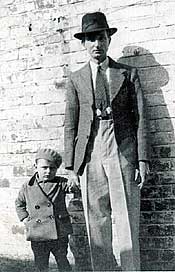
The
four-year old (1936) is me with my father, also
called Wilson Haire. He still dressed like a returned-Yank,
having come back from New York in 1930. |
We were five-year indentured apprentices until the age
of twenty-one and we had to live at home and be subsidised
by our fathers, who usually only had a manual worker's
wage coming in with maybe other sons and daughters to
keep. Starting at fourteen as an office boy and maybe
losing that job was losing the apprenticeship as well.
Five pounds had to be deposited by our fathers as well
at the start of the apprenticeship. To lose the apprenticeship
was to lose that money as well. So father was the man
who pulled you out of bed in the mornings from the age
of fourteen to the age of twenty-one. Nor could you leave
the apprenticeship without written permission from your
father. He was very unlikely to do that. The few
who did manage to leave joined the colonial police or
the army or navy. Some came back on visits and said
it was easier than working in the shipyard with your
father as sergeant-major, prison warder and general
kill-joy.
The wages for young people in the Yard was poor. At
fourteen it was sixteen shillings a week (£0.80p).
At fifteen nineteen shillings (£0.95p).
At sixteen, and the first year of apprenticeship, it
was one pound, four shillings and sixpence (£1.22p).
Bus fares for me at the time (I lived out in Carryduff)
was four shillings and sixpence a week (£0.22p).
Father took you along to Spackman's in High Street and
picked a suit, shirt and tie for you, for he was doing
the paying. When I wore the clothes I felt like a Victorian
mourner. I remember my mother screaming when she saw
me dressed in what my father thought was modern dress.
The wages crept up year by year of the apprenticeship
by a few shillings. Any time lost through illness or
other reasons like bad timekeeping had to be made up
after the five years were up. If you had three months
to make up then you only got fifth year apprenticeship
wages of about four pounds for that three months. The
wages on completion of the apprenticeshp was six pounds,
four shillings and sixpence. (in 1953) If you decided
to live on at home the custom was to hand in half your
wages to the house.
| |
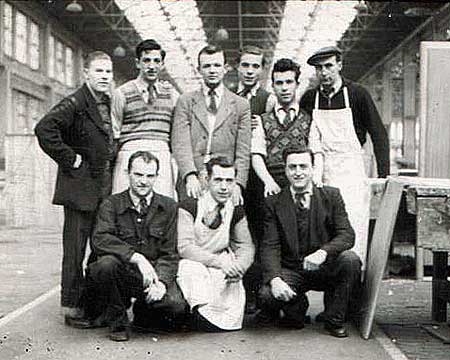
(Above:)
The Joiner's Shop in 1950. I'm to the front
of the group, dressed in a dark jacket and overalls,
with a tie - usually worn by joiners and electricians,
the elite trades. This Joiner's Shop had been
the original aircraft works where my father
worked on constructing Stirling bombers. There
is a phograph in the H&W web pages of it
as a ruin. It was very cold place to work in
winter because of its vast size. The original
very high and wide doors through which the war-time
aircraft were taken throught was still there.
|
During the office boy period the timekeepers in each
time office we visited would give us a shilling a week
but only if we did our work properly. My father would
calculate how much I was being given and I would have
to hand that into the house and expect nothing in return.
It became normal for we office boys to lie and hold
back a shilling or two. In the first year of my apprenticeship
I was given two shillings a week pocket money. That
crept up year by year as well by a shilling or two.
In the third year of my apprenticeship I began doing
Saturday jobs to earn more money. It was usually an
extra ten shillings for the day, renewing someone's
doors or garden gates up the Malone Road. I was reluctantly
allowed to keep this.
The plumbing and sheetmetal apprentices taunted us
for not coming out immediately. They said they would
be back the next day. They came back and there must
have been a thousand of them this time with the added
shipwright, caulker, blacksmith and riveter apprentices.
We were impressed and joined them. Some of us jumped
on to benches to implore our mates to strike. Those
of us who jumped on the benches were added to the strike
committee. This was the first apprentice strike ever
in the history of Harland and Wolff in Belfast.
Some lads didn't want to strike for religious reasons.
The chargehands advised them to go because there were
shouts from us of: `Get his coat!' That became
the slogan. We left the Joiner's Shop and stormed all
the ships lying in the Musgrave Channel and all the
wharves and workshops. We even stormed aboard naval
ships under repair. One had two naval armed guards but
we just brushed them aside and hunted down the apprentices
as if they were rats. Then we gathered outside the Main
Office and chanted for Sir Frederick Rebbeck to come
out: "Come out this very minute ye wee man
ye!" He did come out. I had never seen him
before. He was small all right, slightly bent man wearing
a grey suit and bowler and a large gold pocket watch
and chain. He was so small some of the apprentices called
out to get him a box to stand on. His reply was that
he would box our ears. He said we were no good to him
and no good to ourselves and what did we want anyway.
I was so furious I went up to him and told him that
the overalls I was wearing cost nineteen shillings.
What we wanted was a pound a week rise. He started to
imitate me saying: "My overalls cost nineteen
shillin's, so it did." While I was arguing
with him the harbour police arrived and made for me
and the rest of the committee gathered around him. Rebbeck,
to his credit, shouted to the harbour police in an angry
voice to move away. They also seemed to be no good to
him and no good to themselves.' I suppose we thought
of him after that as a slightly grumpy old granda who
would bear no grudges against us. We liked him for daring
to come out and face us in person, alone.
| |
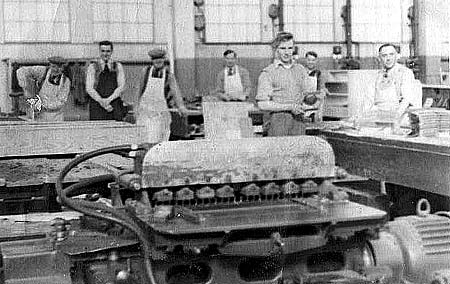
(Above:)
In the foreground is a pneumatic dovetailing
machine. In the row of people at the back I
am standing in white shirt sleeves. Nearer the
machine, second on left, is a young footballer
who once played for Glentoran but suffered an
knee injury just when he had been signed up
for Man United. I can't remember his name at
the moment. He might have been a pre-George
Best
|
After he went back to his office we stood watching
the Engine Works a few hundred yards down the road.
The gates were closed permanently as usual. We knew
they would have to open some time to let lorries in
or out. One lorry was about to come out and the huge
wrought-iron gate on rollers was opened. About five
of the apprentices sprinted towards the open gate. The
gateman being on his own couldn't shut it quickly enough
nor force it against them so he just raised his hands
in surrender. We poured into all the workshops, the
coppersmith's shop, electrical shops, brass moulder's
shops, furnace rooms, with the slogan: "Get
your coat on." There were apprentices who
resisted but usually the journeymen they were working
with advised them to go with us. After that we marched
to Blitz Square or Red Square - as that part of the
WW2 bombed High Street was known to the Belfast wits
of the period - and held a mass meeting. Some apprentices
from the Sirocco Works and Mackie's came out in support
of us for a few hours.
We were out less than two weeks when H&W announced
through one of the newspapers that they agreed to the
one pound rise. As our strike committee was anonymous
and we made no contact with the shipyard management
except briefly with Sir Frederick Rebbeck, whom we presented
with our demands, I suppose the announcement had to
be made through the media. We did all this without any
trade union organisation or support and with no one
over eighteen years old.
We went back to work and the whole structure of the
apprentice's committee just disappeared as if it had
never been. I can't remember anyone discussing the strike
after that. I think it was a major event in the life
of we teenagers then. We came mostly from strictly disciplined
homes during a period when Bing Crosby was in the top
ten records and sheet music.
I think the strike was about more than a pound a week.
We challenged the shipyard management and we spoke to
their head Sir Frederick Rebbeck directly as equals.
Normally we would be overawed by such a man. But mostly
we also challenged our fathers who were afraid that
our apprenticeships would be terminated. Some of us
had to suffer being gurned at night and day during that
crisis. We had no wages, such as they were, for two
weeks, which put a strain on family relationships.
But we knew we were right. Looking back now shipyard
life is the great discipline that stays with most of
us during our life.
_____________________________________
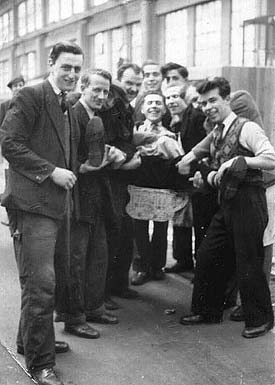
| (Right:)
The joiners' shop around 1950...
A workmate is getting married
and someone cut a chamber-pot out of plywood.
(chamber-pots being still in vogue then) I tried
to obliterate it before showing the photos to
my family or my mother would have thought I was
associating with a no--good crowd.
The shipyard and its workers
were looked down on by the more genteel members
of Northern Ireland society at the time.
Even when we went dancing
at the week-ends we usually told the girls we
worked in the drawing office of H&W while
at the same time gently holding their hands in
order that they couldn't feel our hardened manual
worker's hands. Of course that's what we got for
going dancing in the Co-Op Hall in York Street
with girls who worked in banks and offices.
The dance floor was on
top floor of the Co-Op building that became a
casuality of the bombing campaign during the 1970s.
|
|
________________________________________________________________
 Wilson
John Haire is a playwright whose work has been produced
at Dublin’s Abbey Theatre, The Royal Court and
The Royal National Theatres in London, The Lyric Theatre,
Belfast, and in other theatres throughout the world.
Born in Belfast, just off the Shankill Road, he entered
the shipyard as an office boy at fourteen. At 16 he
became an apprentice joiner, working with men who
had been born in the nineteenth century and had worked
on building the Titanic, had fought in the 1914-18
war and were still working after the Second World
War. Wilson
John Haire is a playwright whose work has been produced
at Dublin’s Abbey Theatre, The Royal Court and
The Royal National Theatres in London, The Lyric Theatre,
Belfast, and in other theatres throughout the world.
Born in Belfast, just off the Shankill Road, he entered
the shipyard as an office boy at fourteen. At 16 he
became an apprentice joiner, working with men who
had been born in the nineteenth century and had worked
on building the Titanic, had fought in the 1914-18
war and were still working after the Second World
War.
At 22 he left Belfast for England,
and in the early ’60s he began to have stories
published and joined the semi-professional Unity Theatre;
in 1968 his one-act play, The Clockin’ Hen,
was performed. In 1971 Within Two Shadows,
described as “the first play on the Ulster Crisis”
won major drama awards. His other plays for the theatre
include Bloom of the Diamond Stone, Echoes
from a Concrete Canyon and Lost Worlds,
and he has written television plays for the BBC: The
Dandelion Clock and Letter from a Soldier
|
Read
more of Wilson's H&W memories...
YP&M main Harland and Wolff pages...
YOUR RESPONSES:
Sonia Banwell - Aug '08
Mr Haire Did you by chance know my Granda Walter Barr he started
work at the age of 14 in 1935 or thereabouts at H&W and
retired as a crane operator at 65 in 1975/76. He was a very
funny man who carried around a homemade furry rat which he
used to scare the shipyard men out of the tea hut with. This
ensured he got his tea while on a time limited break in a
yard with hundreds of men scrambling for a cupper. I would
be so grateful for any info as i emmigrated from Belfast in
1974 as a 7 yr old child and rarely saw my granda and family
after that.
P.S. I have just ordered a copy of your book The Yard on
amazon . com can't wait to read it
Sonia Banwell - Aug '08
A heartfelt thankyou to Wilson John Haire for submitting these
chronicles of shipyard life. You have no idea how much it
means to me to read and put into historical perspective the
lives and attitudes of my family of origin. My Granda Walter
Barr Started work at H & W when he was 14 that was in
1935 or therabouts. He retired from his position as crane
operator in the 70's. He was from E. belfast and married my
Grannie Violet Jackson at 16. They had 13 children my father
being the first. I was born in 67 and we emmigrated to Canada
in 74. I remember my Granda as the patriarch of the family
and i looked up to him as a little girl. He was a jokster
known to many in fact i heard there was a documentary on the
belfast tele re: the shipyard and my Granda was mentioned.
I am very interested in attaining a copy your book The Yard,
How may i do that?
P.S. My mother Elizabeth Greene was from the Shankill
Will Morrison - May '08
A belated reply to Arenee Henderson's query about the names
of the men killed in the Juan Peron accident. Here is the
list, which can be found in Belfast newspaper archives. I
was an apprentice joiner on the boat at that time.
J.BRACKENRIDGE; EDWARD CULLEN; RUSSELL HAMILTON; WALTER HURST;
GEORGE HYNDS; ROBERT JAMES; FRED KERNOGHAN, ROBERT McBRIDE;
JOSEPH McCONNELL; ALAN McCORMICK; FRANK McMULLEN; W.J.PATTERSON;
JOHN PATTON; WILLIAM REID; JOHN SHANNON; ROBERT WEATHERALL;
DAVID WEIR; and ARCHIBALD WHITE.
Will Morrison, author of BETWEEN THE MOUNTAINS AND THE GANTRIES,
(Appletree Press), a memoir containing a story of the disaster,
and the names above.
Arenee Henderson - Feb '08
Would anyone know any names of the men who where killed 31st
January 1951 on the Juan Peron Whaling Ship as I believe my
grandfather to be one of them?
Bill Gwynne- February '08
Dear Mr. Haire, I have read your article about Harland and
Wolff with great Intrest. I was born in Belfast 1934 and can
remember just about all of what you were writing about. I
had two cousins who worked for H&W, one a motor mechanic
and the other a carpenter and joiner, his name was James (Jim)
Campbell, you might even have met him! Both cousins are older
than me. The day the gangway collapsed on the Juan Peron is
especially vivid, seeing my cousin Jim had been working on
board the ship, luckily he was not one of the injured. I remember
the air raids mainly aimed at the docks and can still see
York St nearly demolished and blitz sites in High St which
were used as car parks -- not now! -- I myself lived at the
top of the Ormeau Road and served an apprenticeship at H J
Scott on the Ravenhall Rd as an electrician and had to go
to night school 3 nights a week on a bike, rain hail or snow
!! I joined the Merchant Navy, P&O as an Electri!
cal Officer and was with them for 10 years, married a New
Zealand lass and came to Tasmania in 1969. I must say, reading
your start with H&W and your going to London makes me
remember my own thoughts -- I have to get out of here!! There
IS life outside Belfast. Thank you for your excellent article,
it certainly does bring back memories.
David James Smith - May '07
Hello Wilson
Great to read the stories of the ship yard and your memories
of the two generations of your family working at the Harland
and Wolff shipyard.
Was looking through the sight regarding your Memories of
'The Yard'
and was pleased to see that the yard will never be forgotten
as long as men like yourself' keep the stories a live. my
father was very proud to be a member of such great men who
worked with him and who had came before him. He never forgot
all thoughts men and as a young man was told stories and seen
first hand what it was like to be one of those men. (Walk
the walk) saw bravery, honour, pride, great workmanship, great
heartship, joyfulness, sadness, kindness, fearless men, jokers,
cowboys, rakers, etc. And always said the best men the ship
builders ever seen in the world and always will be. My father
was James Couser Smith aka as Big Jim Dromore. when working
in the shipyard. (Height 6ft 5inc tall well built man) came
from the Mount in east Belfast he started his apprenticeship
with Harland & Wolff Limited, of Queen's Island, Belfast,
Shipbuilders & Engineers on the twenty third of March
1943 at the age of 17 years as a Boilermaker (lived Dromore
Co. Down) and Completed h!
is apprenticeship on 30th June 1948. He retired as a Riveter.
on July 10, 1975 aged only 49 years old of ill health,. (Vertigo).
His father was a William Robertson Smith and he started as
a Clerk for Harland & Wollf Ltd, and his father was a
Robert Logan Smith And he was a Ship-Plater and went on to
be a Foreman in the yard. (From Govan Glasgow) worked in the
Clyde shipyard also. The reason why I was looking at this
page is that I am tracing my family history and my father
told me of the bravery of one such man who worked in the ship
yard and he was of German Nationality and was killed about
the late 1940's early 1950's as he had made the greatest Sacrifice
gave his life to save his fellow man. No greater Sacrifice
can one give. my father was on his lunch break I believe my
father told me with all his work mates including this large
chain connected to the roof of the shed which had a great
big hook on it came lose and headed towards the men who were
sitting having lunch. !
When this young man jumped up onto the chain taking it away
fr!
om the o
ther men killing this young man saving the lifes of his work
mates. I was wondering if anyone was out their who was at
the accident or knows the date of the accident would be great
full for any information which could lead me to the Belfast
Telegraph to find a picture of this great man.
Yours
David James Smith
David Rowe - Feb '07
Very Good site..Does anyone know a site i can research tugs
(londonderry)1940.45. ,Pictures,crew lists,shipping companys
etc.!
Any help would be welcome.
Karen Palmer - Dec 06
My grandfather, Charles Forsythe and my father, Alfred Forsythe,
both worked at Sirocco Works. Charles Forsythe worked as a
labourer until his death in (May?) 1961. Alfred Forsythe undertook
an appreciticeship here in the early 1950's becoming an engineering
pattern maker. Alfred Forsythe also was a very keen football
player and probably played for the Sirocco team. Does anyone
remember either of these gentlemen, both of whom are now deceased.
Any information would be gratefully appreciated.
John Lewis - Dec '06
My name is John Lewis and my father William Lewis was the
swimmer, even in his 80s he still swam.
Wilson John Haire - Oct '06
I would like to first of all comment on what Daniel Robson
wrote on this website on Oct' 06. He is 26 years old and a
bench joiner. He decries the lack of skills now showing in
the woodworking trade. When I say what he has said here in
London, at the age of 74, I am made to feel that I am past
my sell-by-date. So therefore it is refreshing to know that
a young man like Daniel Robson also has this concern.
It is hard to believe these days that an apprentice joiner
once did seven years. My father did from 1914 - 1921 in the
Workman Clark shipyard that used to exist in Belfast. Now
the apprenticeship for a joiner is three years and has been
for some time. But even that time isn't kept to much anymore.
In England here there are three months courses and I have
even known people to do six weeks training in woodwork. You
would be lucky to come across a proper woodworking apprentice
in London today. That is why great numbers of skilled workers
have to be brought in from Eastern Europe. Near where I live
a number of houses are being refurbished and those doing the
woodwork are young Russians. They are excellent joiners from
what I can see. They did a proper apprenticeship. So what
is happening to our own youth in the UK and Northern Ireland
who seem disinclined to learn a skill, particularly joinery
work. And what are the employers doing about it. There are
about twenty East European !
joiners working in my area but not even one apprentice joiner.
Will Morrison, who has contributed to this website by writing
of his experiences as an apprentice joiner in Harland and
Wolff has now got a book published called BETWEEN THE MOUNTAINS
AND THE GANTRIES. A friend sent me a copy from Cork City a
few days ago. When Will left the shipyard in 1954 he began
studying at Trinity College, Dublin and got a B.A., became
a Presbyterian minister, emigrated to Canada, left the ministry
and became a teacher of philosophy and English literature
at a university college in British Columbia. In reading about
his childhood in Belfast, which by today's standards could
be called impoverished and deprived, I ask myself in amazement
how did he achieve all of this. Well, his apprenticeship maybe
taught him accept discipline and by such means he achieved
self-discipline. I reckon we need another shipyard in Belfast
with proper apprenticships then all sorts of talents could
come to the fore again.
Daniel Robson - Oct '06
Im a 26 year old Bench Joiner and I have to say that I find
this article absolutely facinating. I have spent 9 years in
the trade now working mainly in the field of period joinery
reproductions, the quality of work these men produced was
outstanding. I cannot stress enough the loss the trade has
suffered in the name of 'progress'. These days the items those
skilled individuals produced is carried out by a machine and
an operator (To a standard that at the time would have been
considered poorly thought out and shoddy) who's most demanding
task is to push a few buttons. To learn that there was as
many as a thousand joiners all under one roof is a very inspiring
thought, never mind understanding the level of organisation
that must have been required for continuity of work. These
days finding a handfull of these skilled bench joiners in
a district is an achievement , but a thousand! wow.
Thanks for sharing this, its really struck a cord.
Denise nee Kelly - June '06
So enjoyable to read these accounts. It sounds like little
had changed since my Grandfather worked there as a boy rivet
heater from 1901 to 1904. He had held hopes of getting an
apprenticeship but these were dashed when his father a caulker,
died in an accident in the yard. Grandfather then joined the
RN and served at Jutland. His motto, handed down from his
father through my father to me, was "if you have your
health and a job, you have everything".
Anne Herron - March '06
I enjoyed finding out more about the Juan Peron. After a recent
discussion with my partners' grandmother, she informed us
that her mother was the last nurse to leave the scene of the
Juan Peron accident. We were told that there was a big write-up
in the papers the following day, searching for the nurse and
that the doctors wanted to thank her for her help and energy
and for just staying. Her name was Rachel Quail. We've tried
to do a localised search for any newspaper articles or archives
for the date of the accident and the days following, but so
far have come up with nothing. I was wondering if anyone had
any hints or tips or any further help on finding out what
articles were in the local media at the time?
Sid Spence - January '06
Great reading articles like this i started work as a gateboy
in the engine works in1951 before going on to serve my time
as a Boilermaker in the engine works Boiler shop. One of my
tasks was to meet the old Night Gateman Pop Dickeson get money
of him to get the Belfast telegraph and deliver it to managing
Director Mr Blair great job especially at Christmas. All the
Gateboys took it turns to mark the foremen out as they went
home, we got 3d from old pop for doing that. Funny enough
that Hugh (shooie) Long that was mentioned was married to
my wife's next door neighbour from Templemore st. Beersbridge
Rd. Your article brings back a lot of memories. Now Living
in Adelaide Australia for 37 years never tire of reading articles
like this.
Wilson John Haire - January '06
To Larry Brown: Thank you, Larry, for your comments. My branch
of the Haire family don't have any connection with the Haires
of Portadown. They came from the other direction, Strabane,
then Belfast. Seaview Street off York Road in the 19th Century
which my grandfather moved to in order to take advantage of
the industrialisation of Belfast.
Larry Brown - January '06
What a lovely article. I hung on every word. I am,however,curious
about your surname. Are you related to the Haires of Portadown?
Sidney Haire went out to India and joined the Moran Tea Company-at
the outbreak of war he joined an Artillery Division in India
and attained the rank of Major. Sadly he was killed during
operations.
When the Reina Del Pacifico went up just about every street
in East Belfast was affected.
I will have to obtain your many writings.
Best Wishes- from a wee fella who left Belfast in 1960, spent
12 years in India - 16 in Papua New Guinea and now drawing
to a close in Australia - since 1986. My very best Wishes..Larry
Brown.
Wilson John Haire - January '06
Will Morrison mentions Pop Reid. I remember him well though
I had forgotten his name. A big jovial painter who banished
that Monday morning feeling. The finishing trades like joiners
and painters alway had to have a stool to either stand on,
work on or sit on during lunch time. The first thing you did
as a joiner, when assigned to a ship from the shop, was to
make one. And you usually ended up making one for a painter.
Those who worked permanently on the ships always guarded their
stools for they could disappear very quickly. That sent you
searching the ship from stem to stern, from the upper deck
to the engine room. You wouldn't be always sure what reception
you would get when you found its would-be owner. Pop Reid,
after a long search, would find his stool and say to the culprit:
`Mohammed says: Two men will meet before two mountains. That's
my stool, oul hand.'
I worked alongside Pop Reid on a number of ships as an apprentice.
I suppose you could call him the shipyard sage. He always
had a humorous antidote to every awkward situation. When we
learnt he had died because of the Juan Peron accident it made
many of us feel that there was no mercy in this world. There
was another painter of his build in the shipyard but not of
his wit but a decent enough man who wore a hearing aid. (maybe
Will remembers his name) Many of the men said it was this
man who died and not Pop Reid. Wishful thinking at the expense
of this poor man? But it did show how Pop was higly regarded.
He helped you go that extra mile in the harsh environment
of the then shipyard.
William `Pop' Reid was 58 when he died as the the result
of the Juan Peron tragedy on the 31st of January, 1951. He
lived at Lower Clara Crescent, East Belfast.
Will also mentions Pop Reid's method of surviving the Battle
of the Somme. Joe Beattie, at whose bench I worked as an apprentice,
also used to relate his narrow escapes during the ferocious
battle for Crete during WW2. In a particularly tight spot,
when his comrades were falling all around him, he felt a hand
go through his hair and his mother's voice telling him: `Go
on, son, you'll be all right.' Post Traumatic Experience with
its flashbacks was not labelled as such then. At least some
disturbed survivors of the WW1 might be called shell-shocked
and allowances made but the WW2 men seemed to think that to
be an old-fashioned term even though some men were coming
straight from the battlefield into the shipyard. Joe Beattie
did mention an occasion when he tried to dive for cover when
a pneumatic drill during road mending started up near him
suddenly. He, like so many others, had to re-condition themselves
to civilian life, without help
A former boxer for his regiment the Royal Ulster Rifles,
Joe Beattie was known as a hard man in the shipyard. But he
wasn't a bully nor did he ever try to intimidate his work
mates. His brother, also a former WW2 soldier, ran the Pitch-and-Toss
school at Deep Water Wharf during lunch time. Joe would be
there to stop any trouble whether it was to do with attempted
takeovers by rivals or aggrieved gamblers who, having lost
most of their money, might run amok and attack his brother.
No angels maybe but no devils either.
Will Morrison - January '05
Wilson John Haire's recollection that a gaffer, Andy, (Best?)
had survived the Battle of the Somme in WW1, reminded me of
Jimmy, a joiner with whom I worked for a while in a squad
on the whaler, Juan Peron. Jimmy had been at the Somme too.
Once, I asked him how he managed to stay alive in that slaughter.
He said that on going over the top he noticed that men who
dodged to and fro during the attack were being hit. He decided
that he would fix his eyes on a point ahead, and walk straight
towards it, and take his chances. A bullet never got him,
but gas did, and wrecked his lungs. He climbed the gangway
to the boat in stages. Another Somme survivor on the Juan
Peron was Pop Reid, a painter. A jovial and popular man, 'a
great geg'. He had been badly wounded in the war. Tragically,
and ironically, he was one of the 18 men killed when the boat's
gangway collapsed, January 31, 1951.
Wilson John Haire - Jan '06
Ruby Craig played quoits. Ruby played it in the Curtain Shop
in the Yard and a lot of us played in the Joiner's Shop. Our
set of quoits were made of lead. The noise of them hitting
the board was so loud some of the joiners trying to have a
sleep during the lunch break complained. But it didn't do
them any good. You could have a sandwich (piece) in one hand
and a quoit in the other to save time and never think of catching
lead-poisoning while you sipped tea you could stand on from
an old bean tin that had a wire handle. (they don't make us
like that anymore)
Another game was shove-halfpenny. You used your board (a
piece of wood the size of a ten-packet of Woodbines with your
time-office number stamped between the two ears) to shove
the halfpennies towards the goal entrance. The clicks of this
game also annoyed the those joiners trying to catch up on
their sleep - head on bench, body on a hard stool.
Outside the Joiner's Shop not far from the log pile cricket
was played. It was all-year-round cricket which even the snow
couldn't stop. The balls were made by a wood turner out of
a hard wood, usually beech or oak. They were cannon balls
to the batsman who didn't have any protective gear to wear.
Few fielders bothered trying to catch the ball. The stumps
were also turned by the same man. The bats were made by a
joiner. All of this was done while the chargehand was away
on his morning and afternoon ablutions.
Jimmy McGrath, the Joiner's Shop manager, was a keen cricket
fan. The players felt honoured when he came out to watch a
game. One day he decided to take a closer look at the bats,
the balls and the stumps. He had a good look but just smiled.
On one occasion the horn blew (His Master's Voice it was called.
You could hear its bass note the other side of Belfast) in
the middle of a game. You were usually required to be up and
ready at your bench the moment HMV died away but Jimmy McGrath
told the players to go on until finished. But those not playing
were to go back to their benches. He had that game all to
himself for another five minutes.
And table tennis of course - bats made of plywood and cut
on the bandsaw by a wood machinist. Played on a door under
construction on a bench. More annoyance for the would-be sleepers.
Then there were the musicians. I suppose you could call them
air-musicians today for they had no instruments. One of them
was the conductor. He had a conductor's baton - made by himself
with a small wooden ball at the end so as it wouldn't fly
out of his hand. They had sheet music and a lot of humming,
dinging and wow wow wowing went on with the conductor pointing
at each one in turn. I never knew what they were rehearsing
for you dare not interrupt them. Afterwards you asked and
they would just shrug as if to imply that you wouldn't understand.
Maybe they became the Northern Ireland Philharmonic Orchestra?
It was no place to try and have forty winks. The insomniacs
were delighted when all the woodworking machinery started
up again. It could be deafening at times but at least it go
rid of all that other noise.
Ruby Craig - Jan '06
I have enjoyed reading all the stories here , they brought
back some great memories.
In 1961 I worked in the curtain shop with about 11 other girls.
I was 18 at the time. We always got out of work a wee bit
earlier than the rest of the workers , it gave us time to
just get to the bus before we got trampled to death with a
sea of men ...in a hurry to get home for their dinner or to
the pub for a pint. Yes times were hard and some days we were
very cold in the shop, I remember punching holes in cans of
soup with a nail and hammer and then putting them in along
side the hot radiators to heat for our lunch. We played something
at lunchtime ....It was a square wooden board with a hole
in the middle and marked out in four numbered sections, you
had to try getting the highest score. I must say all in all
I enjoyed my time in the "Yard". I was Ruby Wilson
at the time and lived in Belmont Ave.
Wilson John Haire - Dec '05
A tail-piece I forgot to add to my other shipyard experiences
was the talk about William Pirrie (Lord Pirrie). He was very
much a hands-on-man when it came to having a look around the
Yard. One man I worked with in the Joiner's Shop in 1948,
when I had just started my apprenticeship, told me how William
Pirrie usually picked an apprentice to carry his coat during
these inspections. The lad's reward was a pound note - lot
of money back in 1912.
Talk continued around the Yard about Lord Pirrie - his Home
Rule ideas, ideas about setting up a rolling mill to make
steel for the benefit of the whole country. Steel was then
and still is imported into Northern Ireland. I didn't detect
any animosity towards William Pirrie during these conversations.
His ideas and ambitions were stated and acknowledged. I gathered
that he was still a well beloved head of the Yard. No, he
didn't die of a broken heart after the Titanic disaster as
claimed in a recent television drama about the Titanic. He
was still flourishing in his many roles in Belfast nine years
later.
Will Morrison - Dec '05
John Haire mentions the Finn who worked in Moffatt's squad.
I remember him well. We called him the 'Big Finn' because
he was a huge height of a man. He had worked on the windjammers
in the age of sailing ships (we worked at times with men who
were born in the 19th century and, as boys and young men,
had worked on vessels at the turn of the 20th century). The
Big Finn was a terror to have as a mate. He could fling a
massive teak deck door across a bench as if he was tossing
a sheet on a bed. I was his mate for a while. He had fingers
missing from one hand, and by god, I kept my eye on my fingers
every second while I helped him hinge the teak door. The apprentices
often made fun of him. He smoked a large pipe, which he lit
when the siren wailed at the end of the day's shift. One afternoon,
the boys stuffed it with teak shavings, concealed under tobacco,
and as he walked to the time office, we filed behind him sniffing
for the odour of burning teak. His guttural gulders could
be heard at Bangor.
Wilson John Haire - Dec '05
In response to Will Morrison (Willie) 8th December, 2005
I remember Bob Moffatt the chargehand joiner in the H&W
Joiner's Shop, late 1940s/early 1950s - his bowler hat seemed
too big for him and rested on his ears. He was also slightly
cross-eyed. If he is still around and reads this then my plea
is that I have momentarily reverted back to to being a rebellious
young teenager. Certainly in my more mature years now I would
hope that my imagery would be a lot more tolerant. When I
was standing at my bench back then Bob Moffat's section was
further up and to the right of me. I can well remember him
parading between the benches or standing stretching with his
arms behind his back. If I remember rightly in his section
was a Finn and an American.
The Joiner's Shop also had its complement of deaf apprentices
and journeymen. They were usually called "dummies"
but not in a derogatory sense. A lot of terms used then to
describe out of the ordinary people didn't mean the same as
it would in these more enlightened times. Deaf people in H&W
weren't allowed to work on ships nor at any other trade but
the joiners trade. My father knew the sign language and spoke
regularly to a couple of men he was friends with. I remember
him coming home one night during WW2 and saying he had learnt
the sign for Hitler. It was a finger tapped quickly on the
upper lip. That referred to Hitler's unique moustache.
I still dream in my sleep right up to the present day about
being back in the Joiner's Shop. I dream of a life of regimentation
in which I have to turn out a pefect piece of furniture but
in which I have made mistakes. The joinery trade which incorporated
cabinet-making could be difficult. Make a mistake befor going
home and you thought about it the whole evening at home, dreading
the next day. It wasn't so much that you would lose your job
it was more to do with humiliation and the knowing that all
the joiners around you knew about it.
One of chargehands, in charge of the section I was in, was
Hughie Long (known as Shooie) He was as dictatorial as his
namesake the controversial Huey Pierce Long, the 1920s/1930s
governor of Louisana. He could make my life hell at times.
At the end of my apprenticeship in 1953 he did wish me luck
when I was leaving. I saw a better side of him in the last
minutes of my life in the Joiner's Shop. Another chargehand
was Andy (Bell?) A survivor from the Battle of the Somme during
WW1. He must have been to hell and back but never a more serene
man have I ever met. He was especially understanding of apprentices.
He never raised his voice and while I was in his section I
behaved myself for I didn't want him to be disappointed in
me. I never saw him laugh or smile once but his whole presence
conveyed a great human being. Of course we apprentices could
be dismissive of tragic events in someone's life. The stock
joke was that Andy was asked on the Somme if he would like
to join the!
cavalary. Andy's supposed answer to this was: "I don't
want a horse to keep me back when they blow the retreat."
The manager of the Joiner's Shop was called McGrath. His
assistant was head-foreman Johnston. I can't remember their
first names. Those whom we liked we referred to only by their
first names. Those whom we were wary off we used their second
names. With Hughie Long I suppose we liked calling him `Shooie'
because he didn't like that Belfast pronunciation. He was
probably still in his twenties but he was certainly amibitious.
He seemed to be always studying during his lunchtime and coming
in with armfuls of books each morning.
Willie mentions University College British Columbia. I was
there in May, 1979 for Irish Culture Week. The lecturer who
invited me was a Belfastman called John Wilson. Maybe our
paths crossed.
The Main Office of H&W I remember very well. Dozens and
dozens of clerks sat at their desks in the central office.
We office boys had to bring the wages books down there each
week to be checked. The wages books were about two feet by
eighteen inches and had plywood covers. While there we also
had to take our turn in cancelling national insurance stamps
with a spring-loaded ink stamper. You can imagine the piles
of perforated sheets of stamps with thirty-five thousand men
working in the shipyard. The noise of about ten stampers going
was appalling. The man in charge of that was an elderly large
man with a bald head whom we called Curley. If he overheard
you call him that he would suddenly slap you across the mouth
and then say. "I didn't mean that, son, so don't waste
your time telling on me."
Also there was clerk with closely cut hair. He had been a
wrestler. He loved to see the boys fighting one another. Two
boys fell out one day and he brought them into the strongroom
and said he would hold their jackets while they whacked one
another. It turned into a wrestling match and one of the boys
had his shirt torn. He was almost crying but not about the
bloody nose he had. He was afraid of going home with his shirt
ruined. The ex-wrestler was so excited he told the boys to
finish the fight and he would pay for any damage to their
clothes. When they refused he asked them if they sat down
to pee. He later became a boxing and wrestling promoter.
John Morrison was in charge of the Main Office with William
Donald and Joseph Kenney. I'm reading these names from my
Indenture of Apprenticeship which they signed, or rather the
copy - I sent the original to the Linenhall Library some time
ago. William Donald was a stern Victorian you could find in
a Dickens novel like David Copperfield. He referred to us
as `Boy'. "Boy, don't let me catch you running in this
corridor again. God help your poor parents!" John Morrison
I don't ever remember seeing even once. Joseph Kenney was
much kinder to us and usually bid us good morning whereas
William Donald just grunted and wished us out of his sight.
The Main Office was male-orientated but a few females did
exist there in some of the offices. I thought then they seemed
too delicate to be in that harsh industrial environment. The
only other women were a few curtain-makers, upholsterers and
some canteen staff. The office girls started at nine am and
finished at 5pm so they weren't seen by the great waves of
men making their way into work or going home. The curtain-makers
and upholsterers, as manual workers had to start at 8 am like
the rest of us and stop at 5.30pm. From the top of a tram
going up Queens Road you might see a bunch of these women
among a sea of men.
On one occasion I saw a white-boilersuited figure coming
out of the engine room of a ship up for repairs. She was a
woman. A ship's engineering officer. Some of the men lifted
their caps in courtesy and one even offered to carry her tool
kit. Everytime she passed down the ship's alleyways the men
would almost bow and push each other out of the way to make
room for her. Word went round the Yard about her existence.
Most of them thought she was Russian. Russian ships delivering
cargoes of grain were a common sight tied-up in the Pollock
Dock next to Rank's grain elevator. These grain ships carried
female deckhands, and engineers. We would see them on deck
coiling ropes or running around with spanners on our way home
after we got off the ferry. If she wasn't Russian then she
had to be English. She was. Well, we couldn't think of her
as maybe coming from Northern Ireland. How times have changed!
Will Morrison - Dec '05
Mr. Haire's story of the apprentices' strike at the shipyard
struck a chord in me that's still trembling. Every time I
read it, my memory of the event becomes more vivid. A wonderful
article. Thank you.
I recall waiting in the joiners' shop for the whistles to
blow at 1:30 pm, shortly after lunch, to call us off the job
and on to the strike. I was in a squad at the far end of the
shop, and word came down to us that the doors of the time
offices had been opened to let us out. We were on tenterhooks,
because we knew that being indentured we were violating our
contract, but the feeling that we were being unjustly treated
by the Company overcame our jitters. Nobody held back, and
at the sound of the whistles, we streamed through the benches
towards the time office, the journeymen wishing us good luck,
and according to rumour, so too did Jimmy McGrath, the Head
Foreman. My recollection is that the strike lasted 3 weeks
- or was it only 1 week? Will Morrison, Burnaby, British Columbia,
Canada.
Val Elmitt - Dec '05
Great story. My grandfather - Ernie Houston worked at the
shipyard. Anyone out there remember him? During the raids
you mentioned - I remember lying in a ditch close to our home.
I clearly remember the German aircraft. Flying up our road
firing their machine guns.
Will Morrison - Dec '05
I remember the strike well. I started my 'time' in the joiners'
shop in 1949. Also worked on the Juan Peron, and was on it
the night of January 31st 1951. Have a story on that.
I left the shpiyard in 1954 at the end of my time, on matriculating
at Trinity College, Dublin. Did a B.A. there, was ordained
in the Presbyterian Church, left for Canada in 1960, left
the ministry to teach, and taught philosophy and Englash literature
at a university college in British Columbia until I retired
in 1997. Have written a book about boyhood during the war
years in Belfast - grew up on Alliance Road.
Also written two stories about the Yard. Was a Hall Porter
boy at the Main Office from 1947-49.
My gaffers in the Joiner's Shop were Moffatt and Albert Miller,
and another wee fellow. On the Juan Peron my gaffer was called
Norm, a decent bloke. I'd like to hear from you. Will Morrison.
(Willie)
Brian Taylor - Dec 05
This is an excellent article and serves to highlight the working
ethos and hardships prevelant at that time.
Tanya Lauwrence
N o pictures of tobacco making? i need it for my history homework!!!!!!!!
except for that, this is quite good.
|



 print version





















 POST
A COMMENT ON THIS ARTICLE
POST
A COMMENT ON THIS ARTICLE