In 1969 there were over twenty cinemas still
operative in Belfast. By
1978 there were only five still operative due to the
harsh decline in
cinema-going due to television, political unrest and
competition from
multi-screened complexes.
The first cinema screenings occurred in different
places throughout the
world - the most notable however were those of the
Lumiere Brother's in
Paris 1895. However, at this early stage cinema was
presented as a
scientific curiosity. The Lumiere Brothers film "The
Arrival of a
Train" created such a stir when it was first screened
to bewildered
audiences - who fled the cinema thinking the train
would plunge at them
from the screen. Audiences are a little more sophisticated
now and the
only notion they have of images leaving the screen
is when they are
watching a film in 3D.
Early Beginnings
The first ever film
screening in Belfast took place in The Empire
Palace of Varieties, 1896, which used to stand next
to where the
Kitchen bar stood - until recently.
Other early film screenings happened in the Ulster
Hall and Belfast
YMCA.
This 'scientific curiosity' became very popular very
quickly and the
spread of cinemas throughout Belfast was rapid. The
earliest cinemas
known in Belfast were the Princess Palace, the Kevlin,
Shaftsbury
Pictoria, Picture House on Royal Avenue and the Shankill
Picturedrome.
The growth of cinemas throughout Belfast serves to
reflect the growth
and popularity of film in general throughout this time.
Film was now
entering the era of Chaplin and was more popular and
in demand than
ever before.
The Talkies
In 1926 cinema experienced
a revelation that would change it forever -
sound. The first 'talkie' was The Jazz Singer and was
incredibly
popular. Many cinemas however struggled to make the
transition to
accommodate the presentation of 'talkies' in the thirties
as it was
expensive and many believed it was just a phase and
would never 'catch
on.'
The cinema boom of 1933 was greatly influenced by
two men in particular
- Michael Curran - a cinema proprietor - and J. McBride
Neill - a local
architect. Together they were responsible for creating
some of
Belfast's most renowned picture houses.
Cinemas during the war did an incredible job of boosting
the morale of
the public. Films of an uplifting inclination were
extremely popular
during the forties. Newsreels kept the audiences informed
on what was
happening on the front line.
Impact of Television & The Troubles
Just
over the horizon though was a devastating blow to cinema
in the
form of television which would result in the gradual
decline and
destruction of the majority of Belfast's cinemas.
By the seventies, the political unrest and 'troubles'
in Northern
Ireland began to kill off those cinemas that hadn't
been slaughtered
already by television.
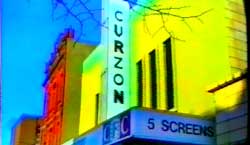
The Curzon was among those that suffered at the hands
of terrorists -
on 23rd September, 1977 - it and The New Vic and ABC
(formerly the
Ritz) were hit by fire bomb attacks. The latter two
were destroyed
however the Curzon managed to have a grand re-opening
later that year
with the screening of Star Wars.
Michael Open - author of Fading Lights Silver Screens
- remarked in his
book that the Curzon "seems to have been constructed
from the essence
of cinema."
<<
Back to the Curzon Cinema
RELATED
LINKS
Ex Projectionist Billy Blaney looks back
at two of Belfast's cinematic institutions :
The Roy
Roger's Club
The Ritz
|



 print version





















 POST
A COMMENT ON THIS ARTICLE
POST
A COMMENT ON THIS ARTICLE 