|
Flax crop
|
|
|
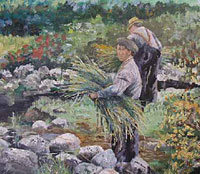 |
Putting flax in dam for 'retting'.
Original painting by Brian Willis.
Stones in the foreground used
to weigh flax down in water |
|
An important ingredient for the local linen industry,
harvesting a flax crop was extremely hard work
because everything had to be done by hand. Cutting
flax destroyed it, so it had to be hand "pulled".
After that it was tied into sheaves and carried
down to a dam, which was filled with water. Stones
would have been put on top of the bundles of flax
to keep it well submerged in the water. This "retting"
softened the plant fibres, so that the different
elements could be more easily separated in the
scutching process.
In 1987 for BBC Radio Foyle's "Uphill and Downdale",
Roy Hamilton spoke to Cathal Dallat and farmers
in the Eglinton area about growing flax. |
Read more
about Brian's painting and the research he undertook
to make sure it was as accurate as possible. |
YOUR RESPONSES
moregil:
As a school boy being reared in N Ireland I can remember the
smell associated with the removal of the flax from the dams.
I am sure that anyone else who was born in the late thirties
or the early forties in the country would have similar memories.
I have seen the whole process many times but that was a long
time ago. In the village that I was born in they also had
a flax mill, but that burnt down many years ago- I think in
the mid forties. Now all that is left is an old wallstead
covered with ivy. That was the last time that I saw it in
98 when on a holiday back there again. Nothing left but the
memories.
|



 print version





















 POST
A COMMENT ON THIS ARTICLE
POST
A COMMENT ON THIS ARTICLE 
