| Armagh Apple Blossom
(Article written May 2004)
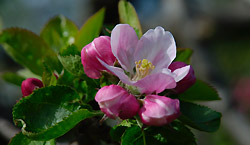
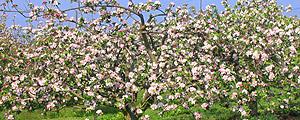
Few scenes could be more beautiful than rural
Armagh during the Apple Blossom season each May. ‘The
Orchard County’ or ‘The Orchard of Ireland’,
as it is known, comes alive with colour as the pink
flowers of apple trees blanket much of the deep green
landscape. Look more closely and you will find that
the blossom ranges from a delicate shade of pink to
vibrant fuchsia.
Listen
- Armagh Tour Guide Barbara Ferguson
describes the glorious sight of the apple blossom
in full bloom.
  |
A Little Bit of History
The history books tell us that apples have been grown
in Armagh for over 3000 years – St Patrick himself
is said to have planted an apple tree at Ceangoba, an
ancient settlement east of Armagh City. In the early
records of the Culdee Monasteries in Armagh we find
that at festival times the brothers were not allowed
to increase their intake of bread at meal times, but
they were allowed certain treats including the apple.
Another theory is that the Crab Apple came from Europe
and Western Asia during the Roman period.
At the time of the Plantation of Ulster tenants were
encouraged to plant orchards including apples, plum,
cherry and pear trees, with an enclosed ditch and white
thorn hedge.
The growing importance of apple trees is made clear
in the Brehon Laws,
“The penalty for cutting down
these is a fine of five cows, with lesser fines
for cutting down the limbs or branches.”
(The Apple in Ireland; It’s History and Varieties
Prof JGD Lamb)
|
Listen - Barbara ponders
some of the theories on the arrival of the apple
in Ireland. |
It is also said that William of Orange quenched his
thirst with the cider of the Orchard County, before
his victory at the Battle of the Boyne. The King sent
his cider maker, Paul le Harper, to Portadown with a
handful of equipment to make sure his army wouldn't
go without their favoured tipple.
The modern history of apple growing in Armagh can be
traced back to the village of Southwell in Nottingham.
In 1809 Mary Anne Brailsford planted a seed, which would
become known as Bramley’s Seedling, in her garden.
A number of years later Mary Anne’s property was
bought by Matthew Bramley and although he played little
part in the development of the tree, it bears his name.
In 1856 nurseryman Henry Merryweather recognised the
commercial potential of the tree and it received a first
class certificate from the Royal Horticultural Society
in 1883. One year later Mr Nicholson of Crangill bought
60 Bramley seedlings from Henry and introduced them
to Northern Ireland. By 1921 the Bramley had become
the principal variety in Armagh.
The Bramley Orchards
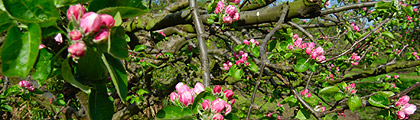
Although the Bramley Orchards have declined in size
since then, to around 1800 hectares, more inventive
production methods mean the total yield remains similar
at 40,000 tonnes.
Listen - Barbara talks
about the hard work involved in maintaining
trees.
Listen - Barbara
chats about the family business tradition
with orchards and the industry today.
|
Around 90% of the crop is peeled and diced for the bakery
trade and for the production of apple sauce. The remainder
of fresh packed apples are sold to retailers or pressed
for juice production for juice or cider.
Memories of the Orchards
The Orchards conjure up happy memories for many people
from the area, including he sweet taste of the locally
grown Kemp apple. The story goes that the Kemp was such
a favourite that the Belfast market men would stand
on ceremony waiting to take delivery of the fruit -
it was a real bestseller in years gone by.
|
Listen - Barbara recalls
some orchard raiding after school and talks about
a few of the delicious apple recipes made by her
mother, including Potato Apple Bread. |
Apple Customs and Traditions
- Drinking a toast to the apple trees
was usually carried out under the best yielding tree.
- St Brigid's Eve was the time to
save apples for the last night of January when old
fashioned griddle apple cake was made. In some places
this was known as St Brigid's tea.
- At Halloween apple dumplings were
made by roasting apples, which were then sweetened
with sugar, flavoured with nutmeg and washed down
with a glass of whiskey. Apple peelings were thrown
over the shoulder of a single person to discover the
initials of the person they would marry.
- Superstition says that if you pull
apples from a tree bearing blossom and fruit together,
there will be a death in the family.
- A wet St Swithin's Day is said
to indicate a bumper crop of unusually large apples.
- Apples were once used to treat ulcerated
wounds. Sorrel was gathered, crushed, then
mixed with apple juice and placed on the wound. Crab
apples poultices were also used for injuries.
Armagh Orchard Trust
The Orchard Trust was set up in 1995 to establish an
orchard to preserve the apple varieties which have been
associated with fruit growing in Ireland. The Trust
also has plans to set up a museum dedicated to the preservation
of the apple production culture of Armagh.
The introduction of the Bramley Apple around 200 years
ago led to the decline of many heritage varieties. Work
is now underway with the Heritage Orchard, located in
the historic walled garden of Drumilly Estate in Loughgall,
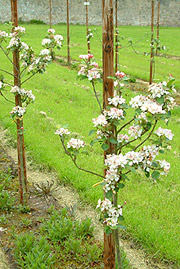
where planting started 2 years ago. Around 100 old varieties
are being researched including the Bloody Butcher, Vicar
of Brighton, Milltown Cooker and Keegan's Crab. Even
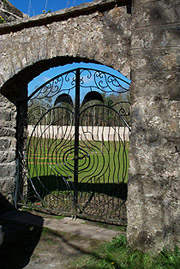
the wrought iron gate of the walled garden is decorated
with the shape of an apple!
Armagh Orchard Trust is keen to find more varieties,
so if you have an old apple tree in your garden, you
never know, it could be one which is missing from the
Heritage Orchard. All you need do is contact the Orchard
Trust and bring in the fruit from your tree at harvest
time. Get in contact at 028 38 892312/892344
As well as being of historical interest these old varieties
are being protected with a view to discovering more
about the apple trees which flourished before the wide
spread use of chemicals on pests and diseases, and had
a natural resistance to diseases such as scab.
They also had over extended flowering periods, flowering
characteristics to avoid late frosts, high quality fruit
and longer harvesting periods. With this is mind, it's
hoped that these elements will be transferred through
breeding to modern varieties.
 |
 |
 |
| The entrance gates
to the Heritage Orchard are styled in the shape
of an apple. |
Around 100 varieties
are being grown in the heritage orchard. |
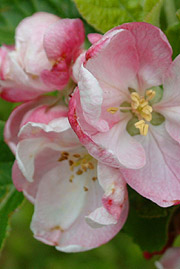
The Ross Nonpareil
is just one of the varieties which appears to be
flourishing. |
|
Listen - Frances Ward
works for the Department of Agriculture and Rural
Development. Let her take you round the Heritage
Orchard and explain their work. |
Peadar MacNeice was a founder
member of Armagh Orchard Trust, a man who was passionate
about the preservation of native apples. Although Peadar
died in 2002, his work is carried on by his fellow apple
hunters and colleagues at the Orchard Trust. Peadar
was also a poet and shared his love of orchards in this
work.
THE FUTURE
The verdant growth on the apple trees
Bearing their fruit in a July Breeze,
With grace and strength
They stand alone,
Each one an identity,
Not a clone.
Listen and you'll hear them,
Almost say
We await through time,
For the human day,
When the fruit we bear
Will be given with tear,
And once more we stand
For another year
Here, we'd rather be
And stay,
With the hares below us
Intent on play,
And the bee, from each foxglove
Onward goes,
To honeysuckle, hawthorn
And hedgerose.
Do you have memories of years gone by in the 'Orchard
County'? Does the sight of the apple blossom lift your
spirits? Maybe you have a recipe for Potato Apple Bread?
Share your stories and comments here at Your Place &
Mine by filling in the form at the bottom of the page.
|



 print version