| Turmoil in the Clouds.
by Joe Burns
The sound of the aircraft droned overhead, as I gazed
through the canopy of Glenarriff Forest Park, four miles
from Cushendall, in the beautiful Glens of Antrim. I
could tell by the sound it was low, but so far hadn’t
spotted it. Then as I walked clear of the trees and
on to the mountain road adjacent to Dungonnel Dam, the
Twin Otter of the Tellus Project, carrying out an airborne
survey for the Geological Survey, cleared the peak I
was walking towards. As it passed over me, I couldn’t
help but feel how ironic it was that this should be
taking place today of all days. For the mountain I was
walking on was Cloughcorr, the peak was Collin Top,
and seventy-four years ago to the day another aircraft
with a young pilot attempted to clear the top, and became
part of the oral history of the Glens of Antrim.
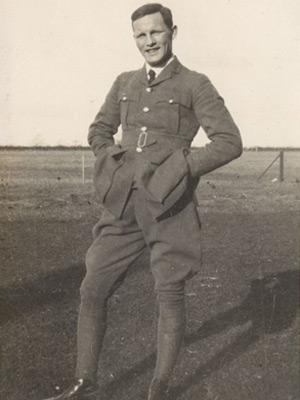
John Frederick Sutton was born on the 4th February
1910, in Enniscorthy, County Wexford. His Father, Mr.
Arnold J Sutton, a draper of George Street in the town,
and mother, Harriet, brought their three sons and daughter
up to be well respected Methodists. Fred, as he was
known, being the second son, like his siblings was educated
in Wesley College, which was situated in St Stephen’s
Green Dublin at that time. Fred was a popular student
and became Senior Prefect before leaving the College.
A keen footballer, he received his Honour Cap when selected
to play in the 1st XV. It was at this time he suddenly
became ill and on the advice of the family doctor was
sent to recuperate with relatives in the country. After
returning from the stay with an aunt and uncle, Fred
surprised everyone by announcing he wished to become
an aviator. So it was with great enthusiasm in 1929,
John Frederick Sutton entered the Royal Air Force with
a short service commission.
Fred’s training began at No. 3 Flying Training
School, Grantham, Lincolnshire, and in due course he
was posted to No. 99 (Bomber) Squadron at Upper Heyford
in Oxfordshire. While posted at these stations he continued
his great love for sport and represented his squadrons
in Rugby, Tennis and Hockey. Fred was a keen airman,
and was studying for the necessary exams to be considered
for a permanent commission. On the 12th November 1931,
Fred, was delighted to be posted to No. 502 Squadron,
Aldergrove, County Antrim, not only because 502 was
closer to home but also this would give him the opportunity
to attain the commission he desired.
At that time No. 502 Squadron was a Special Reserve
Squadron of the Royal Air Force and consisted of two
flights, ‘A’ Flight being a cadre of regular
officers and NCOs while the part-time, Special Reserve
personnel constituted ‘B’ Flight. Flying
Officer Sutton, being a regular officer, was attached
to the cadre flight. 502 Squadron was part of the Air
Defence of Great Britain, and the officer in command
was Wing Commander L. T. N. Gould, MC who succeeded
Wing Commander Leather during the first week in March
1932.
|
|
|
|
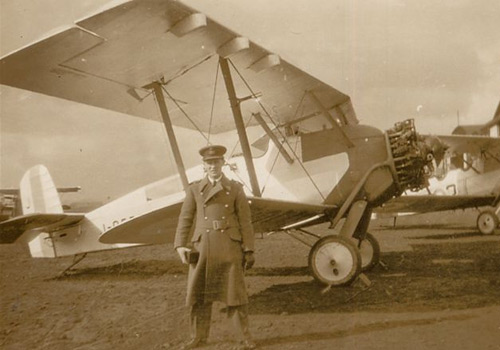
Flying
Officer Fred Sutton, standing in front of an Atlas |
|
In just a few short months Fred was proving to be a
competent and accomplished pilot. On the 19th of February
1932 Flying Officers Sutton and Wardell flew a Vickers
Virginia to Catterrick in Yorkshire, returning on the
20th. However on the 23rd the two young officers managed
to complete this same trip in one day.
In early April Flying Officer Sutton was returning from
leave, at home in Enniscorthy, he, his Mother and sister
Marjorie, travelled to Dublin from where he was to travel
by bus to Belfast. Fred said his goodbyes and left the
two of them in Henry St, Dublin shopping. Later, to
his Mother and sister’s surprise he turned up
having missed the Belfast bus so
treated the two of them to tea and cakes in a city patisserie.
They once again made their goodbyes and Fred caught
the last bus to Belfast. This was to be the last time
a member of his family was to see Fred alive.
On Sunday April 24th, Fred Sutton was the officer
in command of a group of airmen paraded to the Methodist
Church Antrim, to hear the Rev. Stanley H Keen, Staff
Chaplain, R.A.F. London, who was the special preacher
on All Attendance Sunday. Later that evening Fred joined
the Staff Chaplain and other friends at tea, and was
also present at the evening service. The following day
Monday the 25th April, Fred spent the day in the camp
and that evening visited his friend Flying officer R.
S. Sweet in his home. They parted at 7.30.
On the morning of Friday 29th April, Fred was to make
a solo navigational flight, flying from Aldergrove to
Larne, and then following the coast North to Cushendall,
before returning to Aldergrove, the whole exercise taking
approximately one and a half hours. The aircraft was
an Avro 504N, this was the standard trainer of the time,
and remained so until the mid 1930’s. The 504N
had been updated from the 504K by the installation of
a Lynx engine, beefed up Siskin-type landing gear and
a revision of the wing shape. The 504N had a top speed
of around 100mph and carried enough fuel for a two and
a half hour flight. Fred’s aircraft on the morning
of the 29th April was K1253, this particular aircraft
being extensively used for these solo practice flights.
The weather over Aldergrove was a mixture of blue skies
with the occasional mist patches; the weather over the
Antrim hills was of thick mist with the occasional clear
patch. Flight Lieutenant Harry King Goode, Adjutant
of the 502 Squadron, who lived in the officer’s
mess with Fred, looked on, as at 11.10am the Avro 504N
with Flying Officer John Frederick Sutton aged twenty-two
at the controls took off from Aldergrove. He watched
as the thirty-six feet wing spanned aircraft turned
and climbed into blue skies.
Even in 1932 Cloughcorr Mountain had seen its fair
share of tragedies. At the turn of the century three
young local men out hunting with their dogs got lost
in a blizzard, two were found dead from exposure the
following day. The third had fallen into one of what
is known locally as ‘Tanning Holes’. His
body was only found because his dog refused to leave
the spot. Several years later, a gamekeeper walked off
a cliff to his death, not far from the same spot. Local
people have a healthy respect for the area. Three such
locals were on Cloughcorr Mountain, on the morning of
the 29thApril 1932. They were shepherds, each tending
their own flock, some distance from each other, and
because of the thick fog, they were unaware there was
anyone else on the mountain that morning. None of the
men carried a timepiece.
John O Boyle, saw an airplane flying abnormally low,
as it passed into the only clear patch of sky, heading
in the direction of Cushendall. He estimated the time
between 11 and 12 o clock.
John Crawford the second shepherd was working in an
area two miles from Collin Top. He saw an airplane coming
from the Cushendall direction and pass over Cloughcorr
Mountain heading in the direction of the peak; he thought
the engine sounded unusual. John estimated the time
to have been after 11 o’clock. A few minutes after
seeing the plane pass into the fog, he heard a loud
crack.
The third shepherd was Michael McIlhatton, who was tending
his sheep just half a mile away from Collin Top. In
that area, the weather had taken on a surreal appearance.
Unlike other parts of Cloughcorr Mountain, where visibility
was poor, there were patches of fog all round with clear
bright skies here and there. The fog drifted from one
clear spot to the other making the visible invisible
in a moment. Michael thought the time was just after
11 o’clock when he heard a plane in the vicinity.
Watching the machine from time to time, he saw it circle
round and first appear to go southwest, then, shortly
thereafter, it turned round and went out of view in
a north-easterly direction. He heard the sound of the
engine for around a further ten minutes and then it
faded away. It seemed as thought the machine had passed
over the neighbouring mountain.
At around 2pm at Aldergrove, Flight Lieutenant Harry
King Goode and fellow officers were becoming concerned
that there was no sign of Fred. Police stations along
the route the Avro 504N had been flying were contacted
but there was no report concerning the missing plane.
One of the squadron’s twin engine, Vickers Virginias,
piloted by Flying Officer Stevens, was sent off to cover
the path the missing aircraft was to have taken. Just
before 3pm the search plane, flying over the Antrim
hills sent a message by wireless that they saw the wreckage
of a plane on one of the peaks on Cloughcorr Mountain,
but there was nowhere near by suitable for them to land.
Flight Lieutenant Harry King Goode informed the R.U.C.
station at Cushendall, by telephone, of the situation
and prepared a party to meet the police at the site.
Sergeant David Connell R.U.C. Cushendall, with Constable
Edward Harrison, Constable Albert Taylor and Doctor
Alexander McSparran, M.O. Cushendall, put together a
party of volunteers. The Police, who had great respect
for Mr Michael McIlhatton’s knowledge of the mountain,
and preparing for a search well into the night, called
at his cottage. He left his meal and proceeded to guide
the party. G.B. Newe, owner and editor of the local
monthly magazine, “The Glensman”, was also
present. The mist and fog had lifted as the small group
set out across the wild mountain, miles from human habitation.
After walking for around an hour, high on the slopes
of Collin Top the wreck could be seen one wing pointing
skywards, sadly showing them their way. It was a sombre
group of men that for the next two hours worked their
way closer to that point, eighty feet below the summit.
At 6pm the party came to the plane to find Flying
Officer John Frederick Sutton lying by the smashed cockpit
of K1253, dead. Doctor McSparran preformed an External
Post Mortem. The young pilot had suffered multiple injuries
including a fractured skull and thigh and his neck was
also broken. Doctor McSparran stated that death would
have been instantaneous. From marks in the ground it
was determined that the aircraft had first buried itself,
then somersaulted before coming to rest five yards from
where it first struck. The machine was a complete wreck,
parts being strewn for yards from the first point of
contact. The clock in the airplane had stopped at 11.30.
The small group watched as Flight Lieutenant Harry King
Goode and a party of men from R.A.F. Aldergrove made
their way across the heather. At 7pm the R.A.F. Officer
identified the body as that of John Frederick Sutton
and after consulting with both Doctor McSparran and
Police Sergeant Connell, gave the order. The body was
placed on a stretcher and the long walk over rocks,
heather and bog began, as once again fog shrouded the
mountain. The remains were taken to Cushendall where
the inquest was to take place the following day.
Constable Taylor was left to guard the wreck, and remained
until relieved by Constables McMinn and McIvor, who
had great difficulty in finding the fatal spot in the
dark and the returning fog, and once again had to call
on the help of Mr McIlhatton. The R.U.C. guard remained
throughout the Friday night being relieved on Saturday
morning by R.A F. personnel.
The inquest was held on Saturday the 30th April in
the small courthouse in Cushendall. The Deputy Coroner
for Mid Antrim, Mr John Owens, presided. District Inspector
J.A.Martin, R.U.C. Larne conducted the proceeding on
behalf of the crown. Flight Lieutenant Harry King Goode
represented the R.A.F, Mr Arthur McAllister, R.D.C.
being the foreman of the jury. Doctor McSparran and
the three shepherds all gave their evidence. Summing
up, the Coroner expressed sympathy with the relatives
of Mr Sutton, and stated the inference was that he had
collided with the hill in dense fog. The jury returned
a verdict in accordance with the medical evidence, which
stated that death was due to shock as a result of the
massive injuries. The jury expressed their sympathy
and those of the people of the Glens to the relatives
of the dead pilot and District Inspector J.A.Martin,
R.U.C. on behalf of the police associated himself with
these said sympathies. District Inspector J.A.Martin
then went on to pay a public tribute to Mr Michael McIlhatton,
without whom the task would have proved extremely difficult.
On Sunday 1st May in the Methodist Church Antrim, where
only a week before Fred Sutton was the officer in command
of the airmen paraded there, a Memorial Service was
held. The pulpit was suitably draped, and a detachment
of the R.A.F. personnel were present. Fred’s friend
Flying Officer R .S. Sweet was in command. After the
service the Rev. Mr Clayton, called for a vote of sympathy,
which was passed by the congregation to the bereaved
parents, brothers, sister and friends.
|
|
|
 |
| |
|
Fred Sutton’s parents were asked by the R.A.F.
ifthey should like a military funeral held in Northern
Ireland or for his remains to be brought home to Enniscorthy
at their expense. They chose the latter.
The funeral of Flying Officer Sutton left Victoria Barracks,
Belfast, on Monday morning the 2nd May after a brief
service, in the presence of officers and men of 502
Squadron. Full military honours were accorded, with
eighty of the airmen escorting the cortege for some
distance, with reversed arms. The casket, bearing the
inscription, ‘John Frederick Sutton, Born 4th
February 1910. Killed in Flying Accident, 29th April
1932 was covered with the union flag, surmounted by
his cap and several choice wreaths. The cortege was
accompanied to Enniscorthy by the squadron’s commanding
officer, L.M. Gould, R.A.F. and Flying Officer Stephens,
R.A.F. When the funeral reached the town, it was accompanied
by a long line of motorcars, with mourners and sympathisers.
Attendance was large with family and friends coming
from all over the country. The interment took place
in the family burial ground in the Moyne Cemetery. Amongst
the numerous messages of sympathy were a personal letter
from Lord Londonderry, Secretary of State for Air in
London and letters from the officer commanding B Flight,
R.A.F. Aldergrove; and Sir Philip Sassoon, Under Secretary
to the Air Ministry.
The grave was covered with a large number of wreaths
and floral tributes from members of Fred’s family
and friends. There were also wreaths from Air Marshal
Sir W. Salmond and officers of the Headquarters, Air
Defence of Great Britain; O.C. and officers 502 Squadron,
R.A.F.; Lt. Colonel F.R. W. Graham and Officers of the
1st Battalion, Royal Ulster Rifles; the members of the
Sergeants’ Mess, 502 Squadron R.A.F. and the airmen
of 502 Squadron R.A.F. After the funeral L.M. Gould,
R.A.F told Frederick Sutton’s mother that he was
a good pilot, and a great loss to the service, and it
was through no fault of his own that the accident occurred;
it was the abnormal weather conditions which caused
the low lying fog to take on the shape of the mountain,
causing Frederick to assume he had already crossed the
highest peak.
On Tuesday 3rd May an official of the Air Ministry held
an inquiry in the R.U.C. station Cushendall. This was
a private inquiry and among those present were Sergeant
David Connell R.U.C. Cushendall, Doctor McSparran, and
Michael McIlhatton. The inquiry found that the aircraft
had been perfectly airworthy when it left Aldergrove.
This had been determined from the examination of parts,
which were taken from the wreck. It was then ordered
that the remaining wreck, which was still under guard,
should be burned.
The Twin Otter once again droned overhead. I looked
up at the peak of Collin Top, now just thirty metres
above me, and watched a hare disappear over the skyline.
Sitting on the heather, and glancing once again at the
photograph taken on this spot almost three quarters
of a century before, I looked at the same mountain lough
as it changed colour when a breeze passed over it.
Today there was no fog drifting from one clear spot
to the other, making the visible invisible in a moment,
and thanks to the planting of Glenarrif Forest Park
and the building of Dungonnel Dam there are roads and
gravel tracks, which reduce the distance that seventy
four years ago those men struggled over, through bogs
and heather to reach this place.
I stand and adjust my backpack for the journey home
and as the sound of the aircraft engine fades over the
mountain. I look to the Northeast along the Garron Plateau.
For I know, less than six kilometres form here where
Flying Officer John Frederick Sutton died in 1932 is
the site where, ten years later, his colleague, Group
Captain, formerly Flight Lieutenant, Harry King Goode,
was also killed in an air crash, with circumstances
that, even today, still hold a mystery, but that is
another story.
Acknowledgements.
I would like to thank the following people without whose
help the research and writing of this article would
have been impossible. Mr Ernie Cromie, who kept me on
the right course throughout this mission. Victor Cramton,
Whitehead, Who put me in touch with Mrs Marjorie Doherty,
sister of Flight Lieutenant Sutton, and Mary Sutton
of Enniscorthy. Doctor Allister McSparran, Cushendall,
and the many people from the Glens for their tolerance
of my endless questions.
I also have to acknowledge Ron Parsons and Alan Watsons
book ‘Flying the Red Hand’, which I found
both invaluable and an inspiration.
Your Responses.
Liz Weir - July '08
A fascinating true story which took place on a hillside
that I can see from my house - when the fog descends
I can see nothing which is what must have faced that
poor young pilot.
Frank Kennedy McLernon - Jan '08
A beautifully written piece of real history, thank
you!
|



 print version





















 POST A COMMENT ON THIS ARTICLE