Page 2
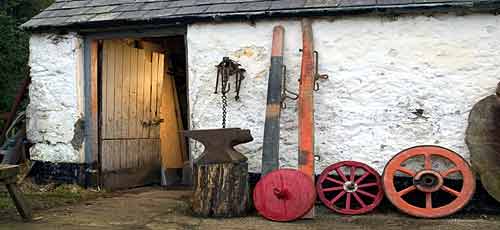
Selecting timber wasn't all that Davey was to learn
in his early days in McMullans workshop, however.
"The first job I was put to was making sprouting
boxes for potatoes," he says, "and when I
sat down at the bench the fella opposite said 'before
you pick up a hammer, there's four things you need to
learn.'
"The first thing was to keep my eyes open
and the second to keep my mouth closed.
Third, keep my nose clean and fourth thing
was to keep my socks up."
He went on... "Now, I understood what he meant
by the first three but I never could figure out what
socks had to do with joinery. Many years later someone
told me that, in the days of the old hiring fairs, farmers
looking for journeymen would inspect the socks of the
men available to hire. They reckoned that if a man was
particular about his appearance he would be particular
about his work, so a neat pair of socks was important."
 |
When he began to learn the craft
skills involved with making wheels and carts, Davey
had to become familiar with some new tools, like
a 'round square' which wasn't a tradesman's joke
at the expense of an apprentice but which was used
to mark out where the mortises for the spokes would
be cut on the elmwood nave. As well as the braces,
planes and spokeshaves, wheelmaking demands the
use of numerous specialist bespoke tools for maintaining
a constant radius and clamping part-built wheels.
Many of thos tools had to be hand-made before the
real job even started. |
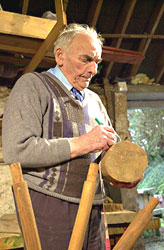 |
| Davey demonstrates marking the spacing for the
tenon holes on the wheel's nave. |
The outer rim of the wheel was made up of six wooden arcs
called 'felloes' which slotted together, using carefully
angled dowels, to make a perfectly circular wheel. The
radius of the arc of these felloes had to be calculated
very carefully and then marked out onto slabs of ash.
Each felloe also had to have mortises cut into its
inner surface to receive two spokes and the tenons on
the spokes were carefully measured to make sure that
the end did not touch the inside of the outer rim. When
the felloes were fitted together, a gap equal to the
thickness of the iron hoop was left between each felloe.
Assembling all of the pieces together required a real
'knack' and the finished wheel was tapped gently together
with a mallet.
The iron hoop was also made in the shop so some smithying
skills, as well as hard graft, were needed to complete
the job. The hot iron was fitted to the wheel and as
it cooled it drew the felloes neatly together, bonded
with the ash and gave a hard-wearing edge to a wheel
built to last.
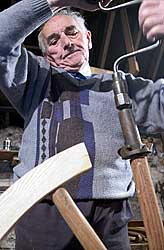 |
| This special brace has a cutting bit like a pencil
sharpener for making spokes. |
To demonstrate the longevity of a well built wheel
Davey showed us an example which he made some 45 years
ago. He didn't make only spoked wheels though. Some
of them solid rather than spoked and were carefully
cut from a single piece of wood. He explained that a
solid wheel is by no means an easy option and the making
of them harboured a few pitfalls.
As with the nave of a spoked wheel, where to cut had
to be carefully judged so that the core (of the tree)
lay in the dead centre of the wheel. There had to be
complete uniformity of strength across the wood. Davey
points out, however, that a solid wheel should not be
cut in a perfect circle...
"If you make it a circle then, when you put the
iron hoop on, it will be squeezed into an oval because
the wood at the parts running alongside the grain will
give way more than the parts at the ends of the grain.
"So what you have to do is cut an oval and, if
you do it just right, it will be a circle after the
hoop has cooled."
Odd as it might seem, not all of Davey's customers
were concerned with the accuracy of his craftsmanship.
In fact two particular customers didn't even care if
it was round! Here he tells us an amusing tale of how
two ladies approached him, very keen to buy a wheel
from him... yes just one wheel!
|



 print version





















 POST A COMMENT ON THIS ARTICLE