|
Article by Rory Connolly
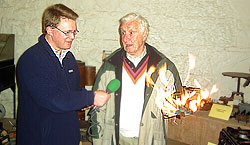
Do you know what helped pay for the building
of Belfast City Hall, The Albert Clock and simultaneously
lit the streets of Belfast? Sam Gault invited us to
Carrickfergus to visit Flame, the Gasworks museum.
| |
|
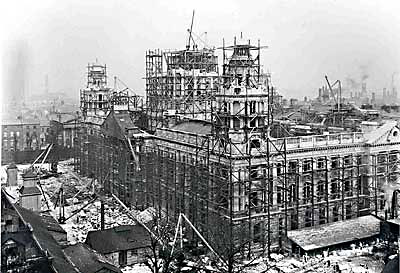
Belfast
City Hall under construction in 1901 |
In 1855 Carrickfergus Gasworks opened up its first
set of coal burning furnaces to help power the street
lamps of the town and its surroundings. Sam, a former
manager of the Gasworks and now proud tour guide of
Ireland’s only gas museum, described how the process
worked.
The mini furnaces known as retorts were used to process
coal into gas. These retorts baked coal instead of burning
it to produce gas, which, after being purified was piped
around the region.
Each retort had two stokers, who worked eight or nine
hour shifts, one packing the coal into the furnace and
another removing the coke. Sam remarked that when the
stoker opened the door to remove the coke he had to
burn off the first bit of gas that escaped to prevent
the retort exploding.
 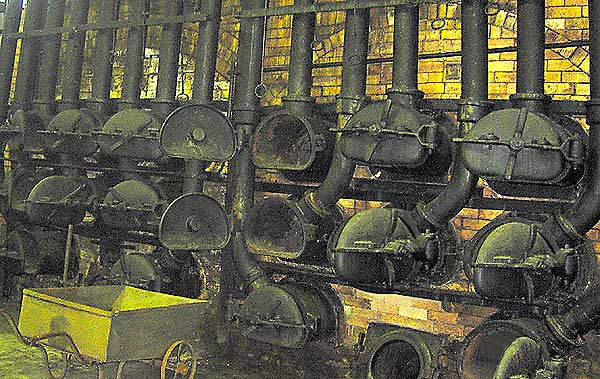 |
a
room filled floor to ceiling with coal burning
'retorts' which produced gas, originally, for
street lighting |
Tough as it seems this stoker got a meagre twenty-five
pence a week, while his partner, who loaded the retort,
was slightly better off with forty-five. By 1947 Carrick’s
Gasworks had expanded to three rooms of retorts with
three teams of stokers and a total staff of seventeen.
In contrast, owners of Gasworks could become very
wealthy; profits could be made not only from the gas
produced but also through the sale of coke and tar left
behind. Sam remarked, “The Belfast Gasworks paid
for the building of City Hall, The Albert Clock and
Queens Bridge”.
Even with gas’s dangerous reputation, the Carrickfergus
Gasworks had only one fatality in it's working history,
and that was strangely due to electrocution. Henry McAuley
was the unfortunate worker, who ran over a bare wire
with a heavy metal wheelbarrow used to haul away tar.
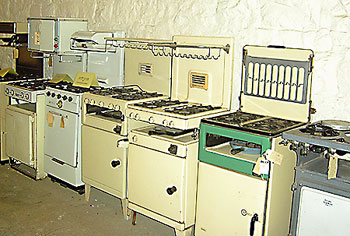
The Gasworks museum also hosts a ‘Hall of Flame’,
a trip back in time through the history of gas appliances
from the first cooking ring adapted from gas lighting
to today’s modern fixtures. Included in this is
an early model of a gas powered chip pan, a profitable
sideline for many a housewife.
|
|
|
a range of gas cookers down the years, including the Cannon
Fridge and Oven "combi" on the far left
of this photograph |
Sam claims that, “It’s a great delight
to be able to bring people in here”. He’s
determined to preserve the memories of the dedicated
staff who worked the station. “I made a vow that
the place wouldn’t end up on the scrapheap.”
He once tried to move the museum to the Ulster Folk
museum, but Flame now sits perfectly at home in Carrickfergus.
How does Sam find all his
artefacts? - “I asked a few plumbers to look out
for anything they thought was interesting.” He
is still missing one vital treasure, “What I’d
really like is a lamplighter’s pole.”
So, over to you, the YPAM audience, can you help complete
Sam's collection by donating a lamplighter's pole ??
If you can help, please fill in the form below.
YOUR COMMENTS:
Andy - February '08
Hi! I'd like to know the year of manufacturer of the
New World seventy five cooker? Thanks so much, regards
Andy.
Bob Allen - Feb '08
Through genealogy research, I became aware that my
great great grandfather was a manager in the Carrickfergus
Gas Works during the 1870's. His name was Robert Green.
Do you keep records of people who worked over the years?
Eleanor kelly - Apr '07
Can u tell me the name and location of grave
yards in carrickfergus?
Nikki - Feb '07
Hi
I have a cannon 134F in my kitchen that i still use it
was my grandmothers and i now live in her house, i am
having a new kitchen soon and will be sorry to see it
go.
Charmian Hughes - Jan '07
hello, can you tell me where I can get replacement control
knobs for my 1958 new world rangette cooker ? thank
you.
Chris Jones - July '06
I also have a new world seventy six, thinking of selling.
would it be worth anything?
Ian Penfold - July '06
Please can you tell me where I may be able to obtain
a replacement oven door knob assembly for a New World
cooker labelled Seventy-Six as the plastic parts of
mine, which is still in daily use, have broken? Thanking
you in anticipation, Yours faithfully, Ian Penfold.
Maureen and Richard Virgoe - May '06
What a fantastic site.
Absolutely fascinating. I have in my possession - excellent
condition and good working order still today a new world
gas cooker labelled seventy-six and converted to natural
gas on 28th September 1970. What can I do with it? Are
you interested? Thank you in anticipation.
Samuel Gault - Mar 06
To find out more, feel free to contact the Gas Museum
at www.flamegasworks.co.uk
or for a guided tour phone to arrange either a tour
for groups or families Phone 02893369575
|


 print version