|
Article by Brian Willis
A natural wonder
The Giant's Causeway on the North Antrim Coast has attracted visitors from the four corners of the earth in growing numbers ever since the first causeway road was built around 1830. One of the natural wonders of the world, explanations of its peculiar hexagonal basalt columns range from the scientific to the mythical. Folklore tells how the great giant Finn MacCool, the Ulster warrior, built the causeway as a path during a fight with a rival Scottish giant. |
50 years ago
With the continued interest in a new Visitor's
Centre for the Giant's Causeway, Your Place & mine
took a step back fifty years to discover what
trade was like there in those days.
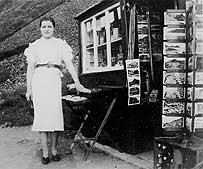
The picture on the right shows Ina Moore standing
outside one of the many little shops at the Giant's
Causeway. . As far as we knew Ina had emigrated
to Canada, but wondered if anyone could help us
track her down. We couldn't have had a better
response.
Ina's daughter, Diane Moore, and a friend Joy Jardine have e-mailed us on behalf of Ina. Apparently this picture of Ina was taken in 1937 when she was 17 years old and worked at 'The Chalet' tearoom. Ina, whose name was Bennett at the time, loved working at the Causeway. In 1945 she went to Canada as a war bride, and now has 3 children and 4 grandchildren.
Click here to read more of Ina Moore's Causeway memories.
A few years ago Ina took a trip home and visited
the Giant's Causeway. Sadly she was disappointed
with the changes she found and missed all the
little stores which had given her so much pleasure
as a young woman. Joy says Ina still makes the
best soda bread in the world! I wonder what secret
ingredients she uses? Has anyone else got a good
soda bread recipe or recipes for other traditional
Irish fare that they'd like to share? |
The entrepreneur
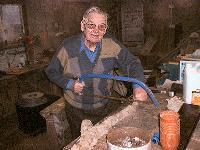
When Dan McConaghy came out of the navy after the war, he and his wife ran one of the eight shops that were along the bottom of the cliffs at the Causeway. These were timber-framed little cabins covered in galvanised iron where visitors could buy postcards, china, rings, etc. Together, Dan and his wife built up a thriving business, but in those austere times souvenirs to sell in the shop were hard to come by, so Dan set to and made his own. Shillelaghs were always a much sought after gift and Dan traveled throughout County Antrim seeking out the high hedges from which to cut the thorns. Then it was back to his workshop at the Aird where he fashioned them into the souvenir we know so well. |
World exports
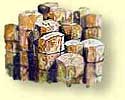
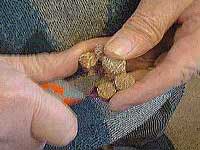
One popular trinket which many of the Causeway entrepreneurs used to make, was a little hand carving of one of the local features - the "Wishing Chair". These went around the world in their hundreds as tourists took them home. They were fashioned, not from the Causeway stone, but from a softer rock (Lithomarge). This was found in a nearby area called the Loom but was usually covered by the sea. Dan would dig out this rock then carve it with a penknife. Perhaps you still have one of these ornaments on your mantlepiece? If so please tell us. These pieces are now rare as the National Trust stopped the removal of the rock when they took over the ownership of the area in 1962, The turnstiles and the shops were also removed at that time. The little Causeway shops were visited by many hundreds of tourists from around the world. as Dan reels off the list of coach parties that used to arrive on a daily basis from hotels throughout the province.
Listen
- Dan talks about coach parties. |
One horse-power
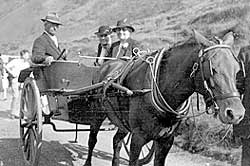
Many of the tourists would avoid the long trudge down (and up!) the long hill to the main causeway by paying for a ride in one of the numerous pony and traps. Here you see a 1937 photograph of two lady tourists escorted by their guide, Alex McLernon. Do you perhaps know or recognise either of these ladies? If so please tell us!
|
The ice cream man..
One regular visitor to the Causeway after the war
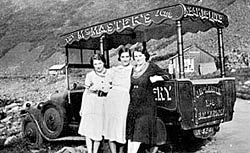
was J McMaster's Ice-cream who brought their van
from Ballymoney. You can just see one of the Causeway
shops between the upright bars of the vehicle. The
lady in the centre of the trio is Nellie McClelland
(who owned the shop that Ina Moore was photographed
in front of - see top of this page). We didn't know
who was either side of her, until Karen McDowell
made contact. Karen tells us that 'on the left is
Mary Pollock and on the right my grandmother Dorothy
McMaster (nee Pollock).' Apparently both ladies
are still alive and well.
Click here
to read more about McMaster's
Icecreams.
Katie McLernon also helped in one of the shops
during this era and still enthuses about a seaweed
dish which they called "Sloake". This was made
from a particular type of weed gathered right
on the seaward tip of the Causeway at low tide
during the winter, usually after a sharp frost.
Katie describes here the gathering and cooking
of this North Coast delicacy.
Listen
to Katie describing the gathering and cooking
of Sloak
|
| |
If you have anything to tell us about the Causeway or its shops, or maybe just something of special meaning to you, whether in response to these articles or not, please feel free to respond or submit your own article.
This article was submitted to Your Place & mine by Brian Willis of Bushmills and the Archive photos have been kindly provided by Isobel McKay)
|
|
|
|



 print version





















 POST A COMMENT ON THIS ARTICLE