|
As a small boy, Mike Cooksey used to hear snippets
of his father's wartime stories, but never knew the
extent of his exploits. More than 60 years later he
came face to face with a man who lived, laughed and
fought under his father's command.
The sprightly 73 year old travelled from his
home near Bristol to meet Tommy Shields in Larne, whose
modest accounts of his actions under enemy fire
belie the truth, which Mike believes saved many allied
lives and in particular Mike's father.
After sifting through his father's papers Mike discovered
the account of the journey of the ML1030 near Crete
and subsequently learnt that its sister ship, the ML1387,
had been restored and is berthed in Southampton. With
his appetite whetted, Mike couldn't believe his luck
when he stumbled on the YPAM story online, featuring
the boat his father commanded and then discovered that
a survivor of the war was alive and well and willing
to share his account of the Crete evacuation.
In addition Peter Siddall, the son of the ship's stoker
Harold Siddall, had aleady been in contact with Mike.
The pair began to share information on their fathers
Naval experiences and the ML in particular.
Audio
Clip I: Mike Cooksey explains the background to meeting
up with Tommy.
|
|
|
 |
|
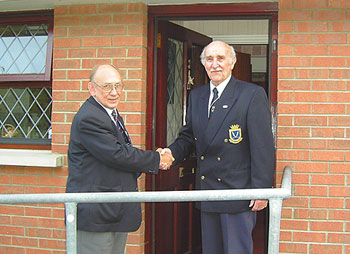
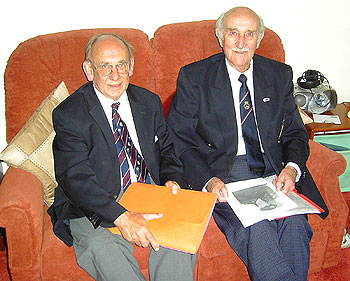
Mike meets Tommy at his home in Larne, Co.Antrim
|
|
The account below was published in Lloyds List and
Shipping Gazette Monday November 10th I941. It was the
result of a letter sent by Mike Cooksey's father, Lt
W 0 Cooksey, skipper of ML 1030 to his brother in law
George Stewart a Lloyds Broker who was then Chairman
of Stewart Smith and Co.
Much has been written and justifiably written about
the part played by small craft in the evacuation of
Dunkirk, but not much has been heard of their work in
the evacuation of Crete. Here is a story of the adventures
of a Motor Launch which was shipped out to the middle
east some time before the German attack on Crete:
"The
boat duly arrived at Port Said and I had to take her
round to Alexandria. Being by myself, this meant sixteen
hours on the bridge making a night passage. The weather
was foul, the decks leaked like a sieve, having opened
up in the blazing sun coming out, the result was that
everything was soaked down below. We had the decks caulked
in Alexandria and started our job of night patrol, very
often clicking daytime jobs as well as emergencies.
This lasted until we received orders to proceed to Suda
Bay in Crete. I expect that those names mean little
or nothing at home, but believe me when I tell you that
we who were there will always have vivid memories of
everything they stood for. Before starting out I had
a young 'No 1" just out from England, appointed
to me; then we set out on our 500 mile run.
|
|
|
 |
|
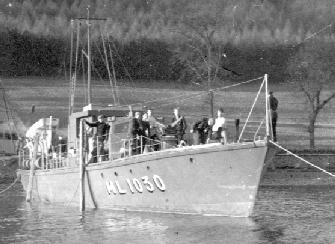
ML I030 |
|
We made Suda Bay safely in fairly good time and
at first life was fairly normal. We did our night patrols
and with the exception of occasional air raids, our
days were uneventful. Life began to get very trying
from May 16th onwards, when raids became more regular
and of greater intensity; dive bombing was introduced
and machine gunning with incendiary and explosive bullets
was the order of the day. At first our Anti Aircraft
batteries kept them in check, but they came over in
such numbers that eventually we were more or less at
their mercy and they commenced making a determined effort
to sink every ship in the bay. They concentrated on
the larger ships one by one.
At that time we received no direct attention unless
we made things too unpleasant for them when they were
attacking another ship, and this we did as often as
we could. Our boat brought down one plane and participated
in the bringing down of three more. However, they eventually
started cleaning up the smaller craft and things got
damnably hot. As you know, we are all wood, very light
at that, and have little protection. Eventually on our
return from night patrol we had to make the boat as
inconspicuous as possible against the side of the cliff
and take to the cliffs in the daytime hiding in the
caves or any cover we could find until the raids were
over. Our decks were by this time well peppered. We
returned to the boat at night and did our usual patrol.
Then came the day when we received orders at 2.30
a.m. to clear out and try to make Alexandria, or alternatively,
if it was too late, to burn our boats and try and get
to Sphakia on the south coast. The message was verbal
and the messenger had forgotten the name of the place
that did not help much. It was too late to start away
then, since we could not possibly make the south coast
of Crete before dawn, and air patrols were very active
from that time onwards. I therefore dropped the mast,
ran out of the bay, took shelter behind a small island
close to the cliffs and covered all exposed glass, hoping
for the best that the patrols would miss her. I was
in a small cave overlooking the most terrific and continuous
bombing and machine gunning of an area about five miles
square on the opposite side of the bay but that is another
story.
We were not spotted, although Jerry was advancing
rapidly on both sides. We slid out of the bay after
dark and although machine gunned as we turned west round
the headland, managed to get clear. Except for occasional
scares due to flares the trip around was uneventful
and we arrived at the south west corner of Crete just
before dawn. I had intended to take cover under the
cliffs at this point for the day and make another night
dash for Alexandria. However, we found the Germans in
possession a ship was burning and flares plentiful.
I waited not upon the order of my going and decided
to try and make and island called Gavdipulo which is
about 25 miles south of Crete, hoping to get cover before
we were spotted. Vain hope.
|
|
|
|
|
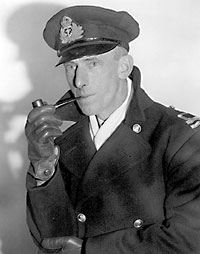
William Cooksey was actually a dentist,
but had withheld that information when he was
embodied to ensure that he could get back to the
Little Ships on which he had already served during
the latter part of WWl. He was 48 years old at
the time of the Crete evacuation but declared
afterwards that he never been so physically fit
as a result! |
|
At 5.30 a.m., when only 15 miles from the island,
a Heinkel spotted us. He gave us the once over, decided
that he didn't like us and commenced to attack. We fought
him off whilst the ammunition lasted; two guns jammed
and let us down, giving him his chance to do his stuff.
I called all the crew into the shelter of the wheel
house with the exception of one man on the bridge to
keep watch ' and let me know Jerry's movements; One
man took the starboard side of the wheelhouse and one
the port. I had the wheel and with a running commentary
from these three lookouts, the fun started. (Jerry had
been joined by a pal by then). Directly they gave the
word that the bombs had been unloaded I manoeuvred the
boat to avoid them.
We cleaned out one plane but the second got us
with the fifteenth bomb to be dropped, blowing off the
forepart of the boat. Every attempt to get the dinghy
and rafts was circumvented by their machine gunning
us with explosive and incendiary bullets. We seemed
to spend a lifetime dodging in and out of the wheelhouse
while the boat went more and more down by the head.
I had my" Sparks" wounded at this time. Eventually,
with the boat afire, our pals either got bored or were
well satisfied we could do nothing to help ourselves,
and cleared off.
We had to hastily stop up the bullet holes in the
dinghy with splinters of wood and tinned sausage meat
plus elastoplasts and, dropping her over the side with
one raft, got away with seven in the dinghy and three
on the raft. We then pulled for the coast of Crete.
Things were very difficult and we had to bale the whole
time. There was a good sea running which kept swamping
the boat. When the raft was not awash, it was capsized.
Pulling was maddening there was only one pair of oars
and row locks, so two men had to sit side by side on
a small seat; this led to irregular pulling with the
raft pulling us all angles and our course was more than
erratic.
After several hours rowing, when we seemed so close
to Crete, I realised we could not make it owing to the
set of the tide and the wind, so altered course for
the island which we reached at 3 a.m. the following
day after 21 hours rowing.
We had no water or food all that time, so after
a rest we searched for water. None was to be found.
Things were getting rather serious. The men on the raft
had never called for relief until utterly exhausted
and at no time did I ever have to detail a relief. One
man instantly slipped over the side and swam to the
raft, which we hauled in and got the exhausted man on
board all very ticklish in a ten foot dinghy and a rough
sea on the quarter. By 11 a.m. the sea had moderated.
We decided to discard the raft, which in any case none
of us had the strength left to pull, so, all ten getting
on board the 10 ft dinghy we left the island in another
attempt to reach the coast of Crete. We had only about
5 inches freeboard and had to continue baling out the
whole time, although we had by then repaired the worst
of the holes with the leather taken off the oars.
We managed to strike the coast at 5.30 a.m. after
a further 18 hours continuous rowing and baling you
can guess that we were all pretty well out for the count
we found a cave, hid the dinghy and flopped out. Then
we began another search for water, without any luck,
but by mid day we were found by an Australian soldier,
who, with a couple of his pals fetched us water and
dry crusts, all they could get they too were hiding
up in the hills with about fifty more. We joined them
at their camp that night.
Audio
Clip 2 : Mike and Tommy recount the harrowing journey
in the over-filled dinghy in the sea around Crete -
avoiding enemy aircraft and coping with debilitating
thirst and hunger.
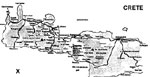 |
click on Mike's map
for a detailed view of the journey the men faced. |
I advised them to split up their members into parties
of ten the next morning and trek along the coast to
a place called Sphakia, which from my chart looked to
be a likely place for an evacuation, or at any rate
a place where we might get hold of a boat. I arranged
for half my crew to be split up amongst them to get
over the water difficulty. It meant a march over foul
ground and mountains of about 20 miles but with a 99%
chance of getting there. My "Sub" went with
them. I could not leave my wounded men and three more
who had no shoes, so I called for a volunteer to come
with me in the dinghy along the coast in an attempt
to get them round. The Chief Engineer volunteered although
he knew we stood little or no chance on account of the
patrol planes in daylight. He gave his boots to the
youngest of the bootless boys and the shore parties
set off.
We left at about 9 a.m. I found I had to row nearly
the whole way, the other boys were good for one oar
each but were too raw at a pair of oars to take the
dinghy close in around the rocks and reefs where we
had to make our way to avoid detection. We had many
scares and twice had to leave the boat and run for shelter
into the rocks. However, about 4 p.m. I realised we
were close to Sphakia Bay. I warned the boys that we
dare not go much further in daylight as we did not know
if the Germans were in occupation, so we decided to
go into the first decent bit of cover we could find,
wait for dark and decide what to do.
I rowed on round the next bend and saw a really
big cave right ahead. Rowing like steam for it I had
the shock of my life when we were challenged and for
a few horrible moments thought that we had lost the
rubber, but the next moment we recognised one of our
own Landing Craft which was in hiding awaiting the darkness
to fall to assist with the final evacuation that night.
We clambered on board just in time as Jerry started
machine gunning right and left apparently not at anything
in particular so far as we could see, which in that
cave was not far.
The evacuation was carried out and we arrived in
Alexandria about 6 p.m. the following day, very much
the worse for wear and owning just what we stood up
in. I found my "Sub" there. He had come over
in another boat. He said all our other boys had reached
Sphakia but had had to conform to a routine before being
allowed down on to the beach. He said that while attending
to them he missed them and thought they had gone on
well they had not. I think I went damn near crazy when
I heard that, after all they had been through, they
had got beaten at the post. For the first week I explored
every possible avenue to trace their possible return,
but had to give up hope in the end. I still think they
are nothing worse than Prisoners of War there. They
were great lads."
|
|
|
 |
|
Tommy and Mike exchange documents and "secrets"
!
|
|
Mike is currently continuing his research into the
complete history of the ML1030 for the Medusa
Trust.
Tommy, as ever, is in fine fettle and recalls the
extreme dangers of war as if it were all a boyhood adventure
- "You know, it sounds strange, but I wouldn't
have missed it."
During the meeting the many in-jokes and laughter without
detail, were explained away as " our little secrets".
It was a great privilege to be a part of the this meeting,
which was a very personal and emotional one.
YPAM would like to thank Mike and Tommy for their openness
and wish them both the best of health and good fortune.
|



 print version





















 POST A COMMENT ON THIS ARTICLE