The
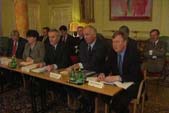
Irish government, represented by Taoiseach Bertie Ahern at the first
session of the British-Irish Council |
The
inaugural summit meeting took place in Lancaster House on 17 December
1999. Ulster Unionist leader David Trimble described the meeting as a
'revolutionary political development' and the Irish Taoiseach Bertie Ahern
said the BIC was part of a new institutional architecture which widened
the relationships beyond 'Anglo-Irish'.
At
the inaugural meeting a list of five topics was agreed and different administrations
were assigned a key area:
| - |
Drug
trafficking and abuse (the Republic's government) |
| - |
Social
exclusion (the Scottish Executive and the Welsh Cabinet) |
| - |
Transport
(the Northern Ireland Executive) |
| - |
The
environment (the UK government) |
| - |
the
Irish and Ulster Scots languages, and |
| - |
e-commerce
(Jersey) |
|
|
|
| It
remains to be seen whether the BIC will be a forum in which policies on
the agreed areas will be decided or whether its main function will be to
co-ordinate policies between different parties involved. References in the
Agreement to members developing bilateral or multilateral arrangements
suggests the BIC could be more than a talking shop on matters of mutual
interest.
The
BIC will have to compete in an already over-crowded market of intergovernmental
activity which includes the British-Irish Interparliamentary Body, the
British-Irish Intergovernmental Council and the Joint Ministerial Committee
on Devolution. The Constitution Unit at University College London suggests
that the BIC, if it is to be effective, "will need a clear role,
a strong interparliamentary body, and an independent secretariat and budget".
|
|
|