The
body that will draw up proposals for a Bill of Rights is the Northern Ireland
Human Rights Commission which came into existence on 1 March 1999. The Commission,
the first of its kind in Western Europe, is led by its Chief Commissioner
Professor Brice Dickson, formerly a professor of law at the University of
Ulster, and nine part-time Commissioners. It is the responsibility of the
Secretary of State for Northern Ireland to ensure "as far as practicable"
that the commissioners, as a group, are representative of the community.
The Commission has an annual budget of £750,000, which the Chief Commissioner
believes is not adequate for it to fulfil its functions fully.
The
functions and powers of the Commission are set out in Sections 68 to 71
and Schedule 7 of the Northern Ireland Act 1998. The principal functions
are:
-
The
Commission has the powers to vet all legislation going through the
Assembly to ensure it is compatible with the European Convention on
Human Rights. Legislation that contravenes international human rights
standards will not be passed into law.
-
It
has the powers to investigate human rights abuses and bring legal
proceedings on its own account or on behalf of individuals. However,
the Government has not given the Commission the powers to acquire
documents or interview witnesses. In this regard its powers fall short
of the UN approved international standard for national human rights
institutions as laid down in the Paris Principles. The Commission
will advise the Secretary of State on additional rights to be enshrined
in a Bill of Rights for Northern Ireland, which will supplement the
rights in the European Convention on Human Rights. The Good Friday Agreement
states that such additional rights should reflect "the principles
of mutual respect for the identity and ethos of both communities and
parity of esteem".
-
Under
the Good Friday Agreement the Irish government is required to establish
a similar Human Rights Commission. Both Commissions will work together
in a joint forum to establish a common set of human rights standards
throughout Ireland.
-
The
Commission will also promote an active human rights culture in Northern
Ireland through education and the media.
The
promotion of a human rights culture in Northern Ireland has raised a number
of provocative questions. In particular, one writer raises critical questions
about how human rights should be enforced while another questions the lack
of public debate around the concept of human rights.
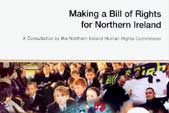
To encourage debate and ownership of any future Bill of Rights, the Human Rights Commission launched a public consultation process on 1 March 2000 to find out what people wanted to see included in the Northern Ireland Bill of Rights.
The Commission held a wide range of events at which people could present their ideas and on 3 September 2001 it published its provisional proposals.
The Commission will be taking until the end of May 2002 to consider all the views submitted. This will enable people to make submissions to the Commission or to add to submissions already made. As soon as the Commission has considered the public reaction it intends to send its final proposals to the Secretary of State with a recommendation that the government enact the Bill of Rights as soon as possible.