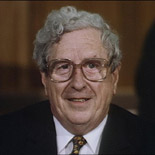
Garret FitzGerald, Part One
Garret FitzGerald argues that after Bloody Sunday in January 1972 it was inevitable hat Stormont would be prorogued, but says much of the responsibility for the state of affairs in Northern Ireland must lie with the Home Office of which the N.I. Office was a part. He said the British had taken the view for half a century that no initiatives were needed, while the Irish government had made anti-partitionism its stated policy, which was unconstructive and unhelpful and only served to alienate Unionists. He describes in detail the Sunningdale talks in 1973 and says Ulster Unionist leader Brian Faulkner believed he had done very well in the negotiations in securing recognition of the unionist veto on Northern Ireland's constitutional position. He reveals that the Irish government decided against a referendum on the Republic's articles 2 and 3 claiming jurisdiction over Northern Ireland for fear that they would lose, and claims that all sides underestimated the irrational element in Unionist fears over a council of Ireland agreed at Sunningdale.
Garret FitzGerald, Part Two
Former Taoiseach Garret FitzGerald gives the inside story of the Sunnigdale talks and says he pleaded with the SDLP to agree to offer Unionists more than they were getting because of fears of a unionist backlash against the deal. He is highly critical of former UK prime Minster Harold Wilson and claims Wilson's position of British withdrawal would have been a disaster. He also says firm action by the British Army in the early days of the UWC strike would have worked, but the British Army GOC Sir Harry Tuzo dominated British government thinking and the Army was unwilling to confront the loyalist strikers. He described Wilson's "spongers speech" as a disaster and condemns Wilson's meeting with the IRA in Dublin in 1971. He is also highly critical of the BBC's coverage of the UWC strike, and says the Irish government was deeply worried about what they saw as the BBC's apparent sympathy with the strikers. The Hunger Strikes greatly strengthened the IRA's hand and the Irish government were fearful that violence could spread throughout the island, one of the key actors which led them to develop the Anglo Irish Agreeement. He says he tried without success to meet Unionist leaders to explain Irish government thinking.
Garret FitzGerald, Part Three
Garret FitzGerald describes how the British Government had no independent sources of information about the civil disturbances in 1969, and is critical of reporting which did not say who was responsible for pogroms against Catholics in August 1969 at the time. He defends the Irish government's broadcasting ban on interviews with Sinn Fein or the IRA, and says it may have helped the IRA move towards peace. He believes there will be political normality in Northern Ireland and people on all sides have learned from the conflict, but it is a painful and extremely slow process. He says the Irish Government did succeed in getting rid of institutionalised discrimination in Northern Ireland, but the two main results of the IRA campaign were to have both governments agree that there could be change to Northern Ireland's position without Unionist consent, while the Northern economy is now weaker than the Southern one, relying on British subsidies, because of a lack of foreign investment.. Regardless of politics, economically it is now impossible for a united Ireland to happen in the foreseeable future. He says history will be hard on the Irish governments for its policy on Northern Ireland pre-1969, but kind to it after that.
 Home Home |
Explore the BBC |