| Crab
Apples
1st
March 2005
When
it comes to value for money it is hard to fault
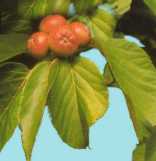
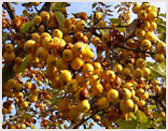
the crab apple. The heavy crops of small apples
are not only highly ornamental but they make
a wonderful jelly. The spring flowers make a
fine display ranging from white to deepest red
depending on the species and variety. In habit
they may be upright with rigid branches, round
headed or weeping.
When
it comes to soil and site they are not too fussy.
Although the purple-leafed varieties will colour
best in full sun the remainder will succeed
in full sun or partial shade. A fertile, moist
but well drained soil is ideal and they will
tolerate moderately acid or alkaline ground.
 If
they have a weak point then it is that they
are prone to diseases, some of which may, in
time, kill the tree. Apple canker can be a serious
problem especially with some varieties such
as Malus tschonoskii. The severity of apple
scab and mildew attacks will depend upon the
weather. Fireblight is a killer but it is uncommon
in N. Ireland’s gardens. If
they have a weak point then it is that they
are prone to diseases, some of which may, in
time, kill the tree. Apple canker can be a serious
problem especially with some varieties such
as Malus tschonoskii. The severity of apple
scab and mildew attacks will depend upon the
weather. Fireblight is a killer but it is uncommon
in N. Ireland’s gardens.
Crab
apples are sold as grafted trees either with
a 2 metre (6 ft ) clear stem or as a bush with
the base of the branches close to the lawn.
Specimen trees are usually the former shape
to permit grass cutting close to the tree without
branches impeding the mower.
Spread
the tree roots out in the planting hole and
back fill with topsoil mixed with a handful
of bone meal and some old, well rotted, farmyard
manure or compost. Where a stake is required
for support insert it in the hole before planting.
 Plant
at the same depth as before keeping the graft
union clear of the soil. Plant
at the same depth as before keeping the graft
union clear of the soil.
Pruning
is only necessary to remove diseased or crossing
branches and those that are growing across the
centre of the tree.
Malus
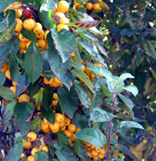
‘Butterball’ is a compact tree ideal
in size for most gardens. The pink-flushed,
white flowers appear in late spring followed
by orange-yellow fruit. With me, birds leave
the fruit until all else has been eaten.
 Malus
‘Golden Hornet’ and M. ‘John
Downie’ are two of the most popular varieties
with bright yellow and orange-red fruit respectively. Malus
‘Golden Hornet’ and M. ‘John
Downie’ are two of the most popular varieties
with bright yellow and orange-red fruit respectively.
For
a large specimen tree I would recommend M. ‘Cowichan’
with red-purple young leaves turning to dark
green. The spring flowers are rose-pink turning
to white. They are followed by large shiny,
purple-red crab apples. Of
the many varieties my favourite (at the moment)
is Malus coronaria. Sometimes called the sweet,
wild crab apple its new foliage is tinged red.
In autumn the leaves turn a deep red-orange.
The pink flowers appear in late spring and are
scented. Large, bitter greenish yellow fruit
last through the winter.
Back to John's index page
|