|
Raise the
Spring Temperature
19 January
2004
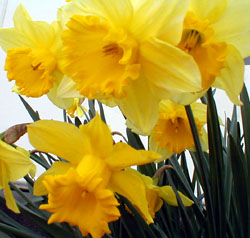 When
I think of spring, yellow comes to mind. Day
old chicks, yellow ribbon, daffodils and masses
of flowering forsythia. Come to think of it,
even the lawn is more yellow than green in spring! When
I think of spring, yellow comes to mind. Day
old chicks, yellow ribbon, daffodils and masses
of flowering forsythia. Come to think of it,
even the lawn is more yellow than green in spring!
It is not that I have anything against the colour
yellow, I even have a yellow tie but I only
wear it once in a while. There is just too much
around and it lasts for too long a period.
There is no need to get rid of any of it, simply
add to the overall canvas with bright red and
rich blue. Both mix particularly well with yellow
as in red and yellow wallflowers and yellow
and blue hyacinths.
 Go
for masses of long stemmed tulips. Deep crimson,
bright read and vibrant scarlet will all give
the daffodils a run for their money. Plant plenty
as some will undoubtedly be cut for decoration.
(
I love it when the blooms turn inside out in
the vase). If tulips are planted at least 8
inches deep they may remain in the soil over
winter making a good show for many years. Go
for masses of long stemmed tulips. Deep crimson,
bright read and vibrant scarlet will all give
the daffodils a run for their money. Plant plenty
as some will undoubtedly be cut for decoration.
(
I love it when the blooms turn inside out in
the vase). If tulips are planted at least 8
inches deep they may remain in the soil over
winter making a good show for many years.
The flowering currant, Ribes sanguineum 'King
Edward VII' produces dark red flowers at the
same time as the forsythia is in bloom and will
tone down the brassy yellow. Don't cut the flower
stems to bring indoors as they smell awful.
If you find you have too much red there is always
the fragrant, yellow flowering Ribes oderatum.
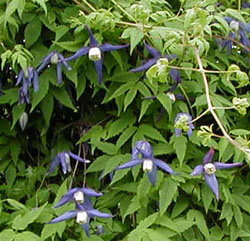 Try this mixed planting for a magnificent spring
show. Plant a Clematis alpina 'Pamela Jackman'
at the base of the forsythia and allow it to
scramble through the branches. The large, rich
blue flowers are a delightful contrast to the
yellow and are followed by silvery, silky seed
heads.
Try this mixed planting for a magnificent spring
show. Plant a Clematis alpina 'Pamela Jackman'
at the base of the forsythia and allow it to
scramble through the branches. The large, rich
blue flowers are a delightful contrast to the
yellow and are followed by silvery, silky seed
heads.
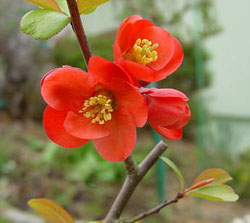
Chaenomeles x superba 'Crimson and Gold' produces
deep crimson flowers with golden anthers from
late winter until late spring. Planted against
a wall it will climb to 5ft high. Fronted with
a line of daffodils, one complements the other.
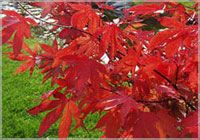 Where
daffodils are massed, introduce a specimen Japanese
acer. Either Acer palmatum 'Atropurpureum' or
Acer Palmatum 'Dissectum Atropurpureum' will
fill the need nicely. Their opening foliage
is deep red-purple making a wonderful backdrop
for the spring yellow. Where
daffodils are massed, introduce a specimen Japanese
acer. Either Acer palmatum 'Atropurpureum' or
Acer Palmatum 'Dissectum Atropurpureum' will
fill the need nicely. Their opening foliage
is deep red-purple making a wonderful backdrop
for the spring yellow.
If you find you have too much red, then be sure
to plant more daffodils!
Back
to John's index page |