|
Summer
Bulbs
The
last of the spring flowering bulbs are still
in bloom but now is the time to plant bulbs
for a colourful summer display.
Gladioli.
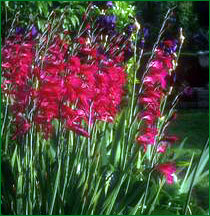 These
are brilliant in the herbaceous border or dotted
through shrubs. The long stems are excellent
for cutting for flower arranging. They are best
planted in groups of 8-10 keeping the corms
about 8 cm (3 inches) apart.Dig a hole 15 cm
(6 inches) deep. Spread a layer of sharp sand
or grit in the base to prevent the corms rotting.
The taller varieties will require staking.It
is better to insert the supports at planting
time or after growth has appeared. Providing
they are not being grown for show, the dead
flowers may be removed as they fade leaving
the remainder to carry on the show. These
are brilliant in the herbaceous border or dotted
through shrubs. The long stems are excellent
for cutting for flower arranging. They are best
planted in groups of 8-10 keeping the corms
about 8 cm (3 inches) apart.Dig a hole 15 cm
(6 inches) deep. Spread a layer of sharp sand
or grit in the base to prevent the corms rotting.
The taller varieties will require staking.It
is better to insert the supports at planting
time or after growth has appeared. Providing
they are not being grown for show, the dead
flowers may be removed as they fade leaving
the remainder to carry on the show.
Dahlias.
 Now
that the risk of serious frost has passed dahlia
tubers may be planted out. Those which have
started to sprout should be planted a little
deeper with the soil covering any growth. Spacing
in the bed will depend on the variety with large
growing decorative and cactus types needing
60-90 cm (24-36 inch) spacing. Make certain
the canes or stakes used for support are not
pushed through the fleshy tubers. Slugs and
snails love the new growths, grazing them to
ground level .Use traps or pellets to keep the
numbers down and remove the bodies. Now
that the risk of serious frost has passed dahlia
tubers may be planted out. Those which have
started to sprout should be planted a little
deeper with the soil covering any growth. Spacing
in the bed will depend on the variety with large
growing decorative and cactus types needing
60-90 cm (24-36 inch) spacing. Make certain
the canes or stakes used for support are not
pushed through the fleshy tubers. Slugs and
snails love the new growths, grazing them to
ground level .Use traps or pellets to keep the
numbers down and remove the bodies.
The range of flower shapes and colours allows
them to be used among shrubs, herbaceous 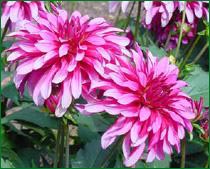 borders
or in the cutting bed for use indoors. Disbudding,
leaving one flower bud per stem, results in
enormous flowers with some of the decorative
varieties growing to dinner plate size. Dahlias
will continue to flower until the first frost
blackens the leaves. They may then be lifted
taking care not to damage the fleshy roots and
dried off for winter storage. borders
or in the cutting bed for use indoors. Disbudding,
leaving one flower bud per stem, results in
enormous flowers with some of the decorative
varieties growing to dinner plate size. Dahlias
will continue to flower until the first frost
blackens the leaves. They may then be lifted
taking care not to damage the fleshy roots and
dried off for winter storage.
Begonias.
Starting the tubers off indoors in trays
of moist peat speeds up the time to flowering.
Set them the right way up with the rounded side
down and the depressed side pointing up. The
shoots are easily broken and need to be 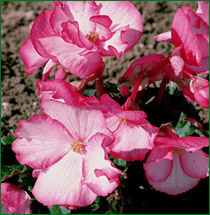 treated
with care. Plant 10 cm (4 inches) deep, 30 cm
(12 in ) apart in groups in the bed. They may
be grown in large containers in a soil based
compost for use on the patio.Shelter from wind
is essential as the stems are brittle. Feed
every week with half strength liquid tomato
fertilizer. Remove diseased leaves before the
botrytis spreads. In autumn lift the plants,
remove the foliage and dry the tubers before
storing them in a frost proof area for the winter. treated
with care. Plant 10 cm (4 inches) deep, 30 cm
(12 in ) apart in groups in the bed. They may
be grown in large containers in a soil based
compost for use on the patio.Shelter from wind
is essential as the stems are brittle. Feed
every week with half strength liquid tomato
fertilizer. Remove diseased leaves before the
botrytis spreads. In autumn lift the plants,
remove the foliage and dry the tubers before
storing them in a frost proof area for the winter.
Back to John's index page
|