| Turning
Roots into Plants
15th
February 2005
There is a simple and very effective
way to increase your stock of some plants by
propagating by root. The best and most scary
examples are those of weeds. Chop up the roots
of dock or bindweed and each piece will re-grow
to become another weed problem. Fortunately
the same principal can be applied to many trees,
shrubs and perennials.
 Propagation
takes place when the plant is dormant. The ideal
period is from late autumn to late winter. It
is practical to dig up herbaceous perennials
such as phlox and acanthus. Wash the soil off
the clump and remove some healthy, young roots
for propagation. At the same time the clump
may be divided and replanted. With large trees
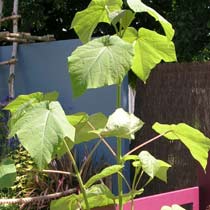
such as Paulownia tomentosa it is best to dig
for the young roots. In the case of the shrub
chaenomeles take portions of young root from
close to the centre of the root ball. Propagation
takes place when the plant is dormant. The ideal
period is from late autumn to late winter. It
is practical to dig up herbaceous perennials
such as phlox and acanthus. Wash the soil off
the clump and remove some healthy, young roots
for propagation. At the same time the clump
may be divided and replanted. With large trees
such as Paulownia tomentosa it is best to dig
for the young roots. In the case of the shrub
chaenomeles take portions of young root from
close to the centre of the root ball.
The ideal diameter of root is
pencil thickness, although thicker can be used.
Thin thread-like roots may also be used but
are positioned differently.
Remove the roots from the parent
plant using a sharp knife to make a clean cut.
Store the roots in a polythene bag until you
are ready to use them and, if the plant has
been dug up, replace it as soon as possible.
Firm it in and water to settle the soil around
the roots.
Remove any thin side roots.
It will be necessary to know which end of the
root is the top and which is the bottom so cut
the top of the root that was closest to the
crown of the plant straight across. The base
of the root cutting is cut at an angle. The
sections of root should be 7.5-10 cm (3-4 inches)
long. Dust the cut ends with Flowers of sulphur
or a fungicidal powder to reduce the risk of
fungal disease.
Insert the cuttings vertically,
5 cm (2 inches) apart in a moist, free draining,
rooting compost with extra coarse grit added.
The top (straight cut end) should be level with
the surface of the compost.
Thin
roots should be cut into 5-7.5 cm (2-3 inch)
lengths and laid horizontally 5 cm (2 inches)
apart on a seed tray of cutting compost. Lightly
cover with the same compost and water the surface.
Keep the cuttings in a cold frame or in a sheltered
position outdoors over the winter months. In
spring the cuttings will have produced more
roots and the advantitious buds will have produced
shoots and leaves. By summer the plants will
be well rooted and may be potted into a compost
with nutrients.
Back to John's index page
|