| TOP
OF THE IVY LEAGUE
1st
June 2009
Ubiquitous it may be but there is always room
for ivy in my garden. The native Irish species
can be a pest travelling far and wide while
behaving like a weed. Its flowers do however
provide late nectar for bees and other insects
and the late winter berries are welcomed by
wildlife.
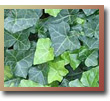 There are other species and varieties that are
better behaved adding evergreen leaf colour
to the winter garden while remaining well within
their allotted space.
There are other species and varieties that are
better behaved adding evergreen leaf colour
to the winter garden while remaining well within
their allotted space.
An obvious use is as screening. Ivies are well
suited to covering unsightly walls and sheds.
The fast growing thin shoots have the ability
to adhere to any surface by aerial roots. Care
should be taken to prevent the stems penetrating
the roof space where they continue to grow making
a mess and dislodging roof tiles.
American gardeners are keen to use ivy as ground
cover under trees. It is tolerant of shade and
dry soil and the glossy evergreen leaves keep
down weeds. When it is clipped over in spring
ivy remains compact with lots of new growths.
The secret of success is to make sure the stems
are not allowed to reach the tree trunk and
start climbing.
Ivy is not fussy regarding soil or position.
It will thrive in any type of soil, dry or wet
and being as tough as old boots may be planted
in exposed, cold sites in full sun or deep shade.
It has a peculiar habit. The mature plant becomes
tree like with thick branches that grow out
from the support and this is why in large, sometimes
old, trees the trunks and branches disappear
under the ivy foliage.
The two main species are the English ivy (Hedera
helix) and Irish ivy (Hedera hibernica). Between
them there are hundreds of varieties many with
beautifully marked foliage. H. helix. ‘Glacier’
only grows to 2 metres in height with small,
grey-green leaves marked with pale grey and
cream.
My favourite species is Hedera helix f. poetarum
sometimes labelled H.h. ‘Poetica Arborea’.
Commonly known as the Poet’s ivy it has
deep, orange-yellow berries. In Italy the foliage
was used to make wreathes for poets.
Reduce
the Watering
It is that time of year; summer, school holidays
and days away. Who knows, perhaps this year
we will have a hot, dry couple of months so
that there is something to complain about.
The trouble is that our plants are not conditioned
for long periods without water. They are so
used to having a constant supply available in
the ground that their roots haven’t had
to go searching for moisture. When we do get
a dry spell they are nowhere near available
water at lower levels.
That is when those Mediterranean plants that
we usually struggle with such as lavender do
best. They love a dry, sun baked soil feeling
pretty miserable most years in our soggy ground.
Mulching, before the soil dries out, will help
prevent evaporation keeping the upper layer
cool and moist. Use bark, gravel, broken slate,
home made compost or farmyard manure.
Store water from down pipes in clean barrels
or water butts in case there is a hose pipe
ban.
Those plants most in need of water will be trees
and shrubs that were recently planted especially
if they were bare root rather than container
grown. Plants in pots dry out quickly. Those
on a soil based compost fare better than those
grown in a soilless compost. If the compost
dries out completely it shrinks away from the
edge of the pot. The only way to re-wet it is
to plunge the whole thing in water until bubbles
stop rising to the surface.
Watering in the evening allows it to penetrate
down into the ground before the sun causes evaporation.
Watering when the sun is shining may cause leaf
scorch and most of it doesn’t reach down
to the root zone.
If you are going on holiday ask a gardener to
look after the plants. He or she will know what
to do.
If we are in for another wet summer then the
good news is that your plants will be happy
and you will have more time to weed!
back
to John's index page
|