| CONTAINERS
FOR SHRUBS
2
April
2008
Where would we be without plant containers.
They are available in a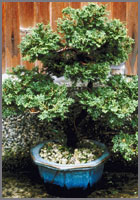 range of materials
and include wood, metal, plastic, earthenware,
ceramic and wire mesh. range of materials
and include wood, metal, plastic, earthenware,
ceramic and wire mesh.
Shapes vary from traditional pot shapes to
wooden barrels and Versailles boxes. There
are square and rectangular ones but a word
of caution, the lovely curved, earthenware
containers with the shoulders are a disaster
for long term plants.
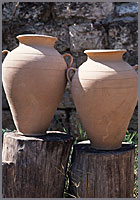 If the “waist” is
wider than the “neck” then when
the plant needs to be re-potted it is impossible
to get the ball of roots out without breaking
the pot. If the “waist” is
wider than the “neck” then when
the plant needs to be re-potted it is impossible
to get the ball of roots out without breaking
the pot.
Metal
containers such as stainless steel, zinc
coated and beaten alloy have become popular
but they can be deadly for plants. In summer
the sun heats the metal scorching the plant
roots while in winter the metal sheet may become
sufficiently cold as to kill young roots.
There must be an adequate drainage outlet
at the base of the pot and 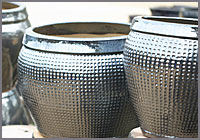 the holes should
be checked on a regular basis to make sure
they are not blocked. Standing the container
on “feet” will
allow water to drain away and prevent wood
lice and ants crawling up through the drainage
holes. If the feet are smeared with Vaseline
it is an effective deterrent for slugs and
snails. the holes should
be checked on a regular basis to make sure
they are not blocked. Standing the container
on “feet” will
allow water to drain away and prevent wood
lice and ants crawling up through the drainage
holes. If the feet are smeared with Vaseline
it is an effective deterrent for slugs and
snails.
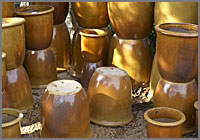 Wherever possible use a soil based compost
for shrubs. It will make watering easier to
control and prevent the compost drying out.
It will have some trace elements and retain
the main nutrients for longer. Although it
is heavier than soilless compost, making moving
the containers more difficuly, its weight will
reduce the risk of the pot blowing over and
breaking. Wherever possible use a soil based compost
for shrubs. It will make watering easier to
control and prevent the compost drying out.
It will have some trace elements and retain
the main nutrients for longer. Although it
is heavier than soilless compost, making moving
the containers more difficuly, its weight will
reduce the risk of the pot blowing over and
breaking.
Cover the drainage holes with either pieces
of broken clay pots or pieces of polystyrene.
These are light and stop the compost blocking
the drainage hole.
Always plant the shrub at the same depth as
previously grown. The surface of the compost
should be at least 5-7 cm below the pot rim.
This will assist with watering and allow for
a top up of fresh compost next year. A decorative
layer of round pebbles, glass beads or gravel
will finish the job.
back
to John's index page |