| BULBS
FOR MEADOWS
7
September 2006
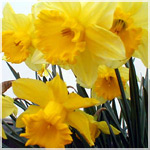 Traditionally
we have naturalized daffodils in lawns where
they often prove to be more trouble than their
display is worth. The foliage is slow to die
down and can’t be cut leaving the grass
long and untidy until late May. When they need
to be divided it is seriously hard work. Traditionally
we have naturalized daffodils in lawns where
they often prove to be more trouble than their
display is worth. The foliage is slow to die
down and can’t be cut leaving the grass
long and untidy until late May. When they need
to be divided it is seriously hard work.
In
meadow areas and wild flower zones there are
no such problems and there is a greater range
of other bulbs that will perform well.
Top
of my list is the tulip. The long stemmed Darwin
types with their late spring flowers held 18-20
inches above ground level. They look superb
in long grass and if the bulbs are planted 8-10
inches deep they won’t need to be lifted
and replanted each year.
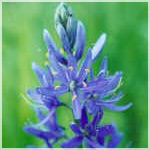 Camassia
bulbs are expensive but, providing the soil
is moist, they will quickly form large clumps.
C. quamash flowers in late spring with 12 inch
long racemes of bright blue flowers. C. leichtlinii
is much taller with racemes of creamy white
flowers in late spring and early summer. Plant
the bulbs 4 inches deep in autumn in fertile,
moist soil and mulch in winter in gardens where
there are late frosts. Camassia
bulbs are expensive but, providing the soil
is moist, they will quickly form large clumps.
C. quamash flowers in late spring with 12 inch
long racemes of bright blue flowers. C. leichtlinii
is much taller with racemes of creamy white
flowers in late spring and early summer. Plant
the bulbs 4 inches deep in autumn in fertile,
moist soil and mulch in winter in gardens where
there are late frosts.
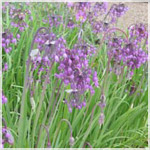 Ornamental
onions such as Allium Cernuum, the nodding onion,
succeed in meadows. It has 8 inch long, strap-like
leaves and 15-24 inch high, pendant umbels of
bell-shaped, deep pink flowers during summer. Ornamental
onions such as Allium Cernuum, the nodding onion,
succeed in meadows. It has 8 inch long, strap-like
leaves and 15-24 inch high, pendant umbels of
bell-shaped, deep pink flowers during summer.
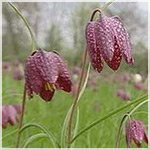 The
Snake’s head fritillary, Fritillaria meleagris
is great for short grass meadows where they
will multiply by seed. There are wonderful drifts
growing wild in and around Oxford. Flowering
in spring, the bell-shaped, pendant flowers
may be purple or pink-purple with purple lines.
Occasionally they may be white. Flowers are
carried on 12 inch stems. The
Snake’s head fritillary, Fritillaria meleagris
is great for short grass meadows where they
will multiply by seed. There are wonderful drifts
growing wild in and around Oxford. Flowering
in spring, the bell-shaped, pendant flowers
may be purple or pink-purple with purple lines.
Occasionally they may be white. Flowers are
carried on 12 inch stems.
Where the soil remains moist during spring and
summer and the position is in full sun it will
be worth growing Galtonia candicans. Its lance-shaped,
grey-green leaves may be as long as 30 inches
with 3-4 ft long, leafless stems carrying racemes
of fragrant, pendant, tubular white flowers
during late summer. The bulbs are quite expensive
but in the right situation will bulk up by offsets
and seed.
back
to John's index page
|