|
The Joy of
An Acid Bed
16 February
2004
If you have limy, alkaline soil you
probably don’t know what you are missing.
There are wonderful plants that insist upon
a soil with a pH well below 7. Below that is
acid while a reading above 7 is lkaline. Most
soils in Northern Ireland are alkaline or neutral
with the peaty areas of Fermanagh and Tyrone
truly acidic.
It is pointless growing acid loving plants on
a limy soil. The foliage will become pale green
or yellow and the plant will be stunted. A 12
inch high raised bed may be formed with timber
or brick sides. Obtain a supply of peaty soil
and add additional peat as the bed is filled.
It is possible to do the same job without the
raised sides. Form a mound
of suitable soil on top of the limy ground.
Plant the deeper rooted plants in the centre
of the mound with shallow rooting material close
to the edge where there is only a thin layer
of suitable soil on top of the
original limy soil.
 Where the soil is wet, construct pipe and stone
drains. Heavy soils can be lightened with the
addition of coarse sand or grit. There are so
many excellent, acid loving plants to choose
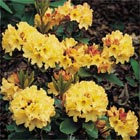
from. With rhododendrons there are shrubs of
tree-like proportions while others have leaves
18
Where the soil is wet, construct pipe and stone
drains. Heavy soils can be lightened with the
addition of coarse sand or grit. There are so
many excellent, acid loving plants to choose
from. With rhododendrons there are shrubs of
tree-like proportions while others have leaves
18
inches long. Some species will only grow 18
inches high making them ideal for the front
of the bed. Evergreen azaleas and those that
are deciduous are now also to be found listed
under rhododendrons.
Evergreen pieris are perfectly hardy but dislike
cold winds and early morning sun when the foliage
is red. They are in a class of their own with
bright red or bronze young leaves in spring
and lily-of-the-valley
-like clusters of creamy-white flowers at the
same time.
 The
calico bush, Kalmia latifolia, produces its
flowers in June. Before they open, the tightly
crimped buds resemble icing sugar sweets. There
are varieties ranging from white to deep pink.
Usually the flower The
calico bush, Kalmia latifolia, produces its
flowers in June. Before they open, the tightly
crimped buds resemble icing sugar sweets. There
are varieties ranging from white to deep pink.
Usually the flower
buds are a deeper colour than the open flower.
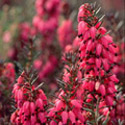
Heathers are a must for the acid garden with
a range of species and varieties to ensure flower
or leaf colour throughout the year. Some such
as Erica carnea can tolerate limy conditions
and may be planted where the imported soil is
shallow.
Gaultheria mucronata used to be called Pernettya
mucronata. It has small, glossy, dark evergreen
leaves. In late autumn the shiny, bead-like
berries are available in colours ranging from
white through pink, red and crimson to purple
depending on variety. It may be used to form
a low-growing, colourful evergreen hedge.
Fill any gaps in the planting design with candalabra
primula. They make a wonderful display in late
spring and early summer with tiered heads of
flower. Primula florindae, the giant cowslip
exudes a wonderful fragrance.
back
to John's index page
|