|
Brighten Up
Your Rockery
20 October
2003
From here on, it’s all downhill or, in
the case of a rockery, uphill and 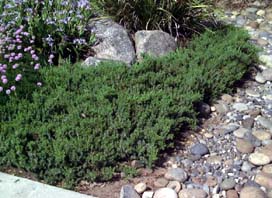 downhill.
Winter is just round the corner and most parts
of the garden are looking a bit jaded. There
is, however, no excuse for the rockery to hibernate.
It retains a big advantage. The rocks have interesting
shapes, colours and texture. It only needs a
few attractive winter plants to make it the
talking point of the garden. downhill.
Winter is just round the corner and most parts
of the garden are looking a bit jaded. There
is, however, no excuse for the rockery to hibernate.
It retains a big advantage. The rocks have interesting
shapes, colours and texture. It only needs a
few attractive winter plants to make it the
talking point of the garden.
A tidy up now will help set it up for the winter.
Remove any straggly plants, debris and autumn
leaves. Cover the soil with grit, 2 inches deep
and dig it in, to improve the drainage, as you
plant. When the work is completed another surface
layer of grit can be added.
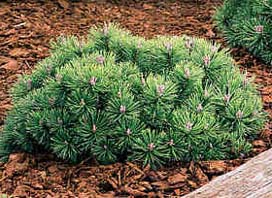 Dwarf
conifers are in keeping in a rock area. The
dwarf Pinus mugo ’Gnom’ will stay
dumpy all of its life looking typically pine
complete with cones. Juniperus conferta and
J.horizontalis will form evergreen mats, steadily
crawling over and taking up the shape of the
rocks. Dwarf
conifers are in keeping in a rock area. The
dwarf Pinus mugo ’Gnom’ will stay
dumpy all of its life looking typically pine
complete with cones. Juniperus conferta and
J.horizontalis will form evergreen mats, steadily
crawling over and taking up the shape of the
rocks.
Gaultheria procumbens only grow 6 inches high
with a spread of 3 ft. It is sometimes called
Wintergreen because its glossy, 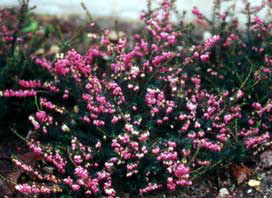 dark
evergreen leaves give off the aroma of wintergreen
when they are crushed. Its white or pale pink,
summer flowers are followed in winter by aromatic,
red fruit which often persist until spring.
Unless you are a dedicated alpine grower you
won’t mind splashes of colour from winter dark
evergreen leaves give off the aroma of wintergreen
when they are crushed. Its white or pale pink,
summer flowers are followed in winter by aromatic,
red fruit which often persist until spring.
Unless you are a dedicated alpine grower you
won’t mind splashes of colour from winter
flowering pansies and polyanthus. Remember to
remove the dead flowers before they set seed
or the plants will stop producing new blooms.
Winter flowering heathers such as Erica carnea
‘December Red’ and E.c. ‘King
George’ will brighten up the dullest day.
Early dwarf bulbs, including crocus, snowdrops,
iris and 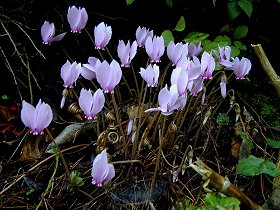 dwarf
narcissus will be in bloom before spring starts.
Being planted in groups in front of rock outcrops
makes them stand out. Hardy cyclamen such as
Cyclamen hederifolium (late autumn) and C.coum
(late dwarf
narcissus will be in bloom before spring starts.
Being planted in groups in front of rock outcrops
makes them stand out. Hardy cyclamen such as
Cyclamen hederifolium (late autumn) and C.coum
(late
winter and early spring) look fragile but are
hardy, tolerating the worst of weather. To complete
the picture a dusting of snow would be nice.
back
to John's index page |