|
Cut
Out The Bad Bits
6 March 2003
There are lots of reasons for pruning. It encourages
growth, helps fruit and flower production and
is used to shape plants. There are times when
it can be described as surgery when the operation
is to prune pieces of the shrub or tree which,
if not removed, will kill or weaken the plant.
 Small stems can be cut with secateurs or a sharp
knife. Thicker branches may need to be removed
with a hand saw or long handled loppers. Whenever
possible make the cut on an angle to allow rain
water to run off rather than sit on the flat
cut and soak into the stem.
Small stems can be cut with secateurs or a sharp
knife. Thicker branches may need to be removed
with a hand saw or long handled loppers. Whenever
possible make the cut on an angle to allow rain
water to run off rather than sit on the flat
cut and soak into the stem.
 Removing diseased branches is essential to prevent
the spread of the fungus spores. Apple
canker is difficult to control and cutting out
the diseased portion or removing the whole branch
is the best
Removing diseased branches is essential to prevent
the spread of the fungus spores. Apple
canker is difficult to control and cutting out
the diseased portion or removing the whole branch
is the best
way of getting on top
of it. Any cuts larger than half inch diameter
should be painted with a proprietary product
or household
paint to seal the wound and exclude spores of
the disease. There is no control for virus disease
and when necessary the infected plant should
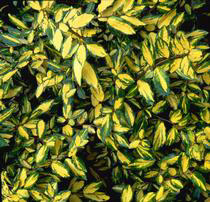
be dug up and burnt. Reversion is a regular
occurrence with some plants such as Eleagnus
pungens ‘Maculata’ (right) and E.p
‘Gold
Edge’. One branch on the variegated shrub
reverts to the plain green leaf of the parent.
If the branch is not removed early when it is
still small it will grow more quickly than the
variegated branches
eventually taking over and smothering the weaker
stems. Remove the whole branch as close to the
main stem as possible.
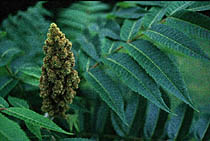 Suckers
coming from below the graft are a nuisance and
can weaken the plant. Rhus typhina, the Stag’s
horn is aggressive and will send up suckers
through hard fill and tarmac. Pull them off
complete with the portion of root they were
attached to or they will resprout. They can Suckers
coming from below the graft are a nuisance and
can weaken the plant. Rhus typhina, the Stag’s
horn is aggressive and will send up suckers
through hard fill and tarmac. Pull them off
complete with the portion of root they were
attached to or they will resprout. They can
be a nuisance in the lawn.
Rose suckers at or from below ground level are
difficult to dig out. Those appearing up the
stem on standard roses need to be pulled off
or cut with a knife close to the main stem.
If not removed they will take over the plant
and eventually kill it. Trees with young branches
often produce narrow angles which, later in
life, can split down the middle
in a storm destroying the tree and anything
below.
Remove the weakest stem or the one least likely
to straighten. Big trees can be trimmed to keep
them within bounds. Paulownia tomentosum, the
foxglove tree, has large 12 inch hairy, mid
green leaves and will grow to 50 ft. If the
young tree is hard pruned to within 12 inches
of the ground in spring it will grow, that summer,
to form upright 8-10 ft high stems with enormous
18 inch leaves.
back
to John's index page
|