Gardening
close to the sea is a marvellous experience
with the advantage of being able to grow a
whole range of plants that would be killed
by frost further inland.
There is also the view but the whole love
affair is tempered by the exposure to salt
laden winds that burn and scorch foliage.
The answer is to plant a perimeter screen
to filter the wind slowing it down and removing
the salt. The secret of success is to choose
plants that will tolerate the conditions without
becoming large enough to block the view.
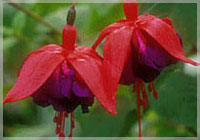 A
quick visit to the coast will show you the
solution. As well as hawthorn, blackthorn
and gorse, hedgerow plants include fuchsia,
rose, hebe and sea buckthorn (Hippophae rhamnoides).
A
quick visit to the coast will show you the
solution. As well as hawthorn, blackthorn
and gorse, hedgerow plants include fuchsia,
rose, hebe and sea buckthorn (Hippophae rhamnoides).
Informal flowering hedges of the large leafed
Escallonia macrantha and Berberis darwinii
do well and shrubs such as hydrangea, genista
and the evergreen Choisia ternata excel.
Quercus ilex is better known as the evergreen
oak and, left to get on with it, will grow
to an enormous tree. When clipped as a hedge
it is impervious to salt laden winds and cold
blasts.Last winter I saw a screen planted
on the coast where it was 20 ft from the high
tide mark.It was 4-5 ft high, clipped and
had managed to produce small acorns.
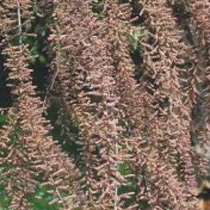 Tamarix
tetrandra looks tender but it is as tough
as an old boot. Its ferny foliage and bright
pink flowers in May make it a choice plant
for the seaside garden.
Tamarix
tetrandra looks tender but it is as tough
as an old boot. Its ferny foliage and bright
pink flowers in May make it a choice plant
for the seaside garden.
The New Zealand flax, phormium tenax, is a
brute of a plant quickly forming an ever increasing
clump of sword-like, upright, 8 ft high, dark
green branches. Where space permits plant
a group of three. Within a couple of years
you will be able to grow less suitable plants
on the land side using them as a windbreak.
Prepare the planting hole well with added
general purpose fertilizer and some well rotted
farmyard manure. Firm the soil around the
roots and if necessary stake the shrubs for
the first year. Water during dry periods and
apply a high potash fertilizer in early autumn
to harden up the young growths ready for the
winter ahead.